Urban Form: Field with Young Trees in the Foreground
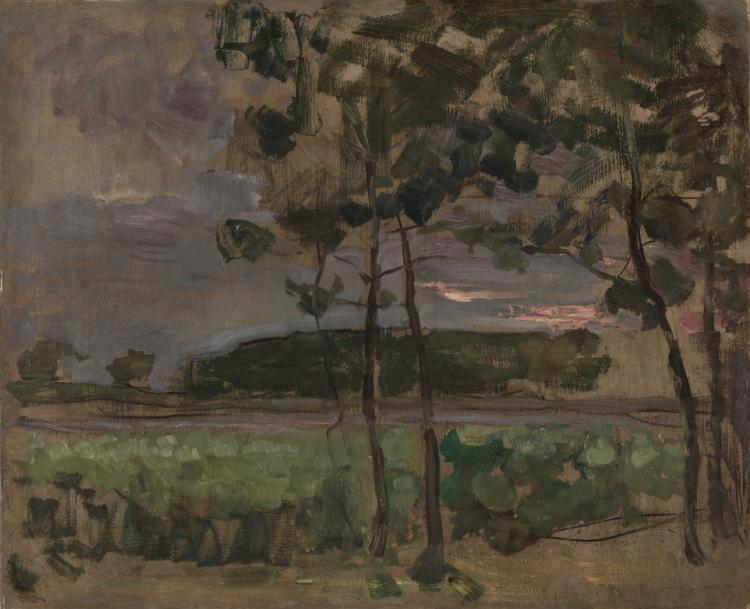
Urban Silhouette Research: Field with Young Trees in the Foreground
I. Preliminary Observations: The Landscape as Structural Proposition
The subject under examination—a field with young trees in the foreground—presents a compositional problem that resonates with the core tensions articulated in the comparative aesthetics of The Temptation of Saint Anthony and the Loquat painting. Where the Western tradition, exemplified by the former, operates through symbolic deformation and the compression of psychic conflict into material form, and the Chinese tradition, exemplified by the latter, privileges intuitive resonance and the unobstructed flow of vital energy through negative space, the field with young trees occupies a liminal territory. It is neither battleground nor mirror. It is, instead, a threshold condition—a site of emergence where form has not yet hardened into monumentality and where the void has not yet been fully domesticated by the brush.
For the purposes of Addison Fashion’s 2026 executive wardrobe, this threshold condition is not merely a pictorial curiosity. It is a strategic template. The young trees—slender, vertical, unadorned—function as primary structural vectors. They do not dominate the field; they articulate it. Their spacing is irregular yet rhythmically coherent, a quality that translates directly into the distribution of visual weight across a tailored silhouette. The field itself, rendered in recessive tones, operates as a chromatic substrate—a neutral ground against which the vertical elements assert their presence without aggression.
II. Formal Deconstruction: Verticality, Interval, and the Slate Register
The young trees are not mature. Their trunks are thin, their canopies sparse, their branching patterns incomplete. This incompleteness is not a deficiency; it is a formal asset. In the context of executive dress, the equivalent is a silhouette that suggests potentiality rather than consolidation—a garment that does not enclose the body in a finished architectural statement but instead frames it as a site of ongoing articulation. The young tree does not command the landscape; it punctuates it. Similarly, the 2026 Addison executive jacket should not overwhelm the wearer with volume or ornamentation. It should provide precise vertical markers—a suppressed shoulder line, a narrow lapel, a straight fall—that allow the body’s own proportions to register as the primary compositional event.
The intervals between the trees are as significant as the trees themselves. In the Western conflict model, intervals are charged with tension—the space between combatants. In the Chinese harmony model, intervals are breathing chambers—the space between breaths. The field with young trees negotiates between these poles. Its intervals are neither agonistic nor serene; they are measured. This measured quality is the essence of the Slate color register. Slate is not black, which absorbs and terminates; it is not gray, which equivocates. Slate is a cool, mineral neutral with sufficient depth to anchor a silhouette and sufficient transparency to allow the wearer’s own presence to emerge. It is the chromatic equivalent of a field that holds without confining.
III. Application to the 2026 Executive Wardrobe: The Minimalist Protocol
The minimalist category, as Addison Fashion defines it for the 2026 cycle, is not an aesthetic of absence. It is an aesthetic of load-bearing reduction. Every element that remains must perform structural work. In the field with young trees, the young trees perform the work of vertical orientation; the field performs the work of horizontal continuity; the light performs the work of differentiation. Translated into a wardrobe system, this yields three imperatives:
First, the vertical line must be continuous but not rigid. The young trees bend slightly; they are not columns. The executive jacket should follow suit—a soft-shouldered construction with a straight but not stiff fall, allowing the wearer’s movement to introduce a controlled irregularity into the silhouette. This is the opposite of the armored power suit. It is a responsive structure.
Second, the chromatic field must be recessive but not inert. Slate, in a matte finish, absorbs light without deadening it. It provides a ground against which skin, hair, and accessory can register as figure. The 2026 executive does not need to announce authority through saturation. Authority is conveyed through the stability of the ground—the confidence of a color that does not compete for attention because it knows it will receive it.
Third, the interval must be treated as a designed element. The space between the jacket’s closure and the trouser’s rise, the space between the cuff and the hand, the space between the collar and the jaw—these are not voids to be filled. They are negative spaces that allow the wearer’s own physicality to become legible. The young trees do not crowd the field; they curate it. The minimalist executive wardrobe must do the same.
IV. Conclusion: The Threshold as Destination
The field with young trees is not a finished landscape. It is a landscape in the process of becoming. This is its relevance to the 2026 executive wardrobe. The era of the consolidated, monumental silhouette—the sartorial equivalent of the mature oak—is passing. What replaces it is not chaos but structured emergence: a silhouette that is precise without being rigid, recessive without being passive, and minimal without being empty. Slate is its color. The young tree is its emblem. The field is its territory.
Addison Fashion NYC does not design for the executive who has arrived. It designs for the executive who is still arriving—and who requires a wardrobe that does not mistake the threshold for the destination.