Urban Form: Fallen Caryatid Carrying Her Stone
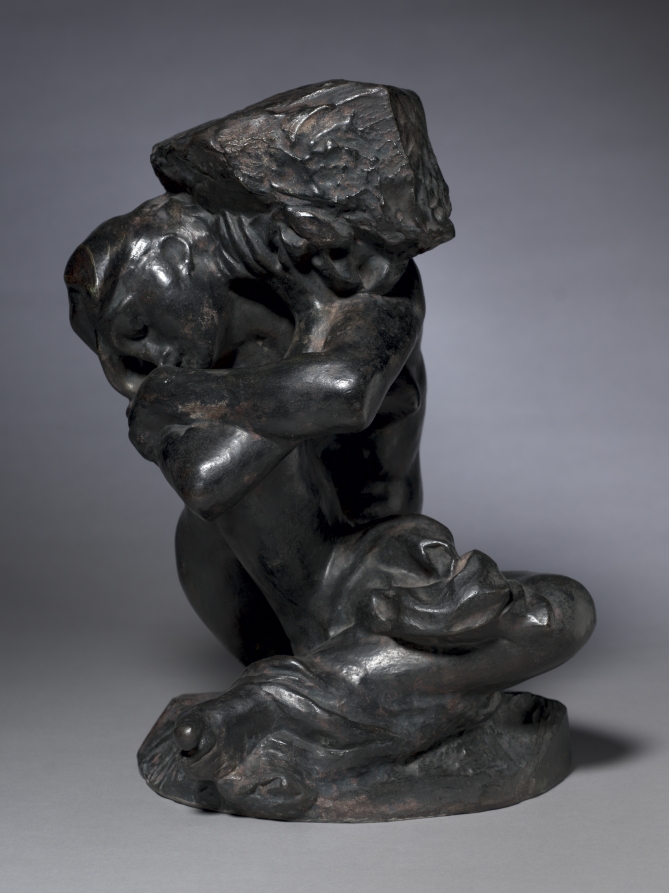
Urban Silhouette Research: Fallen Caryatid Carrying Her Stone — Structural Poetics of the 2026 Executive Form
I. Preliminary Geometry: The Load-Bearing Axis
The Fallen Caryatid is not a figure of collapse. It is a figure of recalibrated load. The sculpture presents a body that has relinquished vertical heroism in favor of a lower, denser center of gravity — the torso pitched forward, the stone retained against the shoulder and hip, the spine describing a shallow arc rather than a plumb line. For Addison Fashion, this is the originating gesture of the 2026 executive silhouette: not the upright column of mid-century authority, but the compressed diagonal — a form that acknowledges weight and metabolizes it into structure.
The geometric integrity here is triadic. First, the base triangle: the contact points of foot, knee, and the resting stone establish a footprint wider than the shoulder line, producing stability without symmetry. Second, the cantilever: the upper body projects forward from the pelvis, creating a moment arm that the garment must resolve. Third, the counterweight: the stone itself, positioned at the rear or flank, functions as a visual anchor that prevents the silhouette from reading as defeat. In tailoring terms, this translates to a jacket whose front panel is cut longer than the back, whose shoulder is dropped and rotated forward, and whose hemline is weighted — not with lead, but with density of cloth.
II. Materiality: Urban Stone and the Textile Corollary
The Caryatid's stone is not polished marble. It is weathered, porous, marked by the city's residue — a surface that records time through accumulation rather than reflection. For Fallen Caryatid, the 2026 executive wardrobe must abandon the high-sheen finish of the previous decade. Onyx as a color directive is not merely black; it is black with a matte, light-absorbing depth, achieved through double-faced wool, brushed cashmere, and bonded cotton with a dry hand. The fabric should feel quarried, not woven — substantial enough to hold a fold without collapsing, yet supple enough to follow the body's diagonal.
Consider the stone's relationship to the figure: it is not carried in the hands, which would imply voluntary burden. It is borne against the body, integrated into the load path. The 2026 silhouette demands the same integration. Garments must not hang from the shoulders as if from a hanger; they must be keyed to the pelvis and the sternum, with internal weighting and strategic seam placement that distributes mass across the torso. A coat, for instance, might feature a concealed inner harness — a grosgrain ribbon anchored at the waist and looping under the arm — so that the fabric moves as a single tectonic plate rather than a series of independent panels.
III. The Fallen Posture as Executive Code
The Fallen Caryatid is often misread as a symbol of exhaustion. In the context of urban professionalism, however, the posture is one of strategic descent. The executive who has lowered her center of gravity is not weaker; she is more difficult to destabilize. The 2026 silhouette therefore rejects the stilted heel and the pinched waist in favor of a low-slung, wide-stance geometry: trousers with a dropped crotch and a tapered ankle, jackets with a hem that falls to the mid-thigh and a shoulder that extends beyond the natural joint. The effect is not slouch, but deliberate mass — a body that occupies space with intention.
This is where the Addison DNA diverges from conventional minimalism. Minimalism often erases the body; the Fallen Caryatid amplifies the body's negotiation with gravity. The garment must show the trace of that negotiation: a diagonal seam across the back, a fold that originates at the hip and resolves at the neck, a collar that stands away from the throat as if braced against wind. These are not decorative gestures. They are structural poetics — the translation of load into line.
IV. The Stone as Accessory and Anchor
In the sculpture, the stone is both burden and companion. It is the only element that remains perfectly still while the body adjusts around it. For Fallen Caryatid, the 2026 executive carries an equivalent: a single, monolithic accessory — a bag, a belt, a clasp — that functions as the visual counterweight to the body's forward lean. This object must be geometric, unadorned, and heavy in the hand. It is not a status symbol; it is a ballast. Onyx leather, brushed silver hardware, a shape that echoes the stone's irregular polygon rather than a perfect rectangle.
The silhouette, then, is not a line but a system of forces. The Fallen Caryatid teaches that elegance under pressure is not about standing taller. It is about redistributing weight until the fall becomes a form of advance. For the 2026 executive, the urban uniform must be built on this principle: low, dense, and impossible to tip.
V. Conclusion: The Caryatid Protocol
Addison Fashion's Fallen Caryatid research concludes that the definitive 2026 silhouette is a minimalist architecture of burden. It rejects the vertical heroism of the past in favor of a diagonal that acknowledges the city's weight — its noise, its velocity, its demand for endurance. The geometry is triadic, the materiality is quarried, and the posture is one of strategic descent. The executive who wears it does not carry her stone. She wears it as structure. And in that wearing, she becomes unshakeable.