Urban Form: Adam and Eve (pair of statuettes)
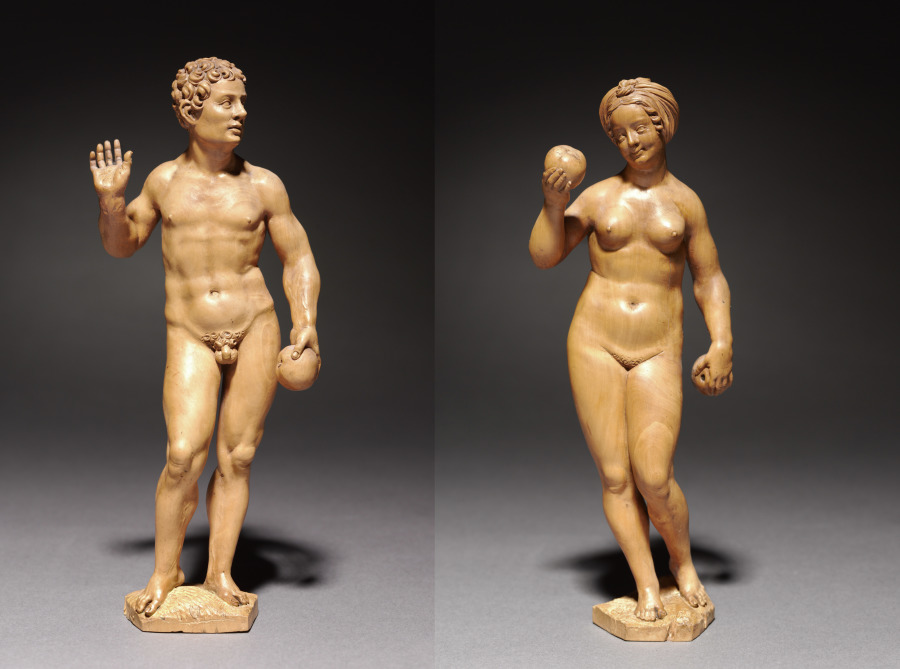
Urban Silhouette Research: Adam and Eve as Structural Archetype
I. Geometric Integrity: The Paired Statuette as Binary Architecture
The Addison Fashion 2026 executive silhouette finds its most rigorous formal precedent in the paired statuette—Adam and Eve—not as narrative subject, but as geometric proposition. The pair operates as a single structural unit: two vertical masses, each approximately equal in height, separated by a negative space that functions as a load-bearing void. This is the essential grammar of the modern urban wardrobe. The executive does not dress as a solitary figure but as one half of a binary system—paired, contrasted, and structurally interdependent.
The statuettes present a closed contour—no extraneous gesture, no rhetorical flourish. The limbs are compressed against the torso; the silhouette is columnar with a slight contrapposto torsion. This torsion is critical. It prevents the form from becoming a mere cylinder. In tailoring terms, this is the difference between a shift and a sheath: the former is inert, the latter is alive with potential energy. The 2026 Addison executive silhouette will adopt this torsional minimalism—a garment that appears static from the front but reveals a subtle spiral when the wearer moves. The geometry is not decorative; it is kinetic architecture.
The pair’s proportional relationship—shoulder width to total height, head size to torso length—establishes a canon. The heads are small, the necks elongated, the shoulders squared but not exaggerated. This is the anti-heroic proportion: authority without bombast. For 2026, Addison will translate this into a high-armhole, narrow-lapel, elongated-torso construction. The executive jacket will sit like a second skeleton—rigid where necessary, fluid where strategic.
II. Structural Poetics: The Void as Garment
The negative space between Adam and Eve is not empty. It is charged. In urban terms, this void is the space of negotiation—the gap between two executives, two ideas, two power centers. Addison’s 2026 silhouette will materialize this void through strategic cutaways: a split-back coat that reveals the spine, a deep V-neckline that exposes the sternum, a side-seam vent that opens with movement. The garment does not cover the body; it frames it. The body becomes the negative space—the essential, irreducible core.
This is a departure from the armored executive of the previous decade. The new silhouette is porous. It breathes. It admits light. The statuettes are solid, but their surfaces are interrupted—by the fold of a knee, the angle of an elbow, the shadow of a ribcage. Addison will replicate this through seam architecture: single-needle stitching that creates micro-relief, topstitched darts that read as structural ribs, raw-edge hems that expose the garment’s internal logic. The poetics are not in the ornament but in the exposed construction.
The pair also introduces asymmetry within symmetry. Adam and Eve are not identical. One is slightly taller, one slightly broader, one turned a few degrees further. This is the urban dialectic: the executive must be both uniform and singular. Addison’s 2026 collection will offer modular tailoring—jackets and trousers that can be interchanged, layered, and re-proportioned. The silhouette is not a fixed shape but a system of relationships.
III. Urban Materiality: From Statuette Surface to City Skin
The statuettes’ material—whether weathered bronze, matte terracotta, or patinated stone—is non-reflective. It absorbs light. It does not compete with the environment; it anchors it. This is the anti-luxury luxury of the 2026 executive. Addison will employ bonded wool crepe, double-faced cashmere, and waxed cotton gabardine—fabrics that are dense, dry, and light-absorptive. The palette is Onyx: not black as absence, but black as presence—the color of basalt, of wet asphalt, of the space between streetlights.
The surface treatment will be matte. No sheen. No gloss. The executive does not glitter; the executive endures. Addison will incorporate micro-textures: slub silk with irregular yarns, paper-touch leather with a dry hand, crushed linen that holds a crease like a memory. These materials record time. They develop a patina. They are not disposable. They are urban artifacts.
The statuettes also suggest weight distribution. They stand firmly. They do not totter. The 2026 Addison silhouette will be grounded—flat-soled boots, wide-legged trousers that break at the instep, long coats that reach mid-calf. The center of gravity is low. The posture is vertical and unapologetic. This is not fashion for the runway; it is fashion for the corridor, the elevator, the boardroom, the street.
IV. Conclusion: The Executive as Paired Statuette
Adam and Eve are not a couple. They are a structural dyad. The 2026 Addison executive will embody this dyad: two halves of a single silhouette, two materials in tension, two voids in dialogue. The geometry is severe. The poetics are silent. The materiality is urban and unyielding. This is not a collection about beauty. It is a collection about integrity—the integrity of the form, the integrity of the wearer, the integrity of the city that contains them both. Addison Fashion does not dress the executive. Addison Fashion builds the executive. Stone by stone. Seam by seam. Void by void.