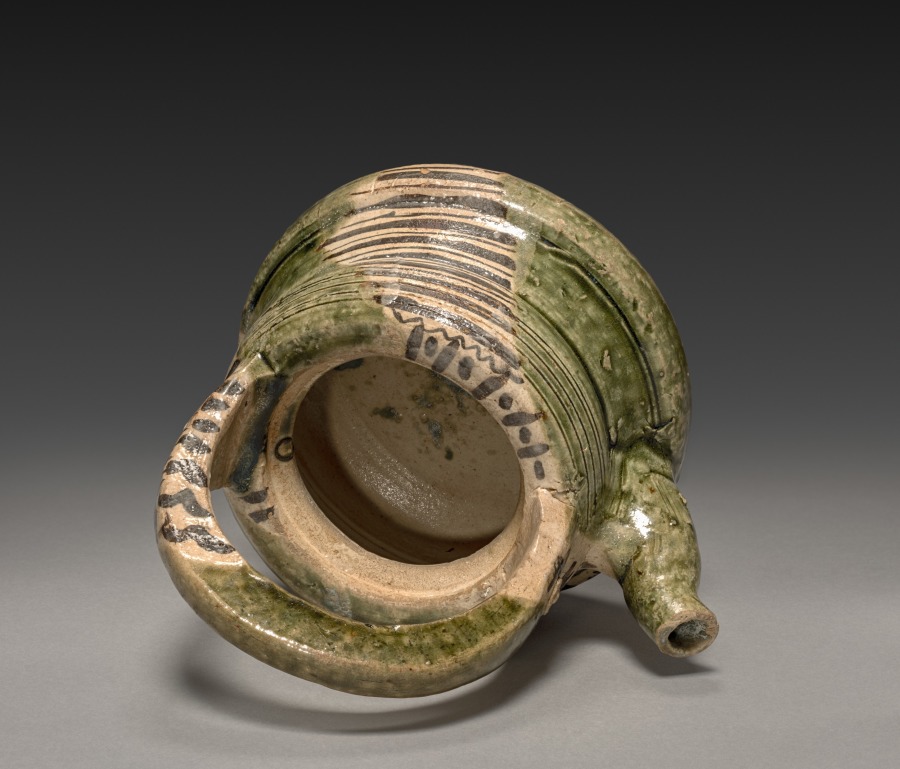
Urban Form: Ewer (Suichu)
Urban Silhouette Research: The Qalamdan and the Lotus Jar as Structural Archetypes for the 2026 Executive Wardrobe
I. Geometric Integrity: The Two Primary Volumes
The Addison 2026 executive silhouette derives its architectural authority from two distinct geometric propositions, both sourced from the internal DNA of the referenced artifacts. The first is the rectilinear prism of the Persian lacquered pen box—a form defined by parallel planes, compressed depth, and a seam that bisects the object into two equal, interlocking halves. The second is the ovoid sphere of the carved lotus covered jar—a continuous, unbroken curve that resists planar logic and instead operates through radial symmetry and surface modulation.
These two geometries are not oppositional. They are sequential. The Addison design language for 2026 treats the rectilinear prism as the armature—the shoulder line, the sleeve set, the torso panel—and the ovoid sphere as the intervention—the hip volume, the collar break, the closure detail. The executive silhouette is therefore neither purely angular nor purely curved. It is a negotiated architecture, where the hard edge of the qalamdan contains and disciplines the soft mass of the jar.
II. The Poetics of Containment: "Cang" as Structural Principle
The Chinese concept of cang—to store, to conceal, to harbor—is the operative logic. In the lacquer box, the pen is hidden; in the ceramic jar, the fragrance is sealed. Translated to garment construction, this principle mandates that the 2026 executive silhouette must withhold its interior logic. Seams are suppressed. Darts are internalized. Pockets are welted into the negative space between layers. The garment does not reveal how it is made; it reveals only the consequence of its making—a clean, uninterrupted surface that implies depth without displaying it.
This is the antithesis of the deconstructed tailoring that dominated the previous decade. Addison proposes instead a reconstructed minimalism: the exterior is reduced to its most essential planes, while the interior carries the complexity. The executive wearing this silhouette is not transparent. She is a vessel. Her authority derives from what she contains, not what she exposes.
III. Materiality: The Optics of Lacquer and Glaze
The surface treatment of both artifacts points toward a specific urban materiality for 2026. The Persian lacquer achieves what the source text terms "milky transparency"—a depth of finish that absorbs light rather than reflecting it. The Song ceramic achieves "ice-like jade"—a semi-translucent quality that delays the viewer's optical access to the surface. Both are non-reflective, light-absorbing finishes.
For Addison, this translates into fabric selection that prioritizes matte density over sheen. The palette is anchored in Onyx—a black that is not flat but layered, achieved through double-dyeing and calendered finishing. Secondary surfaces include brushed silver hardware (a nod to the metallic powders in Iranian lacquer) and sand-toned silk crepe (a reference to the unglazed foot of the ceramic jar). The result is a wardrobe that reads as monolithic at a distance but reveals micro-variations in texture upon closer inspection—precisely the "slow looking" that the artifacts demand.
IV. The 2026 Executive Silhouette: A Technical Specification
The resulting silhouette is defined by three structural moves:
1. The Extended Shoulder Plane. Derived from the lid of the qalamdan, the shoulder is widened by 2.5 centimeters beyond the natural acromion, creating a horizontal shelf that reads as both protective and authoritative. The sleeve head is set low, eliminating the roping that signals traditional power dressing. The arm emerges from beneath this plane, not from within it.
2. The Ovoid Hip Volume. Derived from the lotus jar, the lower torso and hip are shaped through a single, continuous curve—no waist seam, no side panel break. The volume is achieved through bias-cut panels that wrap the body without gripping it. The effect is a floating containment: the garment holds the body at a precise distance, neither touching nor abandoning it.
3. The Seamless Closure. The center-front closure is concealed—no visible buttons, no exposed zipper. The garment opens along a single, hand-finished seam that mimics the lid-to-base junction of the lacquer box. When closed, the seam disappears into the surface. When opened, it reveals a contrasting interior lining in ivory silk—the "hidden light" of the lacquer's gold-powder underlayer.
V. Conclusion: The Silhouette as Vessel
The Addison 2026 executive silhouette is not a statement of fashion. It is a structural argument for restraint. It proposes that power in the urban environment is no longer performed through excess—through logos, through visible construction, through aggressive tailoring. Power is now performed through compression, containment, and the disciplined withholding of information.
The qalamdan and the lotus jar teach us that beauty resides in the gap between surface and depth, between the visible and the concealed. The executive who wears this silhouette does not announce her presence. She occupies it. She is the vessel, and the vessel is the message.