Urban Form: Roundels with Hunters
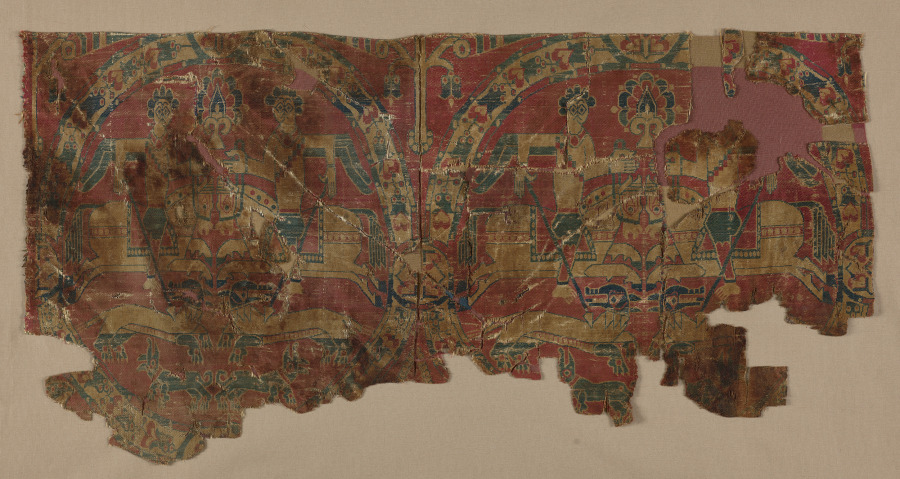
Urban Silhouette Research: Roundels with Hunters — The Aesthetics of Interruption
I. Geometric Integrity: The Roundel as Structural Proposition
The roundel, in its purest geometric articulation, presents a closed system — a circumference without terminus, a continuous curve that resists the linear logic of conventional garment construction. Yet the artwork under examination, Roundels with Hunters, subverts this closure through a deliberate poetics of interruption. The circular motif is not permitted to resolve; it is fractured, overlaid, and ultimately reconstituted through the negative space of the hunter figures. This is not decorative compromise but structural philosophy: the circle as container, the hunt as narrative disruption, the residual void as the true subject.
For the 2026 executive silhouette, this geometric tension translates into a radical proposition. The Addison woman does not wear garments that merely encircle the body — she wears garments that negotiate the boundary between enclosure and exposure. The roundel's circumference becomes the shoulder line: continuous in its architectural sweep, yet interrupted at precise intervals by seam articulations that echo the hunter's stance. The result is a silhouette that reads as both armor and aperture — a closed form that admits light, air, and movement through calculated structural breaches.
II. The Hunter's Stance: Postural Geometry and Executive Presence
The hunter figures within the roundel are not depicted in pursuit but in suspended anticipation — a moment of poised tension that precedes action. This is the essential posture of the Addison executive: not kinetic, but potential. The body is held in a state of readiness that is itself a form of authority. The geometric integrity of the artwork demands that we read these figures not as narrative agents but as structural vectors — their limbs define angles, their torsos establish planes, their relationship to the circular boundary creates a system of internal proportion that governs the entire composition.
Transposed to tailoring, this yields a silhouette characterized by what we term arrested motion. The shoulder is set slightly forward, the waist suppressed but not cinched, the hip line extended through a subtle architectural flare that references the roundel's lower arc. The garment does not follow the body; it frames the body as the roundel frames the hunt — a containing geometry within which the wearer's own physicality becomes the narrative content. The executive presence is thus not asserted through aggressive cut but through the quiet authority of precise proportion.
III. Urban Materiality: Surface as Temporal Record
The artwork's surface — whether ceramic, textile, or pigment — bears the marks of its own making. Cracks, glaze pooling, the slight irregularity of hand-drawn line: these are not flaws but evidence of material intelligence. In the context of urban materiality, this translates to a fabric philosophy that rejects the seamless in favor of the tectonic. The 2026 Addison executive wardrobe employs materials that record their own history: double-faced wool with visible fiber architecture, silk georgette with slub irregularities that catch light unevenly, leather that has been tanned to preserve the grain's natural topography.
The roundel's circular format also demands consideration of edge behavior. A circle has no beginning and no end, yet the artwork's boundary is defined by its own termination — the point at which the composition ceases. In garment terms, this is the hem, the cuff, the collar edge: the places where the silhouette declares its own limits. Addison's approach for 2026 is to treat these edges as rhetorical gestures — raw-cut wool that exposes the weave, bound seams that trace the interior architecture, hems that are weighted to fall with deliberate gravity rather than casual drape.
IV. The Void as Active Principle: Negative Space in Tailoring
Perhaps the most significant lesson from Roundels with Hunters is its deployment of negative space. The areas between the hunter figures, the intervals where the roundel's surface is unmarked — these are not empty but structurally active. They provide the rhythm against which the figures acquire meaning. In the executive silhouette, this principle manifests as the strategic void: the open neckline that frames the clavicle, the sleeve that stands away from the wrist, the jacket that does not close but instead creates a vertical channel of exposed torso between its edges.
This is not exposure for its own sake but compositional necessity. The void allows the garment to breathe, to move, to accommodate the body's own geometry without constraint. It is the difference between clothing as enclosure and clothing as architecture of possibility. The Addison executive does not require her garments to complete her; she requires them to provide the structural armature within which her own presence becomes the defining element.
V. Conclusion: The Roundel as Executive Paradigm
The 2026 Addison silhouette, derived from the geometric and philosophical propositions of Roundels with Hunters, is neither minimalist nor maximalist in conventional terms. It is structural. It operates through the logic of the roundel: a closed system that admits interruption, a continuous form that derives its power from strategic breach. The executive who wears it does not disappear into the garment nor dominate it; she inhabits its geometry as the hunter inhabits the roundel — as the necessary disruption that gives the form its meaning.
This is the urban silhouette for the coming season: not a shape but a spatial proposition, not a style but a structural argument. It is tailored to the body's potential rather than its present, cut to frame the wearer's authority rather than to assert its own. In the roundel's fractured circumference, in the hunter's suspended stance, in the void that activates the whole — here is the grammar of executive presence, rendered in wool and silk and leather, for the woman who understands that true authority is never declared but constructed.