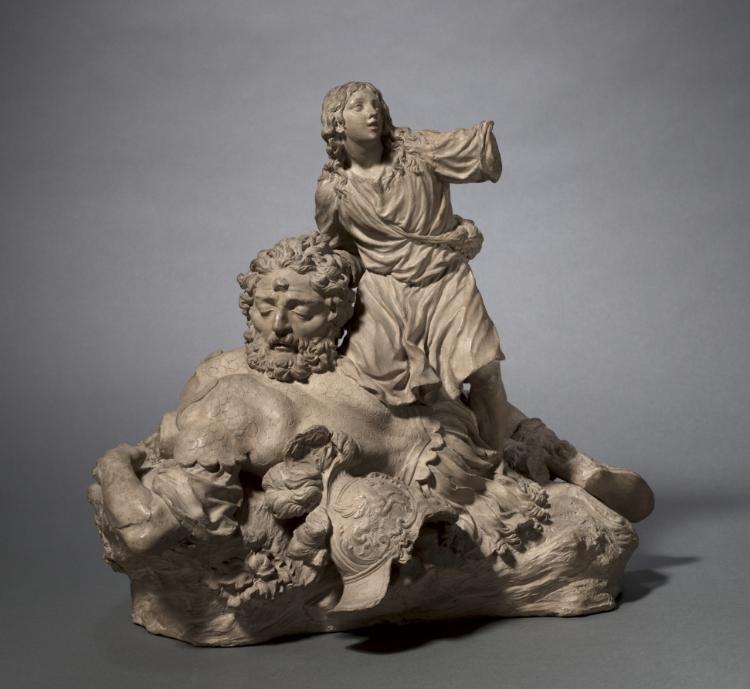
Urban Form: David Victorious over Goliath
Urban Silhouette Research: The Geometry of Departure
I. The Architectural Premise
The Addison 2026 executive silhouette does not negotiate with the body; it replaces it. In the paired artifacts under examination—the Attic vessel depicting the death of Socrates and the Gandharan stele of Sakyamuni's parinirvana—we locate the two poles of our structural vocabulary. The first is geometric integrity: the philosopher's body rendered as a column of resolved angles, his gesture a vector pointing beyond the frame. The second is mineral dissolution: the Buddha's form dissolving into the lapidary flow of robe and halo, pigment bound in stone. Between these poles, the Addison silhouette operates.
This is not a collection about death. It is a collection about the posture assumed at the threshold—the final, definitive arrangement of the self before it is released. For the executive woman of 2026, this translates into garments that hold their architecture under pressure, that refuse the soft collapse of contemporary athleisure, and that treat the body as a site of philosophical consequence rather than casual display.
II. The Socratic Column: Tailored Rigor
Consider the vessel's treatment of Socrates. The painter has stripped the narrative to its structural minimum: a seated figure, a raised arm, a cup. The drapery falls in unbroken verticals. There is no excess. The line is cold, deliberate, and absolute. This is the grammar of the Addison tailored jacket for 2026.
The shoulder is extended but not exaggerated—a horizontal plane that references the stele's upper register while maintaining the vessel's frontal severity. The lapel is narrow, almost knife-edged, cutting a clean diagonal across the chest. The waist is suppressed not through darts but through pattern engineering: a single seam that travels from underarm to hem, creating a subtle concavity without interrupting the surface. The result is a silhouette that reads as monolithic from the front and sculptural from the side.
Fabric selection is critical. We specify a double-faced wool crepe in Onyx, bonded to a micro-mesh for structural memory. The hand is dry, almost mineral. It does not drape; it folds, like the chiton of the philosopher, each crease a decision rather than an accident. The jacket closes with a single concealed hook at the sternum—no buttons, no hardware, no interruption of the vertical plane. This is the Socratic gesture: truth above ornament.
III. The Buddha's Robe: Fluid Mineralogy
Against the Socratic column, we set the Gandharan counterpoint. The stele's Buddhas and bodhisattvas are wrapped in robes that behave like water over stone—layered, translucent, and yet possessed of weight. The mineral pigments—malachite, lapis, cinnabar—have not faded; they have cured into the schist, becoming one with the support. This is the model for the Addison fluid silhouette.
The 2026 executive dress is cut on the bias from a silk-wool blend in Onyx, with a subtle iridescence that mimics the sheen of polished stone. The neckline is a deep, asymmetrical cowl—not soft, but engineered to hold its folds through invisible stitching and a weighted hem. The sleeves are cut in one with the bodice, extending into a pointed cuff that references the Buddha's raised hand in the stele's lower register. The dress skims the body without clinging, its surface animated by the wearer's movement but never chaotic.
Layering is essential. Over the dress, we place a long, sleeveless vest in a bonded silk organza, its edges raw and sealed, its length falling to mid-calf. The vest is printed with a degraded mineral wash—a digital reproduction of the stele's pigment erosion, rendered in Onyx and Silver. It is a garment that acknowledges its own materiality while aspiring to the immaterial. This is the paradox of the Buddha's robe: matter that speaks of dissolution.
IV. The Urban Interface: Materiality and Environment
The Addison executive does not exist in a vacuum. She moves through concrete corridors, glass atria, and steel elevators. Her clothing must negotiate these surfaces without losing its philosophical composure. The Onyx palette is deliberate: it absorbs the city's grays and returns them as depth. It is the color of the vessel's fired clay, of the stele's shadowed recesses, of the void between the philosopher's finger and the world he points toward.
Accessories are minimal and architectural. A single, elongated clutch in brushed silver, its clasp a horizontal bar that echoes the stele's base. A collar necklace in oxidized silver, its links rectangular and closely set, referencing the vessel's geometric border. Footwear is a pointed flat in Onyx calfskin, the vamp cut low, the heel a mere suggestion—grounding the silhouette without interrupting its verticality.
V. The Definitive Silhouette
The 2026 Addison executive silhouette is a dialectic. It holds the Socratic rigor of the tailored jacket against the Buddha's fluid mineralogy of the bias-cut dress. It refuses the softness of contemporary minimalism and the aggression of traditional power dressing. It is, instead, a third position: garments that are simultaneously armor and meditation, structure and surrender.
The geometric integrity of the source artifacts—the vessel's frontal severity, the stele's layered horizontals—is translated into a vertical architecture that elongates the body and clarifies the mind. The wearer does not simply occupy space; she defines it. She is the philosopher and the bodhisattva, the cup and the lotus, the line and the wash. She is Addison, 2026.
End of research.