Urban Form: Architectural Sculpture: Face of Time (Kala-mukha)
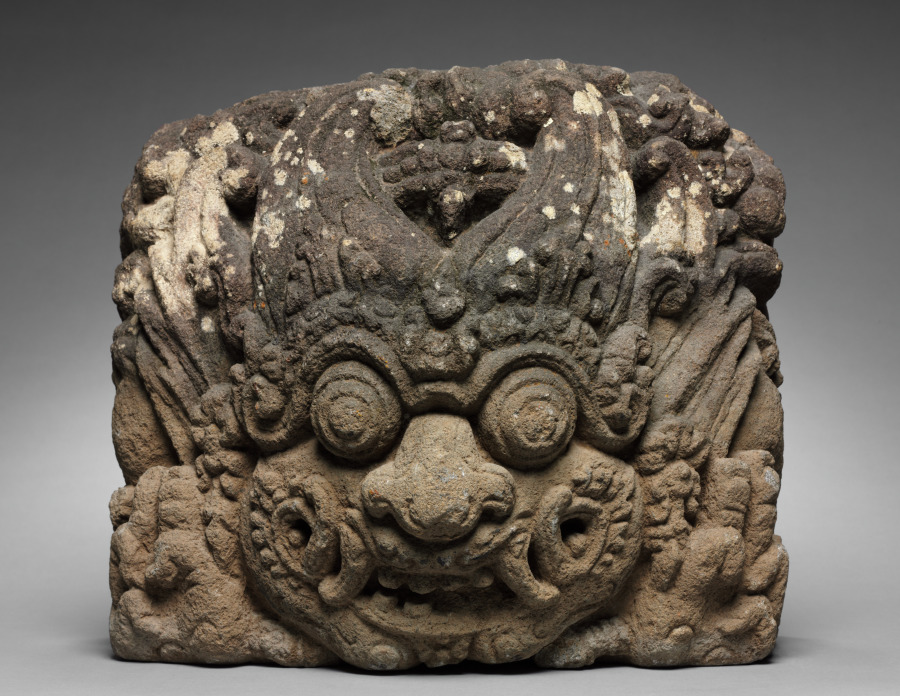
Urban Silhouette Research: Architectural Sculpture — Face of Time (Kala-mukha)
I. The Kala-mukha as Structural Archetype
The Kala-mukha—the devouring face of time carved into the lintels of Java and Khmer temples—operates as a singular architectural proposition: a monstrous visage reduced to pure geometry. Its brow forms a continuous arc. Its jaws articulate a horizontal axis of consumption. Its fangs and tongue create a radial symmetry that is neither decorative nor narrative, but structural. The face does not ornament the temple; it is the temple's threshold logic, the point at which entry becomes transformation.
For Addison Fashion's 2026 executive silhouette, this is the governing principle: the garment as threshold, not surface. The Kala-mukha does not depict time; it enforces it. It is a gate that consumes the profane and emits the sacred. The executive silhouette of 2026 must function identically—a wearable architecture that metabolizes the chaos of the urban day into composed authority.
II. Geometric Integrity: The Radial Jaw and the Linear Spine
The Kala-mukha's geometry resolves into two competing systems. First, the radial jaw: a semicircular mandible that opens downward, its teeth arrayed like the crenellations of a fortress. This is a centrifugal force—energy dispersing outward from a central void. Second, the linear spine: the nose bridge, the brow ridge, the vertical axis of the forehead. This is a centripetal force—energy compressed into a single, unbroken line.
Translated to tailoring, this duality produces the defining tension of the 2026 executive silhouette. The shoulder line is not padded into a sphere but carved into a radial arc—a subtle, outward sweep that suggests the Kala-mukha's jaw without literal quotation. The torso, by contrast, is governed by a linear spine: a single vertical seam, running from the nape to the hem, that acts as the garment's structural nervous system. The result is a silhouette that is simultaneously open and closed—a paradox that mirrors the Kala-mukha's function as both devourer and guardian.
This is not ornament. This is load-bearing aesthetics. The radial shoulder distributes visual weight outward, creating an impression of expansive authority. The linear spine compresses that weight inward, preventing the silhouette from dissolving into theatricality. The executive who wears this garment does not merely occupy space; she organizes it.
III. Urban Materiality: Slate, Onyx, and the Patina of Time
The Kala-mukha is carved from volcanic stone—andesite, basalt, tuff. These are materials that record time not through decay but through patina. The surface darkens. The edges soften. The original chisel marks become a topography of endurance. For Addison Fashion's 2026 collection, this suggests a material palette that rejects the pristine in favor of the proven.
Slate—the color of wet basalt at dawn—anchors the collection. It is neither black nor gray but a chromatic threshold, a hue that absorbs light without surrendering to it. Onyx appears as accent: the deep, vitreous black of polished stone, reserved for the linear spine seam and the inner lining of the radial shoulder. The contrast is not decorative but functional: onyx marks the load-bearing lines, the structural logic made visible.
Fabric selection follows the same principle. The Kala-mukha's surface is not smooth; it is faceted. The 2026 executive silhouette therefore employs double-faced wool with a dry, matte hand—a textile that catches light like unpolished stone. Where fluidity is required—the drape of a back panel, the fall of a wide-leg trouser—the fabric is a high-twist crepe that moves with the body's architecture rather than against it. No shine. No sheen. Only the patina of use, the evidence of a garment that has been worn into authority.
IV. The Devouring Threshold: Silhouette as Ritual Space
The Kala-mukha is placed above the temple door. To pass beneath it is to be consumed and reborn. The 2026 executive silhouette must perform the same ritual function. The urban day is a sequence of thresholds—the elevator, the boardroom, the car, the dinner. Each requires a different self. The garment must mediate these transitions without requiring a change of clothes.
This is achieved through modular architecture. The radial shoulder is a separate structural element—a cape-like overlay that can be removed or reversed. The linear spine is a continuous seam that runs through both the overlay and the base garment, ensuring that the silhouette remains coherent even when its components are separated. The result is a garment that is one thing and many things—a Kala-mukha that devours the day's fragmentation and emits a single, composed presence.
The geometric integrity of the Kala-mukha is not its symmetry. It is its capacity for contradiction: the radial and the linear, the open and the closed, the monstrous and the sacred. The 2026 executive silhouette inherits this capacity. It is not a shape. It is a system—a wearable architecture that metabolizes time, space, and social pressure into the cold, composed face of authority.
V. Conclusion: The Face of Time Worn Forward
The Kala-mukha stares backward into myth. Addison Fashion's 2026 silhouette stares forward into the urban unknown. But the structural logic is identical: the face is a gate, the gate is a garment, the garment is a decision. To wear it is to accept that time devours all things—and to choose, nevertheless, to stand at the threshold, composed, radial, linear, and unbroken.
This is not fashion as self-expression. This is fashion as architectural sculpture—the face of time, worn forward, into the city.