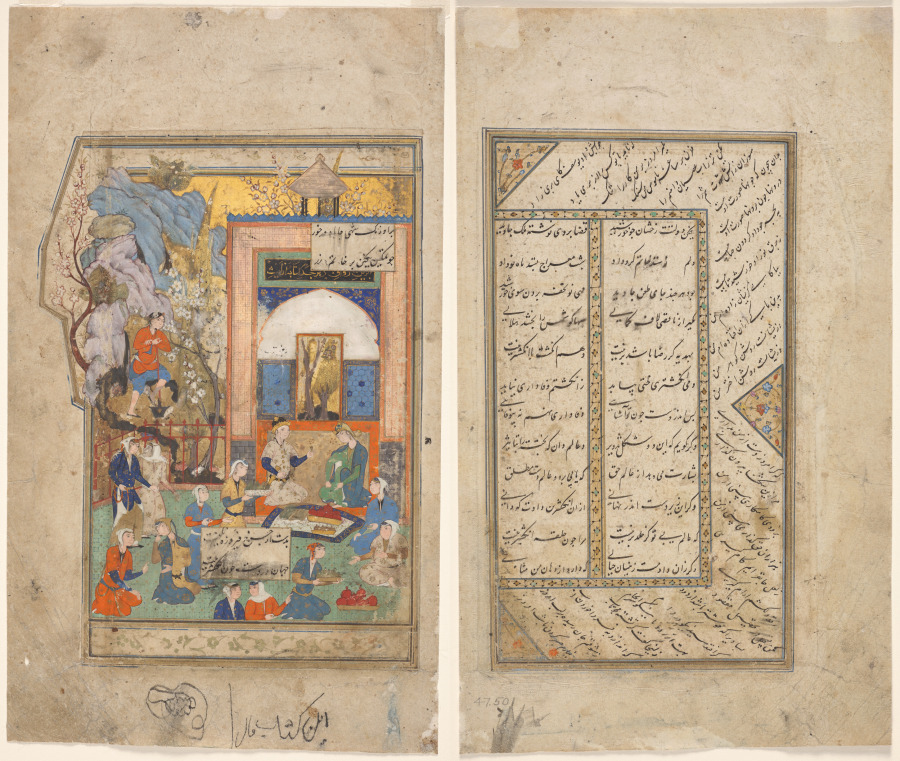
Urban Form: Yusuf and Zulaykha (recto); Text Page, Persian Verses (verso)
The Architecture of Absence: Yusuf and Zulaykha as a Template for the 2026 Executive Silhouette
The recto of this Persian manuscript leaf presents a problem of extraordinary density. Yusuf and Zulaykha occupy a garden of interlocking planes—architectural, botanical, and human—rendered in pigments that have settled into a palette of mineral restraint. The verso, a text page of Persian verses, operates in an entirely different register: the calligraphic line as the sole structural agent, the page as a field of controlled negative space. Together, they constitute a dialectic that Addison Fashion must interrogate if the 2026 executive silhouette is to achieve anything beyond the merely competent.
The Recto as Structural Proposition
The composition of the recto is governed by a rigorous geometry of containment. The garden wall, the architectural framing, the disposition of figures within a shallow pictorial depth—all operate as a system of nested rectangles. The eye is led not through perspectival recession but across a surface of calculated interruptions. This is not the Western window into illusionistic space; it is a planar architecture of adjacency.
For the 2026 executive silhouette, this translates into a garment whose structural integrity derives from the relationship between discrete planes rather than from the continuous modulation of a single form. The shoulder, the lapel, the waist seam—each must function as an independent architectural event, yet cohere within a total system. The Addison tailleur for the coming season will abandon the seamless dart in favor of the articulated panel: a construction in which the front of the jacket is conceived as a series of overlapping planes, each with its own grain direction and weight. The result is a silhouette that reads as monolithic from a distance but reveals its complexity only upon close inspection—a garment that rewards the informed gaze.
The Verso and the Poetics of the Void
The text page is the more radical document. Here, the calligrapher has deployed the nasta'liq script as a rhythmic armature across the page, but the decisive aesthetic act is the disposition of empty space. The margins are not residual; they are constitutive. The text block floats within a field of ivory paper, its edges irregular, its density variable. This is the "计白当黑" principle—counting the white as black—transposed to the page.
Addison's minimalist proposition for 2026 must absorb this lesson. The executive wardrobe has for too long treated fabric as mere covering, as though the body were a problem to be solved rather than a volume to be framed. The new approach treats the garment as a text page: the fabric is the ink, the body is the paper, and the silhouette is the calligraphic gesture that mediates between them. A single-breasted coat in double-faced cashmere, closed with a single concealed hook, the lapel line extending from shoulder to hem without interruption—this is the nasta'liq of tailoring. The void between the coat and the body is not empty; it is the space of intention.
Materiality and the Urban Condition
The internal DNA of this artwork—the "优昙钵华" plaque and the Han dynasty bronze mirror—insists on the dialogue between materials. Wood and ink, bronze and patina. The plaque achieves its power through subtraction; the mirror through accumulation. The 2026 Addison silhouette must operate at this same intersection.
Consider the urban executive in motion: the commute from penthouse to boardroom, the transition from daylight to artificial light, the constant negotiation between interior climate and exterior atmosphere. The garment must perform as both plaque and mirror—reducing the body to its essential geometry while simultaneously reflecting the city's shifting conditions. A wool-silk blend in Onyx, woven with a subtle metallic thread that catches light only at specific angles, achieves this duality. The fabric is matte in the office, faintly luminous on the street. It is a material that withholds its full character until the wearer moves through different environments.
The 2026 Silhouette: A Provisional Specification
The definitive Addison silhouette for 2026 will be characterized by three structural imperatives. First, the shoulder must be architectural but not aggressive—a soft construction that extends the line of the clavicle without padding, achieving presence through proportion rather than force. Second, the waist must be defined by a seam rather than a belt, a horizontal interruption that echoes the garden wall of the recto. Third, the hem must be asymmetric, falling longer at the back than the front, a gesture that references the calligraphic sweep of the verso while serving the practical demands of movement.
The color palette will be restricted to Onyx, Slate, and Ivory, with Silver as the sole accent. No prints. No embellishment. The only ornamentation permitted is the quality of the cloth itself and the precision of the cut. This is not minimalism as deprivation; it is minimalism as concentration. The executive who wears this garment does not need to announce her authority. The silhouette does it for her, in the silent language of architectural form.
The manuscript leaf, with its recto of painted figures and its verso of written verse, teaches us that the most powerful statements are those that hold two contradictory principles in suspension. The 2026 Addison silhouette must be both full and empty, both structured and fluid, both present and absent. It must be, in short, a garment that functions as the bronze mirror functions: a surface that reflects the world while revealing the self.