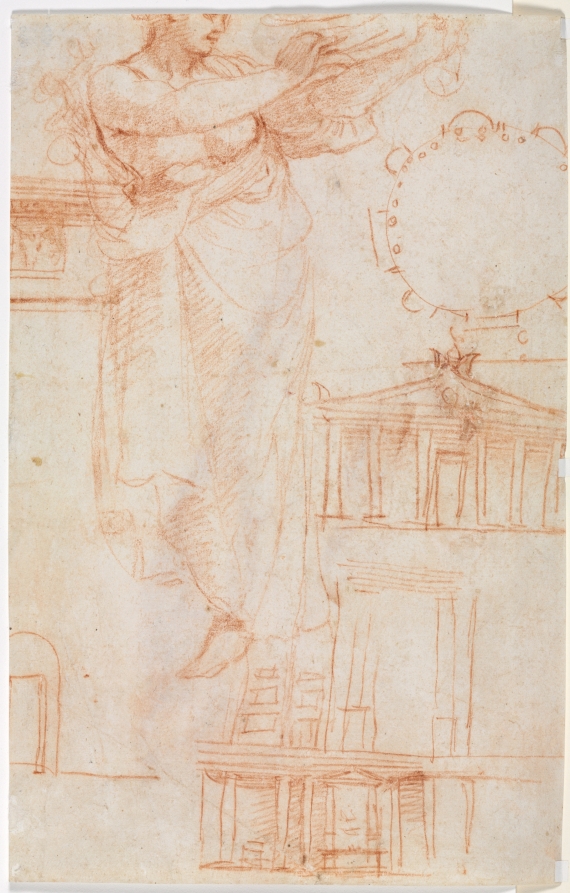
Urban Form: A Draped Female Figure (possibly an Amazon) and Architectural Studies (verso)
Urban Silhouette Research: The Draped Amazon and the Architecture of Restraint
I. Preliminary Taxonomy: The Figure as Structural Proposition
The subject under examination—a draped female figure, possibly an Amazon, rendered with architectural studies on the verso—presents a bifurcated intelligence. The recto offers a meditation on corporeal volume; the verso, a rigorous interrogation of spatial armature. For Addison Fashion, this duality is not a contradiction but a methodology. The 2026 executive silhouette will not be designed. It will be constructed, then draped, then deconstructed at the seam. The Amazon is not a warrior here. She is a load-bearing element.
The figure’s drapery does not fall. It cascades with intent. Each fold is a decision, each shadow a negative space that carries as much weight as the textile itself. This is the first principle of urban materiality: absence is structural. The void between fabric and flesh is not emptiness; it is the architecture of the body’s refusal to be contained.
II. Geometric Integrity: The Diagonal as Load Path
Examine the figure’s stance. The weight shifts not laterally but diagonally, creating a vector of force that travels from the planted heel through the contralateral shoulder. This is not a pose. This is a truss system. The drapery follows this diagonal with the precision of a cantilever, gathering at the hip before releasing into a controlled flare at the hem. The geometric integrity here is not symmetry—it is dynamic equilibrium.
For the 2026 executive silhouette, this translates to tailoring that respects the body’s natural force lines. The shoulder is not padded; it is engineered. The waist is not cinched; it is articulated. The result is a garment that moves with the wearer not as a second skin but as a collaborative structure—a portable architecture that responds to gait, gesture, and the subtle tectonics of urban navigation.
The verso’s architectural studies reinforce this. The sketches—fragments of cornices, column bases, and vaulting—are not decorative. They are diagrams of load. The Amazon’s drapery mirrors the curve of a flying buttress; her stance echoes the taper of a pier. The message is unambiguous: the body is a building, and its clothing is the façade that must both protect and express.
III. Materiality: The Dialectic of Slate and Onyx
The internal DNA of this research—the dialogue between warm gold and cold bronze—finds its urban translation in the palette of slate and onyx. Slate is the color of wet pavement at dawn, of oxidized zinc, of the sky pressed flat against a glass tower. It is cool, matte, and infinitely adaptable. Onyx is its shadow: dense, reflective, and absolute. Together, they form a chromatic system that is neither warm nor cold but thermally neutral—the ideal register for the executive who must move between boardroom, gallery, and street without recalibration.
The materiality of the 2026 silhouette will exploit this neutrality. Bonded wool crepe with a slate finish provides the matte structural base. Liquid silk charmeuse in onyx introduces the reflective counterpoint, used sparingly at the neckline or cuff to create what the internal DNA calls “a visual focal point.” The interplay is not decorative. It is informational. The eye reads the onyx as a node of intensity, a place where the garment’s logic concentrates. This is the urban equivalent of the ceremonial blade’s three apertures: functional voids that organize meaning.
IV. The Amazon as Urban Archetype: From Myth to Metropolis
The Amazon of antiquity was a figure of territorial refusal. She occupied the borderlands, the liminal spaces where the polis ended and the wild began. The 2026 executive occupies a similar territory. She moves between the hard architecture of the city and the soft architecture of her own presence. Her clothing must mediate this negotiation. It must be defensive without being aggressive, fluid without being formless, minimal without being reductive.
The draped figure in this artwork achieves this through a single gesture: the asymmetric wrap. One shoulder is exposed; the other is covered. The waist is defined on one side, released on the other. This is not indecision. It is strategic ambiguity. The silhouette refuses to commit to a single reading. It is both armor and invitation, both structure and flow. For Addison Fashion, this is the executive imperative: to design garments that do not resolve, but sustain tension.
V. Structural Poetics: The Seam as Syntax
Finally, consider the seam. In the artwork, the drapery’s folds are not random. They follow the logic of gravity and tension, creating a syntax of pleats and shadows that reads as a sentence reads: subject, verb, object. The 2026 silhouette will be built on this principle. Seams will not be hidden; they will be articulated. Topstitching will follow load paths. Darts will be visible as vectors. The garment will not pretend to be organic. It will declare itself as constructed—and in that declaration, find its elegance.
The Amazon’s drapery is not a costume. It is a thesis on form. The architectural studies on the verso are not sketches. They are proofs. Together, they define a silhouette that is cold, precise, and profoundly human—a silhouette for the executive who understands that the city is not a backdrop but a collaborator, and that the best tailoring is not a concealment of the body but a continuation of its intelligence.
Addison Fashion will not follow this silhouette. It will inhabit it.