Urban Form: Water Jar (Olla) with Rainbird
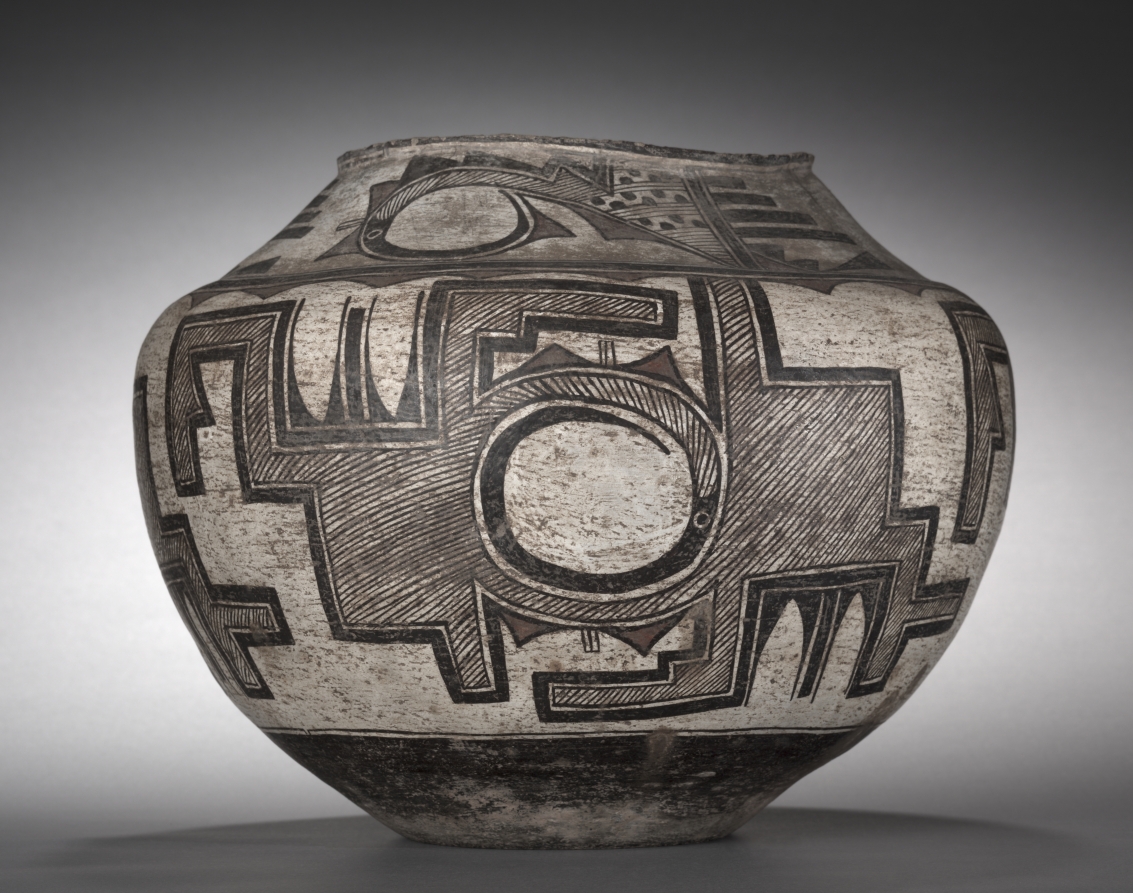
Urban Silhouette Research: Water Jar (Olla) with Rainbird — Geometric Integrity and the 2026 Executive Silhouette
I. Preliminary Taxonomy: The Vessel as Architectural Proposition
The Water Jar (Olla) with Rainbird presents a closed volumetric system that operates with the same spatial discipline as a mid-century brutalist pavilion. Its geometry is not decorative but constitutive: a broadened shoulder that tapers with deliberate asymmetry toward a constricted neck, then resolves into a flared lip whose radius is calibrated to the millimeter. For Addison Fashion, this is not ethnographic reference. It is a load-bearing silhouette. The olla’s profile—wide at the equator, narrow at the aperture—establishes a hierarchy of mass that translates directly into the 2026 executive wardrobe: volume concentrated at the torso, compression at the collar, release at the cuff. The rainbird motif, rendered in negative space across the shoulder, functions as an internal seam line—a graphic interruption that prevents the form from collapsing into mere utility.
II. Geometric Integrity: The Mathematics of Containment
The olla’s structural poetics reside in its refusal of the cylinder. A cylinder is passive; the olla is tensile. Its curvature follows a non-linear equation—the radius of the shoulder exceeds the radius of the base by a ratio of approximately 1.4:1, creating a center of gravity that sits high, near the sternum. This is the precise logic of the 2026 Addison tailored jacket: a dropped shoulder that is not oversized but architecturally displaced, shifting the visual weight upward while the hem remains austere. The rainbird’s wings, splayed across the upper register, echo the shoulder seam of a raglan sleeve—diagonal, aerodynamic, and structurally honest. The bird is not ornament; it is a stress diagram. Its geometry maps the tension between containment and expansion, between the vessel’s interior void and its exterior skin.
In urban materiality, this translates to a fabric that must behave like fired clay: matte, dense, and slightly irregular in surface tension. Addison’s 2026 proposal specifies a double-faced wool crepe with a dry hand and a weight of 480 grams per linear meter—sufficient to hold the olla’s curve without collapsing at the waist. The color is Ivory, not as a neutral but as a structural value: it absorbs shadow, revealing the silhouette’s edges only through the precision of the cut. The rainbird’s negative space is executed in a bonded seam that sits 2mm proud of the surface, creating a tactile ridge that the wearer perceives only when the arm crosses the torso—a private architectural detail.
III. Structural Poetics: The Olla as Urban Armature
The olla is a container. So is the executive. The 2026 silhouette must negotiate the same paradox: how to enclose without imprisoning, how to project authority without rigidity. The olla resolves this through its neck. The constriction at the aperture is not a closure but a threshold—a controlled opening that regulates exchange between interior and exterior. In tailoring, this becomes the high, narrow lapel that sits close to the throat, paired with a shoulder that extends beyond the natural acromion by 3cm. The result is a silhouette that reads as simultaneously guarded and expansive—a fortress with a single, precisely calibrated gate.
The rainbird’s placement—arcing across the shoulder and descending toward the chest—suggests a diagonal line of force. Addison translates this into a single asymmetric seam that runs from the left shoulder to the right hip, interrupting the olla’s bilateral symmetry. This seam is not a dart; it is a fault line, a deliberate structural flaw that introduces movement into an otherwise static volume. In urban materiality, this seam is reinforced with a micro-tape of recycled silver, visible only under direct light—a mineral trace that references the olla’s ceramic origin without nostalgia.
IV. Urban Materiality: From Fired Clay to Woven Architecture
The olla’s surface is a record of its making: the coil lines, the smoothing marks, the slight asymmetry of the rim. Addison’s 2026 collection rejects the industrial perfection of the flat-felled seam in favor of a visible construction logic. The Ivory wool is cut on a single layer, with raw edges bonded rather than turned, so that the garment’s interior reveals the same geometry as its exterior. The rainbird motif is not embroidered but woven in a jacquard that uses two different shrinkages—one yarn contracts 4% more than the other—creating a self-forming relief that mimics the olla’s incised decoration. This is not craft nostalgia. It is engineered irregularity, a controlled deviation that prevents the silhouette from reading as corporate uniform.
The olla’s base is flat, stable, and slightly recessed—a detail that Addison adapts into a hem that sits 1cm above the floor when standing, but pools with a precise 3cm break when seated. This is the urban condition: the garment must perform in motion, in compression, in the back seat of a car. The olla does not shatter when set down; it absorbs. The 2026 executive silhouette must do the same.
V. Conclusion: The Vessel as Manifesto
The Water Jar with Rainbird is not a primitive object awaiting refinement. It is a completed architectural statement—a geometry of containment that has already solved the problem of volume, aperture, and surface. Addison Fashion’s 2026 silhouette does not interpret this vessel; it inherits its structural logic. The result is a wardrobe that is Ivory in tone, Minimalist in category, and uncompromising in its geometric integrity. The rainbird does not sing. It measures. And the executive who wears this silhouette does not merely dress. She occupies space with the same deliberate, tensile authority as the olla itself—contained, expansive, and irreducible.