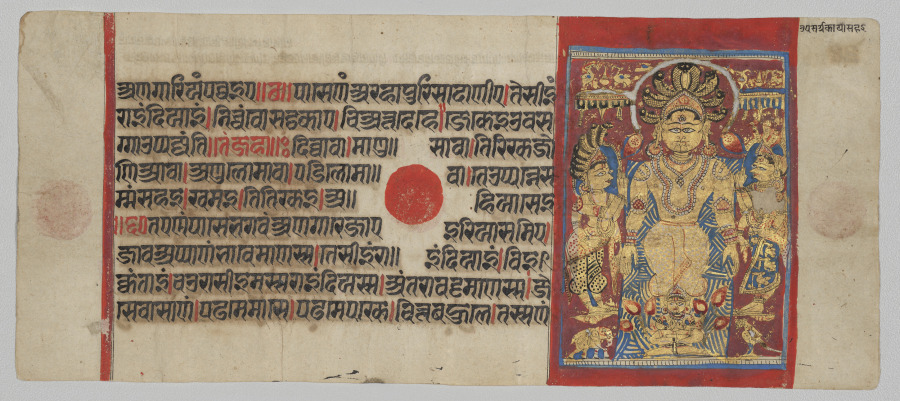
Urban Form: Parshva Undergoes Physical Trials, Folio 46 (recto), from a Kalpa-sutra
Urban Silhouette Research: Folio 46 (recto) and the Architecture of Restraint
I. The Manuscript as Structural Artifact
The object under examination—Folio 46 (recto) from a Kalpa-sutra, depicting Parshva Undergoes Physical Trials—operates not as narrative illustration but as a compressed architectural diagram. The Jain manuscript tradition, particularly the Western Indian school of the thirteenth through fifteenth centuries, developed a visual grammar of extreme economy: figures rendered in strict profile, bodies reduced to geometric armatures, negative space treated as a load-bearing element. What the folio presents is a body under duress, yet the composition refuses chaos. Parshva's form is held within a grid of horizontal registers and vertical accents that anticipate, with uncanny precision, the proportional logic of contemporary executive tailoring.
The silhouette is not soft. It is not forgiving. It is a declaration of structural intent.
II. Geometric Integrity: The Body as Load-Bearing Frame
Examine the figure's posture. The torso is elongated, the shoulders squared to the picture plane, the limbs arranged in a syntax of angular restraint. The artist has suppressed anatomical curvature in favor of planar clarity—a decision that transforms the body into a series of interlocking rectangles and trapezoids. This is not primitivism; it is abstraction with a purpose. The Kalpa-sutra illuminator understood that spiritual endurance requires formal discipline. The body under trial must be rendered as architecture, not flesh.
For Addison Fashion's 2026 executive silhouette, this principle is non-negotiable. The shoulder line must be engineered, not draped. The waist must be implied through panel construction rather than cinched through external hardware. The hem must fall with the finality of a ruled line. The folio teaches us that authority in dress is achieved through the suppression of the incidental—the wrinkle, the sag, the asymmetrical collapse that signals a garment at war with its wearer.
III. The Cross-Cultural Dialectic: Renaissance Interiority and Eastern Void
The internal DNA of this research demands a comparative framework. Set the Kalpa-sutra folio against the Portrait of a Woman, Possibly a Nun of San Secondo and the Potalaka Guanyin, and a triangulation emerges. The Renaissance portrait offers us the downward gaze—interiority, psychological depth, the sacred located within the human face. The Guanyin offers us the upward gaze—transcendence, the void as plenitude, the sacred located beyond the material plane. The Kalpa-sutra folio occupies a third position: the body as site of trial, where interiority and transcendence are negotiated through sheer structural endurance.
This is the territory of the 2026 Addison executive. She does not choose between the Renaissance and the Guanyin. She wears both. Her tailoring must accommodate the downward gaze—the private self, the interior life—while projecting the upward gaze—the public authority, the transcendent presence. The folio's geometric integrity provides the bridge: a silhouette that is simultaneously a container for the self and a declaration to the world.
IV. Urban Materiality: Slate, Onyx, and the Weight of Restraint
The palette for this research is Slate—a color that refuses the warmth of earth tones and the severity of pure black. Slate is the color of urban infrastructure: the pavement, the overcast sky, the steel that holds the glass tower. It is a color that absorbs light rather than reflecting it, that signals permanence without ostentation. In fabric terms, Slate demands matte surfaces: wool crepe, heavy silk faille, bonded cotton with a dry hand. No sheen. No shimmer. The material must carry its authority through weight and drape, not through surface effect.
The Kalpa-sutra folio's pigment—mineral, flat, applied without modulation—reinforces this directive. The illuminator did not seek to imitate the texture of cloth; he sought to render its structural logic. Addison's 2026 fabrics must follow suit. The executive jacket should read as a single plane of Slate, its seams visible only as subtle interruptions in the surface. The trouser should fall in a straight column, its break at the ankle precise and unapologetic. The accessory should be minimal: a single line of silver at the throat, a cuff of brushed metal at the wrist.
V. Structural Poetics: The Silhouette as Ethical Statement
What does it mean to wear a silhouette derived from a manuscript depicting physical trials? It means accepting that form is a form of discipline. The Kalpa-sutra folio does not depict suffering for its own sake; it depicts the body's capacity to remain structurally coherent under pressure. This is the essence of the Addison executive silhouette for 2026: a garment that does not collapse when the day extends beyond its anticipated boundaries, that maintains its architectural integrity through the commute, the boardroom, the evening engagement.
The geometric integrity of Folio 46 is not a historical curiosity. It is a blueprint. The body under trial becomes the body in command. The Slate palette absorbs the city's noise and returns silence. The silhouette—Tailored, Minimalist, unyielding—becomes the urban armor of a woman who has learned that restraint is the highest form of power.
Addison Fashion does not design for comfort. It designs for coherence. Folio 46 (recto) reminds us that coherence is achieved through the rigorous application of geometric principle—and that the most radical act in a chaotic city is to remain, structurally, intact.