Urban Form: Landscape at Loosduinen
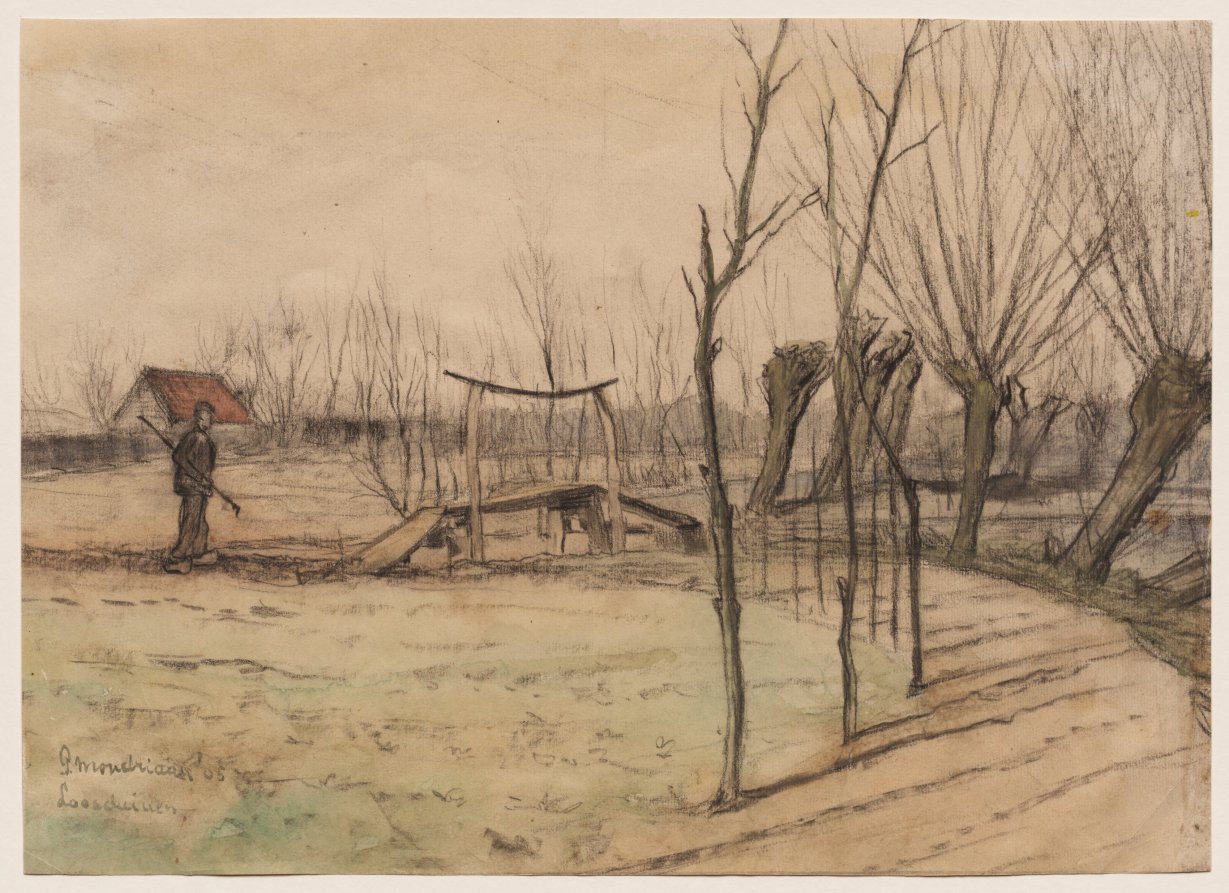
Urban Silhouette Research: Landscape at Loosduinen — Geometric Integrity and the 2026 Executive Form
I. Preliminary Structural Reading
The Landscape at Loosduinen presents itself not as a pastoral idyll but as a rigorous exercise in planar compression. The horizon line—unwavering, absolute—bisects the composition with the cold finality of a drafting rule. Above it, sky is reduced to a negative field of atmospheric gray; below, the earth is parsed into horizontal strata of tonal weight. This is not landscape as escape. It is landscape as architecture of restraint. For Addison Fashion, the operative principle is immediately legible: the silhouette must behave as this horizon behaves—authoritative, unornamented, and structurally inevitable.
The painting’s geometric integrity resides in its refusal of the diagonal. There is no romantic sweep, no Baroque torsion. Every element—the low tree line, the flat field, the recessive water—is locked into a grid of horizontal and vertical coordinates. The result is a visual field that feels load-bearing. It supports weight. It does not decorate space; it defines it. This is the first law of the 2026 executive silhouette: the garment must function as a structural member, not a surface application.
II. The Poetics of the Horizontal Plane
Consider the painting’s treatment of the ground plane. It is neither textured nor expressive. It is a sequence of tonal bands—slate, ash, muted umber—each one calibrated to advance or recede with mathematical precision. The eye is not invited to wander; it is directed to scan. This scanning behavior is precisely what the Addison executive silhouette must provoke in the urban environment. The wearer moves through the city as the viewer moves across the canvas: with a controlled, lateral gaze that registers hierarchy, interval, and edge.
In practical terms, this translates to a silhouette built on horizontal severance. A coat that terminates at the mid-calf with a single, uninterrupted hem. A shoulder line that extends beyond the anatomical joint, creating a shelf of negative space. A trouser that falls in a straight column, unbroken by taper or flare. These are not stylistic choices. They are geometric consequences of the painting’s internal logic. The 2026 executive does not dress to attract. The 2026 executive dresses to occupy space with structural certainty.
III. Materiality and the Urban Surface
The painting’s surface is a study in urban materiality avant la lettre. The sky is not blue; it is the color of wet concrete at dusk. The water is not reflective; it is opaque, like brushed steel. The trees are not verdant; they are silhouettes of themselves, reduced to the graphite gray of a city skyline in winter. This palette—Slate, Onyx, Ivory, Silver, Sand—is not a seasonal trend. It is a permanent chromatic infrastructure for the executive wardrobe.
For Addison Fashion, the implication is a fabric vocabulary that prioritizes density over sheen, matte over gloss, weight over drape. Double-faced wool in slate. Bonded cotton in onyx. Silk crepe in ivory with a hand that feels like cold stone. These materials do not flutter. They hold form. They resist the body’s movement just enough to create a silhouette that is legible from twenty meters. In the urban context—where the executive is perpetually in transit, perpetually observed—this legibility is not vanity. It is command presence.
IV. The 2026 Silhouette: A Technical Specification
Drawing directly from the Landscape at Loosduinen, the Addison 2026 executive silhouette is defined by four geometric constraints:
1. The Absolute Shoulder. The shoulder seam extends 4–6 cm beyond the acromion, creating a horizontal plane that mirrors the painting’s horizon. No padding. No roll. The extension is achieved through pattern engineering alone—a cantilevered structure that floats above the arm.
2. The Columnar Leg. The trouser is cut with a single, straight seam from waist to hem. No pleats. No darts. The fabric is heavy enough to fall in a continuous vertical line, interrupted only by the shoe. This is the painting’s tree line rendered in cloth.
3. The Recessive Neckline. The collar is minimal—a narrow stand or a deep, clean V. The neck is not framed; it is exposed as a structural void. This mirrors the painting’s treatment of sky: a negative field that gives weight to everything below it.
4. The Unbroken Hem. Whether coat, jacket, or dress, the hem is a single, straight line. No curves. No asymmetry. The hem is the painting’s horizon—a final, absolute statement of where the garment ends and the world begins.
V. Conclusion: The Executive as Landscape
The Landscape at Loosduinen is not a picture of a place. It is a diagram of order. Its geometric integrity—the horizontal dominance, the tonal restraint, the refusal of the diagonal—offers Addison Fashion a precise blueprint for the 2026 executive silhouette. The wearer does not merely put on a garment. The wearer inhabits a structure. The city becomes the canvas. The body becomes the horizon. And the silhouette—slate, absolute, unornamented—becomes the only necessary statement.
This is not fashion as self-expression. This is fashion as spatial governance. The 2026 executive does not ask to be seen. The 2026 executive defines the field of vision.