Urban Form: Waist Cloth (Kain Panjeng)
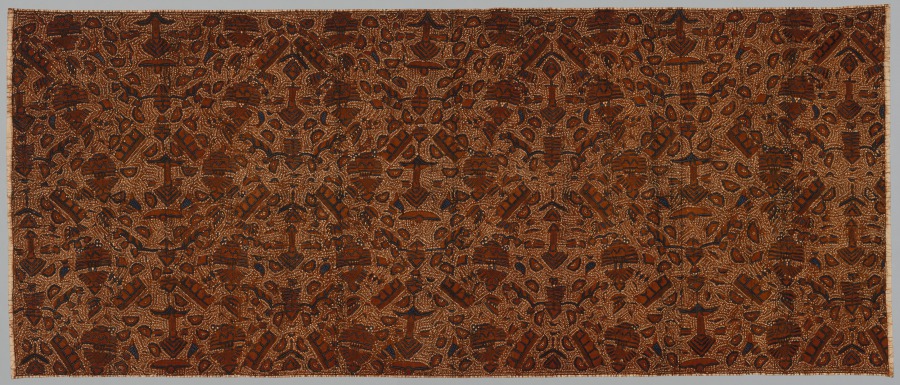
Urban Silhouette Research: The Waist Cloth as Terminal Form
I. Formal Taxonomy: From Drape to Architecture
The kain panjeng—the Javanese waist cloth—enters the Addison research dossier not as ethnographic artifact but as a case study in terminal form. Its construction is deceptively simple: a single length of batik, unstitched, wrapped and secured at the waist. Yet this apparent simplicity conceals a rigorous geometry. The cloth’s silhouette is determined not by cut but by tension—the interplay of gravitational drape, the anchor point at the iliac crest, and the controlled release of excess fabric along the vertical axis. In this, it anticipates the minimalist executive wardrobe’s central problem: how to achieve authority without armature.
The DNA source pairs Socrates’ death with the Song dynasty meiping. Both are studies in containment. David’s composition locks the philosopher’s body into a rational grid—the outstretched arm, the vertical of the cup, the horizontal of the bed. The meiping, by contrast, contains through continuous curvature: the wave motif is not applied but fired into the glaze, a surface that records its own making. The waist cloth operates in the same register. Its folds are not incidental; they are the visible trace of a system—the kain’s width, the wearer’s movement, the knot’s tension—resolved into a stable silhouette. This is form as process made legible.
II. Chromatic Logic: Slate as Terminal Neutral
The palette for this research is Slate—a color that occupies the precise midpoint between mineral and atmosphere. In the meiping, cobalt blue is suspended in a field of celadon; the wave pattern reads as frozen motion, a chromatic event that never resolves into narrative. Slate performs the same function in the executive wardrobe. It is not black, which absorbs and terminates; it is not grey, which retreats into ambiguity. Slate holds temperature—cool enough to signal restraint, warm enough to register as human. Against the skin, it reads as shadow; against architecture, as stone.
David’s Socrates is lit from the left, his torso a plane of warm ochre against the cool shadow of the prison. The painting’s chromatic drama is not in its hues but in their distribution—the way light isolates the body while the surrounding figures dissolve into a unified darkness. The waist cloth achieves a comparable effect through tonal compression. Batik’s wax-resist process produces micro-variations in dye absorption; no two sections of cloth are identical in value. This is not imperfection but information—a record of the maker’s hand, the climate’s humidity, the duration of the dye bath. For 2026, we translate this into textile engineering: a slate wool-silk blend with a non-repeating tonal matrix, achieved through differential yarn dyeing rather than surface print.
III. The Knot as Executive Interface
The waist cloth’s critical detail is its closure. Unlike the tailored trouser, which conceals its mechanism (the zipper, the hook-and-bar), the kain panjeng exposes its fastening. The knot is not hidden; it is the silhouette’s generative point. Every fold radiates from it. This is a radical proposition for the executive wardrobe, which has historically treated closure as a problem to be solved rather than a formal element to be composed.
Consider the meiping’s foot ring—the unglazed circle that grounds the vessel, the point where the potter’s hand last touched the clay before firing. It is both functional and indexical: it records the moment of making. The knot in the waist cloth performs the same double duty. It secures the garment, but it also announces the system. For Addison’s 2026 collection, we propose a deconstructed waistband—a slate silk-cotton cord, hand-knotted at the left hip, from which the trouser’s pleats are suspended. The knot is not decorative; it is the load-bearing element of the silhouette. Remove it, and the form collapses.
IV. Terminal Aesthetics: The Wardrobe as Vessel
Both the Socrates and the meiping are objects of terminal contemplation. They do not depict death as event but as condition—the condition of being complete, of having reached the limit of one’s form. The waist cloth, too, is terminal. It is not a garment that evolves through the day; it is fixed at the moment of wrapping. Its silhouette is determined once and then inhabited. This is the opposite of the contemporary executive wardrobe, which is designed for modularity—the blazer that adapts, the shirt that transitions, the shoe that performs across contexts.
Addison’s proposition for 2026 is a return to the terminal. Not as nostalgia, but as strategic clarity. The executive who dresses in the morning is not assembling a kit; she is committing to a form. The slate waist cloth—reinterpreted as a high-waisted, flat-front trouser with an exposed cord closure—offers a silhouette that is complete at the point of fastening. It does not require adjustment. It does not invite modification. It is, in the meiping’s terms, fired.
The wave motif on the Song vessel is not a picture of water; it is water as structure—a pattern that contains without depicting. The executive wardrobe of 2026 must achieve the same: garments that are not about power but are structured by it. The waist cloth, with its exposed knot and gravitational drape, offers a model. It is not a garment of arrival. It is a garment of conclusion—the point at which the body’s movement through space is resolved into a single, legible form.
This is the terminal aesthetic. Not an ending, but a containment. The meiping holds nothing; it is the holding. The waist cloth covers nothing; it is the covering. The executive wardrobe, at its highest register, must do the same: not dress the body, but be the body’s form.