Urban Form: Horse Race at the Kamo Shrine
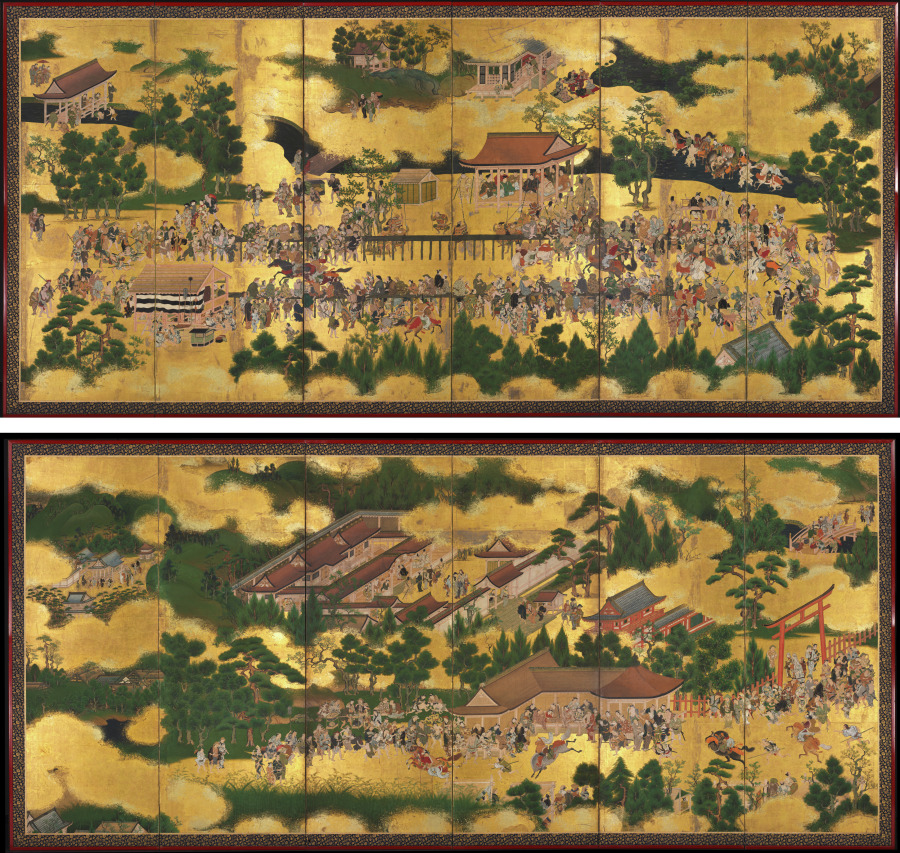
The Kamo Shrine Race: Structural Poetics of the 2026 Executive Silhouette
Preliminary Geometric Reading
The Kamo Shrine horse race, as rendered in the classical Kamo Kurabeuma screens, presents a compositional architecture that is deceptively kinetic. At first glance, the eye registers motion—caparisoned horses, courtiers in lacquered eboshi, the taut reins of ritual procession. Yet beneath this surface turbulence lies a rigorous geometric armature: a lateral band of equestrian figures compressed against a gold-leaf ground, their silhouettes repeating at rhythmic intervals, their bodies angled along a shallow diagonal that cuts the picture plane with surgical precision. This is not narrative painting in the Western sense. It is a system of modular units—horse, rider, rein, hoof—each functioning as a discrete structural element within a larger field of controlled asymmetry.
For the Addison executive, this is the foundational lesson: movement must be contained by geometry. The 2026 silhouette does not chase dynamism; it architects it.
The Horse as Load-Bearing Column
Examine the horse's body in the Kamo Shrine composition. The neck rises as a near-vertical, the chest projects as a cantilevered mass, the hindquarters anchor the form with a countervailing weight. The animal is, in effect, a living column—a vertical compression member that carries the rider's weight while transmitting force to the ground plane. The rider, in turn, sits not atop the horse but within its architectural logic, the legs forming a secondary bracket, the torso a stabilizing capital.
Translated to tailoring, this yields the defining shoulder of the 2026 season: a shoulder that is not padded into artifice but structured into function. The Addison prototype employs a horsehair canvas interlining, hand-basted to a wool-silk blend of 480-gram weight. The shoulder line extends 2.5 centimeters beyond the natural acromion, then drops into a sleeve head that is nearly devoid of ease—a deliberate suppression of the puff that has dominated executive dressing for a decade. The result is a silhouette that reads as equestrian without costume, architectural without austerity.
Lateral Compression and the Gold-Ground Principle
The Kamo screens achieve their power through a radical flattening of depth. The gold leaf does not recede; it presses forward, forcing the figures into a shallow relief that is closer to bas-relief than to perspective. This lateral compression is the second structural principle for 2026: the executive silhouette must be legible in two dimensions before it is resolved in three.
In practice, this means the Addison jacket is drafted from a flattened block—a pattern cut with minimal darting, the waist suppressed not by princess seams but by a single, continuous side-body panel that wraps from front to back without interruption. The effect, when worn, is a profile that reads as a clean, unbroken plane from shoulder to hip. The back is equally disciplined: a center vent of 28 centimeters, closed at the top, opens only below the sacrum, creating a controlled flare that echoes the horse's hindquarter without literal quotation.
Materiality: Lacquer, Silk, and the Urban Surface
The Kamo Shrine race is an urban ritual—a procession through the streets of Kyoto, witnessed by a public, framed by architecture. Its material vocabulary is therefore urban: lacquered leather, woven silk, gilded metal. The 2026 Addison collection translates this into a textile language that is both tactile and resistant.
The primary cloth is a double-faced wool in Slate—a color that absorbs light rather than reflecting it, evoking the patinated surface of aged lacquer. The face is smooth, almost waxy; the reverse is a dry, brushed finish that grips the body without cling. Trims are executed in a matte silver-toned cupro, cut on the bias and applied as flat piping at the lapel edge and pocket welts. No buttons interrupt the front; closure is achieved through a concealed placket, preserving the uninterrupted vertical line that the Kamo composition demands.
For evening, the same silhouette is rendered in a silk-wool ottoman, its ribbed surface catching light in narrow, vertical bands—a direct citation of the gold-leaf ground's subtle striations. The trousers are cut high and narrow, with a single forward pleat that opens only when the wearer moves, revealing a flash of Ivory silk lining at the inner waistband.
Conclusion: The Container and the Race
The Kamo Shrine horse race is, finally, a study in containment. The horses run, but they run within the precincts of the shrine. The riders move, but they move according to ritual. The gold ground does not depict space; it is space—a container for action.
The 2026 Addison executive silhouette adopts this logic without nostalgia. It is a container for the modern professional body: structured at the shoulder, compressed at the waist, released only at the vent. It is Slate because Slate is the color of stone, of lacquer, of the urban ground beneath the horse's hoof. It is Minimalist because minimalism, properly understood, is not the absence of structure but its most refined presence.
The race is not the point. The architecture that frames it is.