Urban Form: Architecture of the Middle Ages: Church of St. Gisors, Interior
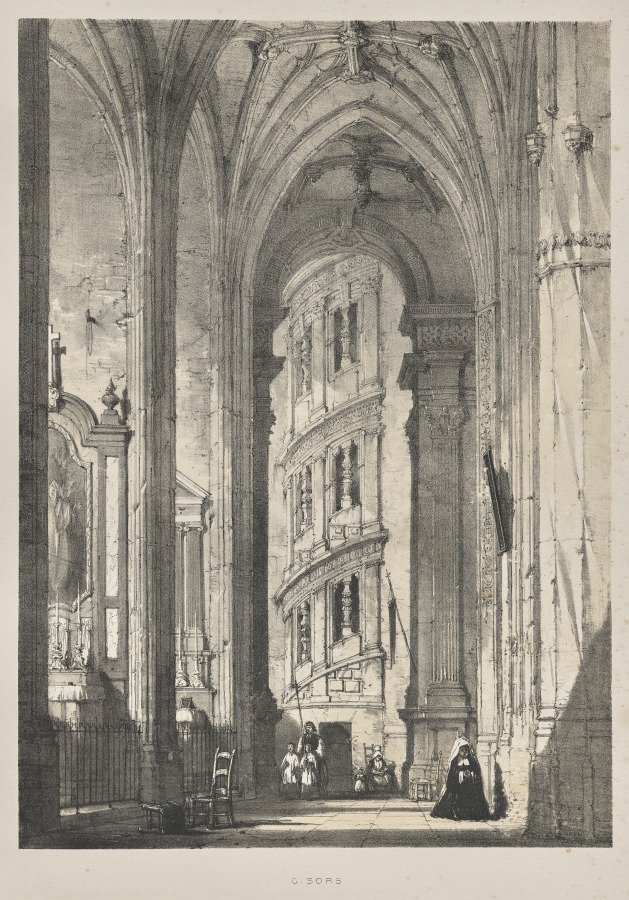
Urban Silhouette Research: The Gisors Interior as Structural Protocol
I. Geometric Integrity: The Romanesque Vault as Tailoring Matrix
The interior of the Church of St. Gisors presents a geometry of severe economy. Its Norman Romanesque skeleton—cylindrical piers, transverse arches, and the pointed vault that anticipates Gothic ambition—operates not as ornament but as load-bearing logic. The eye is conducted upward through a sequence of stacked horizontals: the pier base, the impost block, the arch springing, the clerestory sill. Each transition is a seam. Each seam is a decision.
For the 2026 executive silhouette, this translates into a vertical columnar read interrupted by precise horizontal articulations. The Addison woman does not wear a garment; she occupies a structural bay. The shoulder line corresponds to the impost—a clean, load-transferring break between the column of the torso and the arch of the sleeve. The waist is not cinched but marked, as the vault rib marks the bay without interrupting its continuity. This is the difference between tailoring as constraint and tailoring as architecture.
The pointed arch—that transitional innovation at Gisors—offers a critical lesson in proportional tension. It is neither the semicircular completeness of pure Romanesque nor the full release of High Gothic. It is a compressed aspiration, a form that reaches upward while acknowledging the weight above. The 2026 Addison shoulder adopts this logic: a slight elevation at the sleeve head, a forward pitch of no more than seven degrees, creating the illusion of ascent without sacrificing the horizontal integrity of the shoulder yoke. The result is a silhouette that reads as both grounded and ascending—a contradiction resolved only through precise pattern engineering.
II. Structural Poetics: The Socratic Vessel and the Morandi Void
The internal DNA of this research demands a confrontation between two poles of objecthood. David's Death of Socrates presents the cup as teleological vessel—every curve of its profile is charged with narrative consequence. The hand reaches; the cup receives; the meaning is fixed. Morandi's Vases present the vessel as phenomenological residue—form without destination, surface without story. The cup does not point; it simply is.
The Gisors interior occupies the space between these poles. Its piers are not Socratic—they do not narrate salvation or martyrdom. Nor are they Morandian—they are not mute. They are structural witnesses, bearing the weight of centuries without commentary. Their surfaces—worn limestone, accumulated soot, the patina of liturgical use—constitute a materiality that is neither symbolic nor neutral but testimonial.
For Addison's 2026 executive wardrobe, this suggests a fabric protocol of witnessed surfaces. Slate wool with a dry, chalky hand. Silk crepe de chine that absorbs rather than reflects. The textile must carry the memory of its own construction—visible pick stitching, exposed seam allowances finished with bias binding, the faint impression of the tailor's chalk. These are not flaws; they are architectural records. The garment documents its own making, as the Gisors vault documents its own engineering.
The Socratic cup and the Morandi vase converge here: the executive garment is both vessel and void. It contains the body—shapes it, supports it, gives it architectural legibility—while remaining empty of imposed meaning. It does not signal status through logos or hardware. It signals through structural honesty. The shoulder seam sits exactly where the arm requires it. The dart terminates precisely at the apex of the bust. The hem falls at the golden section of the leg. These are not choices; they are consequences of geometric integrity.
III. Urban Materiality: Limestone, Shadow, and the Executive Palette
The Gisors interior is a study in Slate—not the color of the stone itself, which tends toward warm limestone and ochre, but the chromatic effect of light filtered through clerestory glass onto cold stone. It is a gray that is neither neutral nor warm, but temporal: the gray of accumulated shadow, of incense residue, of centuries of footfall. This is the Addison Slate for 2026: a gray with depth, with history, with the faintest undertone of green-black in its deepest recesses.
The materiality of the Gisors interior is defined by contrast without conflict. Rough stone meets smooth glass. Heavy pier meets light vault. Dark shadow meets pale illumination. The executive silhouette must achieve the same: a matte wool trouser against a fluid silk blouse; a structured shoulder against a soft, unlined sleeve; a precise, narrow lapel against a wide, architectural collar. The tension is not resolved; it is composed.
For urban materiality, this translates into a wardrobe that functions as infrastructure. The coat is not a covering but a portico—its shoulders squared, its length calibrated to the knee, its closure hidden to preserve the purity of the vertical line. The dress is not a garment but a nave—columnar, uninterrupted, its seams placed at the structural bays of the body. The suit is not a uniform but a vault—each panel transferring visual weight to the next, creating a continuous surface of controlled tension.
IV. The 2026 Executive Silhouette: A Synthesis
The Addison 2026 executive silhouette emerges from this research as a Minimalist architecture of consequence. It rejects the Socratic temptation to narrate—no visible branding, no decorative hardware, no symbolic gestures. It equally rejects the Morandian temptation to dissolve—the garment must do something, must structure the body, must create legibility. It occupies the Gisors position: structural witness.
The silhouette is vertical, columnar, and interrupted only by necessary articulations. The palette is Slate—a gray of depth and duration. The materials are witnessed—surfaces that record their own making. The proportions are derived, not designed: shoulder width equals one-quarter of total height; jacket length terminates at the mid-thigh; sleeve length exposes exactly one centimeter of shirt cuff. These are not rules but consequences of geometric integrity.
The executive woman of 2026 does not dress to be seen. She dresses to occupy space with intention. Her garment is not a statement but a structure. It does not point to meaning; it is meaning—the meaning of form that has submitted to function, of surface that has accepted the weight of its own history. In the Gisors interior, the vault does not ask to be admired. It simply holds. The Addison 2026 silhouette holds likewise.