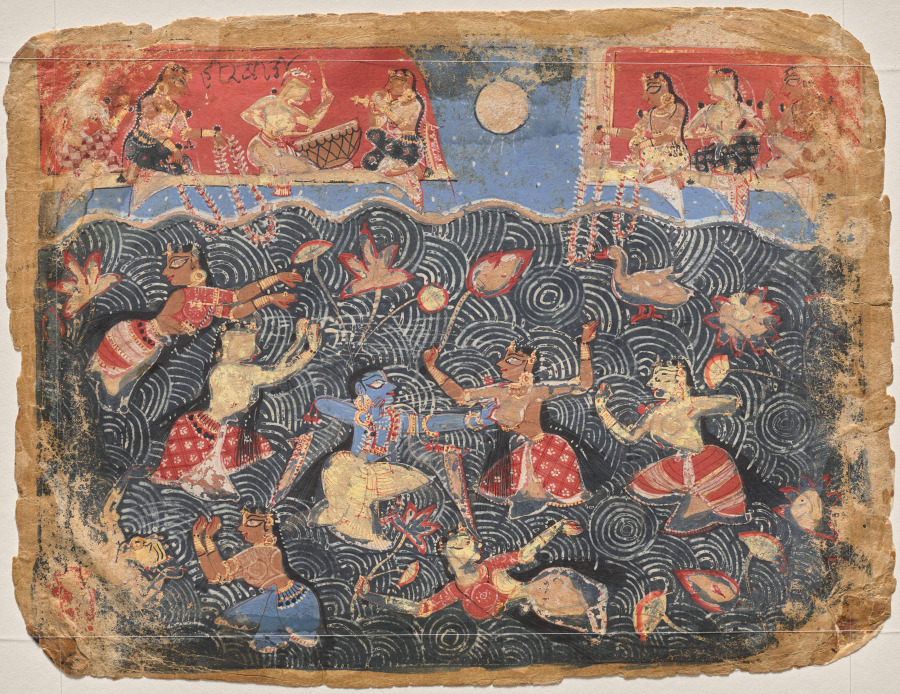
Urban Form: Krishna sporting with the gopis in the Jumna River, from a Bhagavata Purana
Urban Silhouette Research: The Jumna River as Structural Protocol
I. Preliminary Geometry: The Submerged Body as Architectural Negative Space
The Bhagavata Purana depiction of Krishna sporting with the gopis in the Jumna River presents a compositional problem that Addison Fashion regards as foundational to the 2026 executive silhouette. The image operates not through frontal assertion but through submerged volumetric negotiation—bodies partially occluded by water, limbs intersecting at oblique angles, the river itself functioning as a translucent membrane between surface and depth. This is not a scene of action. It is a scene of structural poetics, wherein the human form is continuously redefined by its environment rather than imposed upon it.
The water line in this painting is not a horizon. It is a cutting plane—a horizontal severance that divides each figure into visible and invisible registers. What emerges above the surface is legible, social, composed. What remains below is turbulent, intimate, ungoverned. Addison Fashion identifies this bifurcation as the central tension of the urban executive wardrobe: the necessity of a public architecture that conceals a private fluidity. The 2026 silhouette must perform this same amphibious logic.
II. The Gopi Cluster: Multiplicative Volume and the Rejection of Singular Form
Observe the gopis. They do not stand as individuals. They form a dense, overlapping mass—shoulders brushing, garments merging, the boundaries between one body and the next deliberately dissolved. The painter has refused the Western convention of isolated heroic figures. Instead, the composition presents multiplicative volume: a single silhouette that is, in fact, many silhouettes compressed into a unified chromatic field.
This has direct implications for tailoring. The 2026 executive cannot afford the fiction of the solitary monolith. The Addison pattern for the coming season proposes a layered shoulder construction—not padded, but stacked—wherein the outer shell of a coat or jacket carries the visual weight of three garments while the interior remains almost weightless. The gopi cluster teaches us that authority is not singular. It is cumulative. The silhouette must read as though it has absorbed its surroundings, not resisted them.
III. Krishna's Arm: The Diagonal as Instrument of Control
Krishna's arm—extended, reaching, whether toward a gopi or toward the river's surface—creates the painting's primary diagonal. This line is not decorative. It is operational. It cuts across the horizontal water line, across the vertical postures of the surrounding figures, and establishes a vector of intentionality within an otherwise diffuse composition. Without this diagonal, the image would collapse into ornamental chaos.
Addison Fashion translates this into the asymmetric closure of the 2026 executive coat. The single-breasted front, when fastened, must produce a subtle diagonal tension—a line of closure that travels from the left shoulder to the right hip, echoing Krishna's arm. This is not a stylistic flourish. It is a structural necessity. The urban environment is diffuse. The executive silhouette must provide its own vector of control. The diagonal is the difference between a garment that merely covers and a garment that directs.
IV. The Jumna's Surface: Materiality as Liquid Architecture
The river in this painting is rendered not as transparent water but as a slate-toned membrane—opaque enough to conceal, reflective enough to suggest. It is a surface that refuses full disclosure. Addison Fashion reads this as a directive for urban materiality: the fabrics of 2026 must possess this same amphibious quality. Not sheer. Not solid. Slate—the color of wet stone, of overcast light on moving water, of the river's own ambiguous depth.
The technical specification calls for a double-faced wool-silk hybrid with a matte face and a low-luster reverse. When the garment moves, the surface shifts—not dramatically, but perceptibly. This is the Jumna effect: a material that reveals its depth only through motion, that rewards the observer who waits. The executive silhouette must not announce itself. It must accrue.
V. The Absence of Ground: Floating Silhouettes and the Urban Condition
Note that the painting provides no stable ground plane. The figures do not stand on earth. They are suspended in water, their lower bodies dissolved into the river's chromatic field. This is a floating composition—a structural condition that Addison Fashion identifies as the defining characteristic of the contemporary urban executive. There is no ground. There is only the negotiated surface of the city: pavement, glass, transit, threshold.
The 2026 silhouette must therefore abandon the traditional weighted hem. Instead, Addison proposes a tapered, fluid lower register—trousers that narrow toward the ankle without gripping, skirts that fall in a single unbroken line from hip to floor. The garment must appear to hover, not rest. This is not a matter of aesthetics. It is a matter of ontological accuracy. The urban executive does not stand on solid ground. She moves across a series of temporary surfaces. The clothing must acknowledge this.
VI. Conclusion: The Silhouette as Amphibious Protocol
The Jumna River painting is not a scene of leisure. It is a technical diagram for a silhouette that operates simultaneously in two registers—the visible and the submerged, the social and the intimate, the structured and the fluid. Addison Fashion's 2026 executive silhouette draws its geometry from this source: the diagonal of Krishna's arm, the multiplicative volume of the gopi cluster, the slate-toned membrane of the river's surface, the absence of ground.
This is not a collection about Krishna. It is a collection about the conditions Krishna's image encodes: the negotiation between surface and depth, the rejection of singular authority, the acceptance of floating as a permanent state. The urban executive of 2026 does not conquer her environment. She moves through it—fluid, slate-toned, structurally poetic. The river does not resist her. It receives her.