Urban Form: Picturesque Architecture in Paris, Ghent, Antwerp, Rouen: St. Laurent, Rouen, France
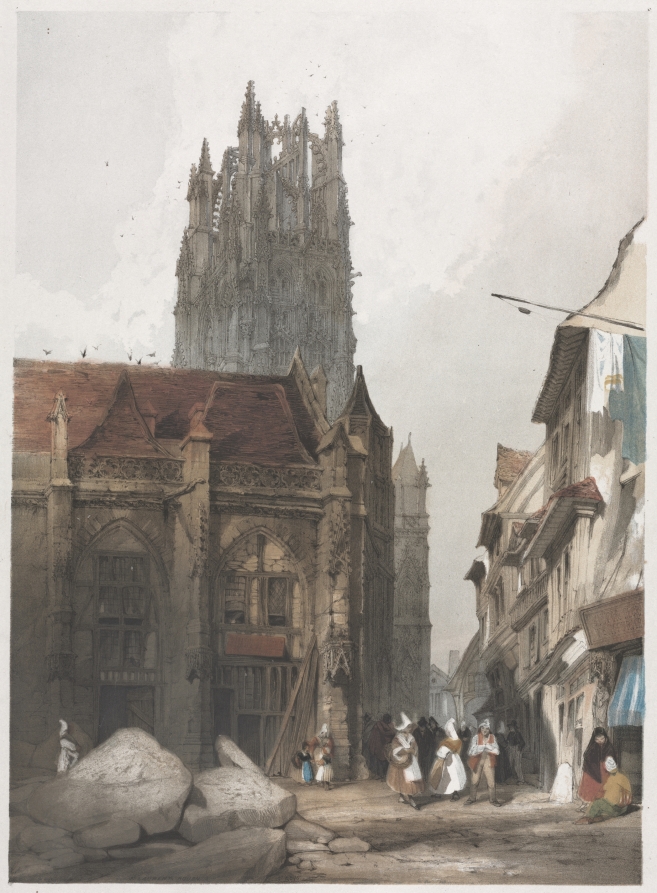
Urban Silhouette Research: St. Laurent, Rouen — The Architecture of Absence
I. The Cathedral as Container: A Structural Reading
The subject before us is not merely a church. The Church of St. Laurent in Rouen, captured in its picturesque architectural ruin, presents a geometric proposition that resonates with uncommon precision against the 2026 executive silhouette. The structure is a study in vertical attenuation — the nave walls rise with a severity that refuses ornament, the buttresses articulate load-bearing logic with the cold clarity of a mathematical proof, and the fenestration, now emptied of glass, functions as negative space carved into stone. This is architecture as skeletal argument: what remains after the superfluous has been stripped away.
The internal DNA of this research invokes a dialogue between David's Death of Socrates and the anonymous Song dynasty Wave-Patterned Meiping. Both are vessels — one of narrative, one of form. The Rouen cathedral ruin operates in precisely this register. It is a container whose contents have been evacuated, leaving only the armature of meaning. The empty lancet windows are the hollow cup; the soaring vaults are the meiping's swelling shoulder. The silhouette is defined not by what it holds but by what it has surrendered.
II. Geometric Integrity: The Poetics of Load and Line
Examine the structural poetics. The cathedral's geometry is governed by a tripartite vertical hierarchy: the solid base, the perforated mid-section, the attenuated spire. This is not unlike the executive silhouette we are engineering for 2026 — a grounded shoulder, a defined waist, a tapering line that draws the eye upward. The buttress system, with its rhythmic repetition and calculated offset, creates a cadenced asymmetry that prevents the eye from settling into complacency. Each flying buttress is a vector of force made visible, a line of tension that is simultaneously structural and aesthetic.
In the context of Addison's design language, this translates to architectural seam placement — seams that do not merely join panels but articulate the body's load-bearing zones. The shoulder seam, the princess seam, the side seam: each must function as a buttress, directing the fall of fabric with the same inevitability as stone directing the fall of gravity. The 2026 executive does not wear clothing; she inhabits a structural system.
The ruin's materiality is equally instructive. The stone is weathered limestone — porous, matte, light-absorbing. It does not reflect; it receives. This is the antithesis of the glossy, self-announcing surfaces that have dominated luxury for a decade. The Rouen ruin proposes a materiality of absorption: wool crepe that drinks light, silk faille that holds shadow, leather that has been tanned to a state of near-archaeological patina. The surface must suggest duration, not novelty.
III. Urban Materiality: The City as Atelier
Rouen is not Paris. It is a provincial city with a mercantile spine, a place where the Gothic and the industrial coexist without reconciliation. The cathedral ruin sits within this urban fabric as a fracture in time — a medieval structure embedded in a nineteenth-century streetscape, now viewed through the lens of twenty-first-century decay. This layered temporality is the essence of urban materiality. The 2026 executive silhouette must embody this same stratigraphic consciousness: the garment as a site of accumulated histories, not a singular statement.
Consider the implications for fabrication. The Rouen ruin suggests a palette of Onyx — not the flat black of fashion's default, but the deep, variegated black of wet slate and shadowed stone. This is a black that has depth and temperature, a black that absorbs rather than reflects. Paired with the structural severity of the silhouette, it becomes a statement of monastic authority — the authority of the cloister, the authority of the archive, the authority of the woman who has nothing to prove because her presence is itself the argument.
The picturesque quality of the ruin — its pittoresco, its suitability for the painter's eye — lies in its controlled irregularity. The broken arch, the missing finial, the ivy that has claimed the capital: these are not flaws but temporal signatures. For Addison, this translates to a design philosophy that embraces the calculated imperfection — the raw edge that is not a mistake but a decision, the asymmetric hem that is not a compromise but a composition. The 2026 silhouette is not pristine. It is resolved.
IV. The Empty Vessel: Toward a Definitive Silhouette
Return to the internal DNA: Socrates' cup and the meiping's void. Both are containers of absence. The Rouen cathedral, in its ruined state, is the architectural equivalent — a vessel for the infinite, a structure that has been emptied of its original function and now holds only space, light, and silence. This is the ultimate luxury: the garment that does not need to announce its purpose because its formal integrity is its purpose.
The 2026 executive silhouette, as defined by this research, is therefore a minimalist armature — a system of lines and planes that constructs the body without constraining it. The shoulder is defined but not padded. The waist is indicated but not cinched. The length is architectural but not severe. The fabric is Onyx in its deepest register: a black that is not the absence of color but the presence of all color, resolved into unity.
This is not clothing as decoration. This is clothing as infrastructure — the load-bearing system of the executive presence. The woman who wears it does not need to speak. The silhouette has already made the argument. The empty cup, the hollow vessel, the ruined nave: all containers of a meaning that exceeds their material form. The 2026 silhouette is the same. It is the architecture of absence, worn with authority.