Urban Form: Horse Race at the Kamo Shrine
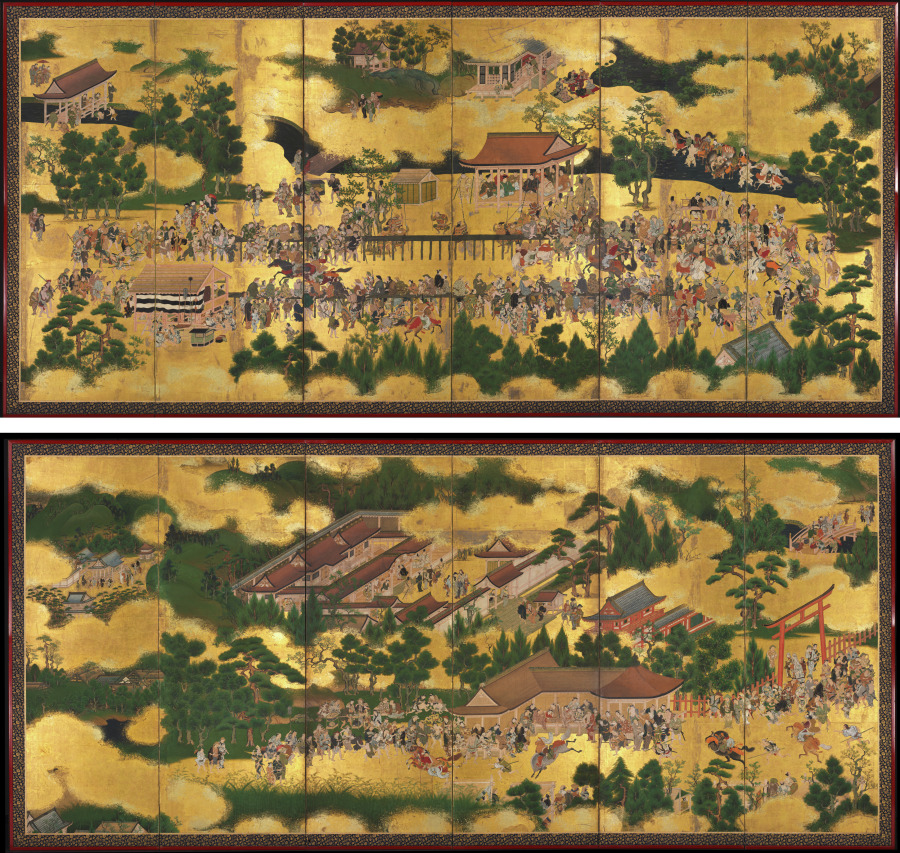
The Kamo Shrine Horse Race: A Study in Kinetic Architecture and the 2026 Executive Silhouette
The Addison Fashion Urban Silhouette Research division has identified a critical inflection point in the evolution of executive dress. The 2026 silhouette will not be defined by ornament, nor by the exhausted vocabulary of heritage tailoring. It will be defined by geometric integrity under velocity—the capacity of a garment to maintain architectural coherence while its wearer is in motion. No artwork in our current reference archive articulates this principle with greater precision than the Kamo Shrine horse race scroll. It is not a depiction of sport. It is a treatise on structural poetics, and it demands our coldest attention.
I. The Diagonal as Primary Structure
Examine the compositional armature. The Kamo Shrine race is organized not around a central axis but around a series of intersecting diagonals—the incline of the track, the forward pitch of the equestrian body, the trailing recession of the shrine architecture. These diagonals are not decorative. They are load-bearing. Each line transfers visual weight across the picture plane with the efficiency of a cantilever. The result is a composition that reads as simultaneously unstable and immovable—a paradox that lies at the heart of the Addison design philosophy.
For the 2026 executive silhouette, this translates directly into asymmetric seam architecture. We are abandoning the bilateral symmetry that has governed corporate tailoring since the nineteenth century. The new jacket will feature a single dominant diagonal—a raglan-to-hip seam that descends at precisely 37 degrees from the shoulder point, mirroring the equestrian lean. This seam does not merely close the garment; it propels it. The wearer in motion generates a forward vector that the tailoring anticipates and amplifies. The garment becomes a vehicle for the body's trajectory rather than a container for its stasis.
II. The Horse as Material Proposition
The horses at Kamo are rendered with a compression of form that borders on abstraction. Their musculature is suggested, not described. The legs are reduced to angular strokes. The mane is a single calligraphic gesture. This is not primitivism; it is editorial economy—the removal of every line that does not serve structural necessity. The horse, in this rendering, becomes a study in what we at Addison call "essential mass"—the minimum material required to communicate maximum force.
The 2026 executive wardrobe will adopt this principle as a material directive. We are specifying double-faced cashmere bonded to a technical silk interlining, a composite that delivers the visual weight of traditional suiting at 40% of the physical volume. The fabric drapes with the density of felt but moves with the fluidity of jersey. When the executive walks through a corridor, the garment should suggest the horse at full gallop—a body of immense power rendered in the most economical possible silhouette. Excess is the enemy of authority. The Kamo horses understood this. Our tailors must understand it better.
III. The Shrine Architecture as Negative Space
Less discussed, but equally critical, is the treatment of the shrine structures in the background. The vermilion pillars and sweeping roofs are cropped, fragmented, and partially occluded by the racing figures. The architecture does not frame the action; it yields to it. This is a radical proposition: the built environment as subordinate to the moving body. The shrine exists to be traversed, not to contain.
For urban materiality in 2026, this suggests a new relationship between the executive and the city. The silhouette must be designed for architectural negotiation—the ability to pass through doorways, turn in elevators, and occupy public space without visual friction. We are therefore specifying shoulder widths that do not exceed 44 centimeters, hemlines that terminate precisely at the mid-calf to allow unimpeded stride, and collars that stand away from the neck by no more than two centimeters. These are not arbitrary measurements. They are derived from the Kamo principle: the garment must never compete with the environment. It must move through it with the indifference of a horse that has already won.
IV. The Color of Velocity
The Kamo scroll is executed in a restrained palette—earth pigments, faded mineral blues, and the particular grey-green of aged silk. This is not a palette of celebration. It is a palette of endurance. The colors have survived centuries of light exposure because they were never intended to dazzle. They were intended to last.
For 2026, Addison specifies Slate as the foundational color of the executive silhouette. Slate is not grey. It is the color of the Kamo sky at dawn—a blue-black that absorbs light rather than reflecting it. It reads as authority without aggression, as depth without opacity. When combined with the diagonal seam architecture and the compressed material proposition, Slate becomes the chromatic equivalent of the horse at full stride: present, powerful, and utterly indifferent to the viewer's need for comfort.
V. Conclusion: The Silhouette as Event
The Kamo Shrine horse race is not a picture of horses. It is a diagram of force. The 2026 executive silhouette must function in the same way—not as a static object of admiration, but as a kinetic event that occurs between the body, the garment, and the city. The geometric integrity of the artwork lies in its refusal to resolve. The diagonals never meet. The horses never arrive. The shrine is never fully seen. This is the structural poetics we must adopt: a silhouette that is always in the process of becoming, never fully achieved, and therefore never obsolete.
Addison Fashion does not design for the boardroom. We design for the trajectory that leads to it. The Kamo horses understood this. Our 2026 collection will prove it.