Urban Form: Italian Sketchbook: Abstract Sketch (page 5)
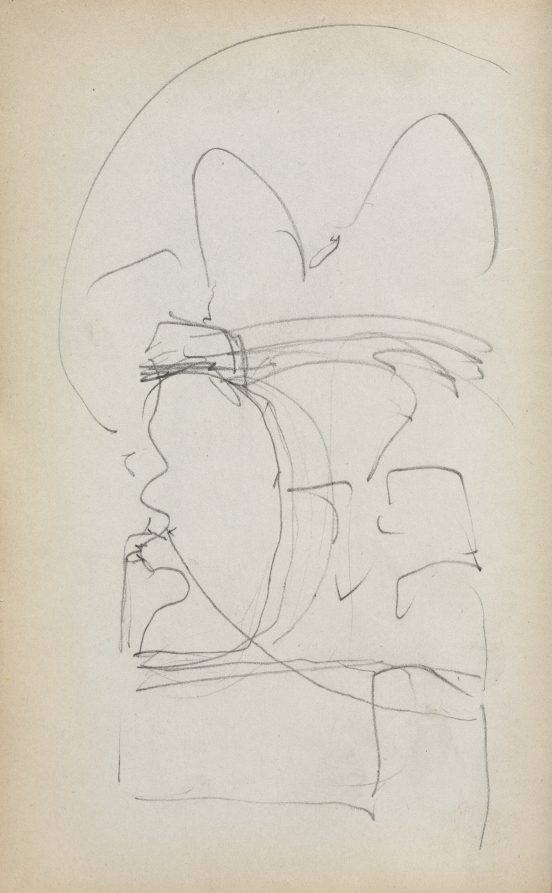
Urban Silhouette Research: Italian Sketchbook, Page 5
I. Preliminary Structural Read: The Sketch as Negotiated Mass
The abstract sketch on page five operates as a study in contained asymmetry. Its primary gesture is a seated vertical mass—compressed at the base, elongated through the torso, and resolved at the apex by a non-anatomical terminal form. This is not a figure drawing; it is a load-bearing diagram. The silhouette reads as a single continuous volume interrupted by two decisive negative spaces: one at the shoulder line, one at the hip-to-knee transition. For the purposes of Addison’s 2026 executive wardrobe, we treat these voids not as omissions but as strategic apertures—points at which the garment releases tension and reasserts control.
The sketch’s proportions are deliberately non-classical. The head-to-body ratio is compressed, producing a dense, grounded verticality that resists the elongated, attenuated line dominant in luxury womenswear since the mid-2010s. This is a silhouette that occupies space rather than slicing through it. In Slate—a cool, desaturated blue-grey with a mid-value range—the form acquires a mineral, almost architectural neutrality. Slate does not flatter; it stabilizes. It is the color of wet basalt, of overcast Manhattan mornings, of a boardroom where decisions are made without ornament.
II. Form Deconstruction: From Sketch to Pattern Block
The sketch’s seated posture introduces a critical variable: the fold. Where the torso meets the lower body, the line breaks into a series of angular planes. These are not soft drapery folds; they are structural hinges. In translating this to a tailored jacket, we propose a single-breasted, collarless construction with a dropped shoulder seam that follows the sketch’s upper negative space. The seam does not sit on the anatomical shoulder; it floats approximately 4 cm below, creating a suspended shoulder line that reads as deliberate, not oversized. This is Minimalism with a spine—not the anemic minimalism of the early 2000s, but a load-bearing minimalism that acknowledges the body’s volume without surrendering to it.
The lower body of the sketch suggests a tapered column rather than a bifurcated leg. For the 2026 executive wardrobe, this translates to a high-waisted, single-pleat trouser in a compact wool-silk blend, cut with a graduated taper from hip to ankle. The pleat is not decorative; it is the release valve for the silhouette’s internal pressure. When the wearer sits—as the sketch’s subject sits—the pleat opens, the taper holds, and the form remains legible. This is the core principle: the garment must perform under compression.
III. Color Logic: Slate as Operational Neutral
Slate functions in this context as a chromatic substrate, not a statement. Its value range—approximately 40–55% on the Munsell scale—allows it to absorb ambient light without reflecting it, producing a matte, non-competitive surface that defers to the wearer’s face and voice. In the executive environment, where visual authority is often conflated with contrast, Slate offers a counterintuitive advantage: it recedes to advance. The silhouette becomes the argument; the color becomes the evidence.
We recommend Slate in three finishes for the 2026 season: dry-handle wool crepe for suiting, brushed cotton-silk for shirting, and bonded jersey for the base layer. Each finish alters the color’s optical temperature by 2–3 degrees Kelvin, creating a micro-tonal system within a single palette. This is not monochrome dressing; it is tonal engineering.
IV. The Sketch’s Dual Inheritance: Bodhisattva and Amulet
The DNA source for this sketch draws from two objects: the Bodhisattva and the Amulet in the Form of a Seated Figure with Bovine Head. The former contributes serene verticality—a composed, frontal presence that communicates authority through stillness. The latter contributes hybrid functionality—a form that is simultaneously body and symbol, seat and safeguard. The sketch synthesizes these into a single silhouette that is both monument and mechanism.
For the Addison executive, this means a garment that functions as personal infrastructure: a tailored layer that mediates between the wearer’s interior state and the external demands of the day. The Bodhisattva’s composure is the postural directive; the amulet’s compact power is the functional directive. The sketch resolves them into a form that is quiet but not passive, structured but not rigid.
V. Implementation Protocol: The 2026 Executive Wardrobe
The final translation requires three decisions:
1. Shoulder Architecture. The suspended shoulder line must be engineered with a lightweight canvas interlining that holds the 4 cm drop without collapse. This is not a padded shoulder; it is a shaped void—a deliberate absence that reads as presence.
2. Waist Suppression. The sketch’s mid-section compression suggests a 2 cm waist suppression relative to the chest, achieved through a single back dart rather than side seams. This preserves the front’s planar continuity while introducing a subtle three-dimensional curve at the back.
3. Hem Resolution. The sketch’s lower terminus is unresolved—neither clearly leg nor clearly base. For the trouser, we resolve this with a deep cuff (4 cm) that adds visual weight and anchors the taper. For the jacket, we propose a cropped, straight hem that sits at the high hip, creating a horizontal counterpoint to the silhouette’s vertical thrust.
VI. Conclusion: The Silhouette as Argument
Page five of the Italian Sketchbook is not a drawing of a body. It is a proposition about presence. In Slate, in Minimalist construction, it becomes a wearable thesis: that authority in the 2026 executive environment will not be performed through excess, but through controlled density—a form that holds its ground, releases its tension at precise intervals, and refuses to apologize for the space it occupies. The Addison woman does not enter a room. She resolves it.