Urban Form: Bacchanale
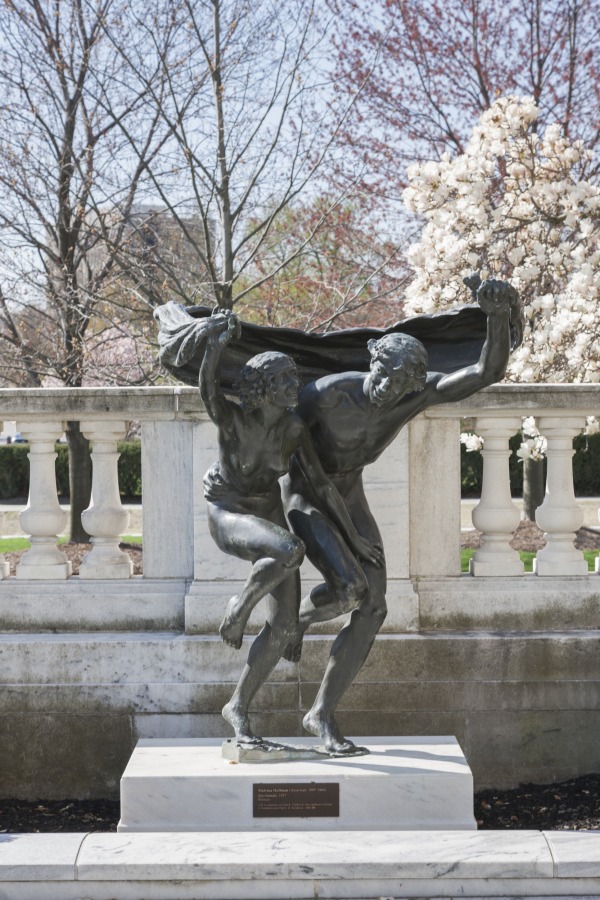
Urban Silhouette Research: Bacchanale — Geometric Integrity and the 2026 Executive Form
I. The Delft Bowl as Structural Prototype: Concentric Order and the Contained Silhouette
The Addison 2026 executive silhouette begins not with the body, but with the bowl. The Bowl with Ducks among Waves and Reeds — Delftware in cobalt underglaze — presents a geometric proposition that is deceptively simple: a circular vessel whose interior radiates outward in concentric rings, each ripple a controlled expansion from a fixed center. This is architecture in miniature. The bowl's circumference is absolute; its walls rise with mathematical restraint; its foot ring anchors the entire composition to a single point of gravity. For the 2026 executive wardrobe, this translates into a silhouette defined by containment without constriction — a tailored shell that holds the body in precise relation to space, neither gripping nor abandoning it.
The reed arcs that frame the ducks are not decorative flourishes. They are structural vectors — curved lines that distribute visual weight across the bowl's interior, preventing the central motif from collapsing into mere illustration. In garment terms, this corresponds to the shoulder-to-hem continuum: a single unbroken line that runs from the clavicle through the waist to the floor, interrupted only by the body's own architecture. The 2026 Addison executive jacket will feature a continuous raglan seam that mimics the reed's trajectory — a slow, deliberate arc that resolves tension rather than creating it. The result is a silhouette that reads as inevitable, as though the wearer's form and the garment's geometry were always already one proposition.
The crackle glaze — that network of fine fissures across the bowl's surface — introduces a critical material intelligence. It is evidence of time, of thermal stress, of the kiln's violence rendered benign. For urban materiality, this suggests surfaces that record their own history: wool that has been washed and re-felted to a dense, slightly irregular hand; silk that has been sand-washed to a matte finish that catches light without reflecting it; leather that has been tumbled to a soft, grained patina. The 2026 executive does not wear pristine surfaces. She wears surfaces that have survived — and in surviving, have become more themselves.
II. The Temptation of Saint Anthony as Disruptive Counterpoint: The Expansive Silhouette and Its Limits
Against the bowl's centripetal order, the Temptation of Saint Anthony operates as a centrifugal force — a visual field that refuses containment. The painting's geometry is one of stacked disorder: figures that do not share a ground plane, architectural fragments that float without support, light sources that contradict one another. This is not chaos for its own sake. It is a deliberate spatial argument — that the interior life cannot be mapped onto a single coherent surface, that the self is a contested territory.
For the 2026 Addison silhouette, this painting serves as a necessary corrective. The executive wardrobe cannot be only bowl-like — serene, contained, resolved. It must also acknowledge the temptation of expansion: the desire to occupy more space, to disrupt the grid, to let the hem fall asymmetrically or the sleeve extend past the wrist in a gesture of refusal. The 2026 collection will introduce a controlled asymmetric hem — a diagonal cut that references the painting's tilted ground planes without surrendering to them. The fabric will be a double-faced wool in slate, its reverse side a half-tone lighter, so that the asymmetry reads as a fold in the material's own logic rather than an external imposition.
The painting's palette — bruised purples, sulfurous yellows, deep umbers — is not directly translatable to the Addison executive register. But its tonal instability is. The 2026 silhouette will employ gradient dyeing on silk crepe and wool gabardine: a hem that darkens as it descends, a shoulder that lightens toward the seam. This is not ombré as decoration. It is tonal erosion — a visual record of the garment's negotiation with gravity and light, a quiet acknowledgment that even the most resolved silhouette is under pressure.
III. The Intersection: Structural Poetics and the Urban Body
The bowl and the painting are not opposites. They are two states of the same system — order and its disruption, containment and its breach. The 2026 executive silhouette must hold both. This means a garment that is architecturally resolved at its core — a fitted bodice, a defined waist, a shoulder that sits precisely — but poetically unresolved at its edges. The hem may float. The cuff may be raw. The collar may stand away from the neck by a calculated two centimeters, creating a shadow gap that reads as breath made visible.
Urban materiality for 2026 demands fabrics that perform under pressure: compact jersey that holds its shape through a twelve-hour day, bonded wool that resists wind without stiffness, silk-cotton blends that breathe while maintaining a dry, matte surface. The palette is slate — that blue-gray that sits between the Delft bowl's cobalt and the painting's storm sky. Slate is the color of urban dusk, of concrete after rain, of the moment when the city's geometry becomes visible against a fading light. It is neither warm nor cold. It is precise.
The geometric integrity of this artwork — the bowl's concentric order, the painting's disruptive field — defines the 2026 executive silhouette as a negotiation between containment and expansion. The Addison woman does not choose between the bowl and the temptation. She wears both. She is the vessel and the storm. Her silhouette is the line where they meet.