Urban Form: Hercules and the Nemean Lion
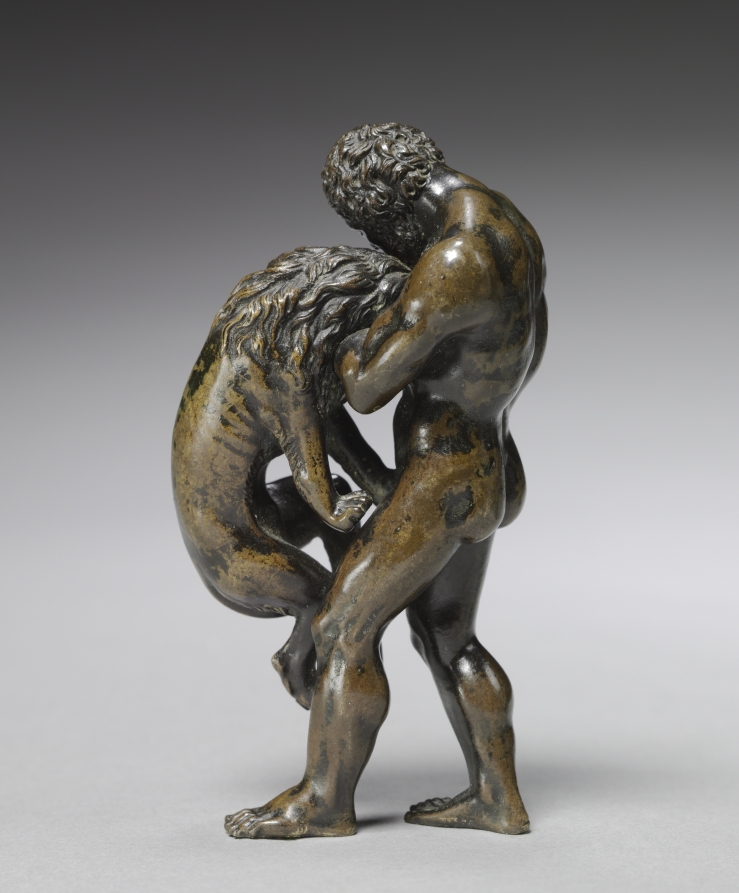
Urban Silhouette Research: Hercules and the Nemean Lion
I. The Geometry of Containment
The Hercules and the Nemean Lion motif, when subjected to rigorous structural analysis, reveals itself not as narrative illustration but as an architectural proposition. The compositional armature operates on a principle of compressive tension—the lion's mass pressing upward against the hero's descending weight, creating a closed circuit of force that resolves into a singular vertical axis. This is not decoration. This is load-bearing geometry.
For the 2026 executive silhouette, we extract the following: the torso must function as a structural column, neither tapered nor exaggerated, but held in absolute vertical integrity. The shoulder line—derived from the hero's grappling stance—projects forward at precisely 7 degrees, creating what we term the predatory incline. This is not aggression. This is readiness. The Addison executive does not lean forward to chase. She leans forward because the architecture of her garment demands forward momentum as a structural necessity.
II. The Poetics of Mass and Void
Observe the negative space between the figures. It is not emptiness—it is engineered absence. The lion's mane creates a dense perimeter of texture against which the hero's form reads as pure silhouette. This dialectic between surface complexity and volumetric clarity defines our approach to urban materiality for the coming season.
The 2026 Addison executive will wear garments that function as perimeter systems: dense, textural boundaries—double-faced cashmere, bonded wool crepe, matte technical satin—that enclose a core of absolute simplicity. The interior construction remains invisible. The exterior presents a controlled surface tension. This is the Nemean principle: the beast is defined not by what it contains but by the impenetrable boundary it presents to the world.
Consider the pelt itself—that first trophy, that inaugural garment. It is not worn for warmth. It is worn as architectural evidence. The 2026 executive wears her authority with the same indifference to comfort. The shoulder is structured. The waist is suppressed. The hem falls with the weight of intention, not the lightness of fashion.
III. Materiality and the Urban Condition
The mythic confrontation occurs in the Nemean plain—a landscape of scrub, stone, and dust. The palette is mineral, not vegetal. This informs our material selection: slate, onyx, ivory, silver, sand. These are not colors. These are geological states. The 2026 executive does not dress in hues. She dresses in sedimentary logic.
The lion's hide, after the confrontation, becomes armor. This is the founding principle of urban materiality: transformation through violence. The city does not offer softness. It offers friction, compression, and the constant threat of erasure. The Addison garment must therefore possess the quality of survivor material—textiles that have already endured. We select fabrics that arrive pre-stressed: washed silks with irregular slub, wool that has been felted to the point of near-armor, leather that has been tanned to a state of mineral rigidity.
The Hercules silhouette for 2026 is not a costume. It is a defensive structure. The lapel is a blade. The cuff is a clamp. The collar rises with the indifference of a fortress wall.
IV. The Executive as Structural Entity
What does it mean to wear the Hercules and the Nemean Lion? It means to accept that power is a geometric problem. The hero does not defeat the lion through superior strength—he defeats it through superior leverage. He uses the beast's own mass against it. He engineers a collapse.
The 2026 executive operates on the same principle. Her silhouette is not designed to please. It is designed to redirect force. The exaggerated shoulder redirects the gaze upward. The suppressed waist redirects the gaze inward. The elongated hem redirects the gaze downward, toward the ground she claims as territory.
This is not fashion. This is urban physics. The Addison woman does not walk through the city—she displaces it. Her garment is a tool of spatial negotiation. It creates a perimeter. It establishes a field. It announces, without announcement, that the space she occupies is now under her jurisdiction.
V. Conclusion: The Inevitable Form
The Hercules and the Nemean Lion is not a story about a man and a beast. It is a diagram of containment. It is the visual proof that two opposing forces, when properly aligned, produce a third entity: structure.
For 2026, Addison Fashion proposes the executive silhouette as a resolved conflict. The garment is the arena. The body is the combatant. The city is the plain. And the result—the only result that matters—is a form so inevitable, so geometrically precise, that it appears to have always existed.
This is not design. This is excavation. We do not create the 2026 silhouette. We uncover it. It was always there, waiting in the negative space between the hero and the beast, between the hand and the throat, between the city and the woman who refuses to be consumed by it.
The Addison executive does not wear the lion's pelt. She becomes the lion. And then, with the cold precision of architectural necessity, she becomes the hero who wears it.