Urban Form: The Death of Count Ugolino della Gherardesca and His Sons (Inferno Canto XXXIII)
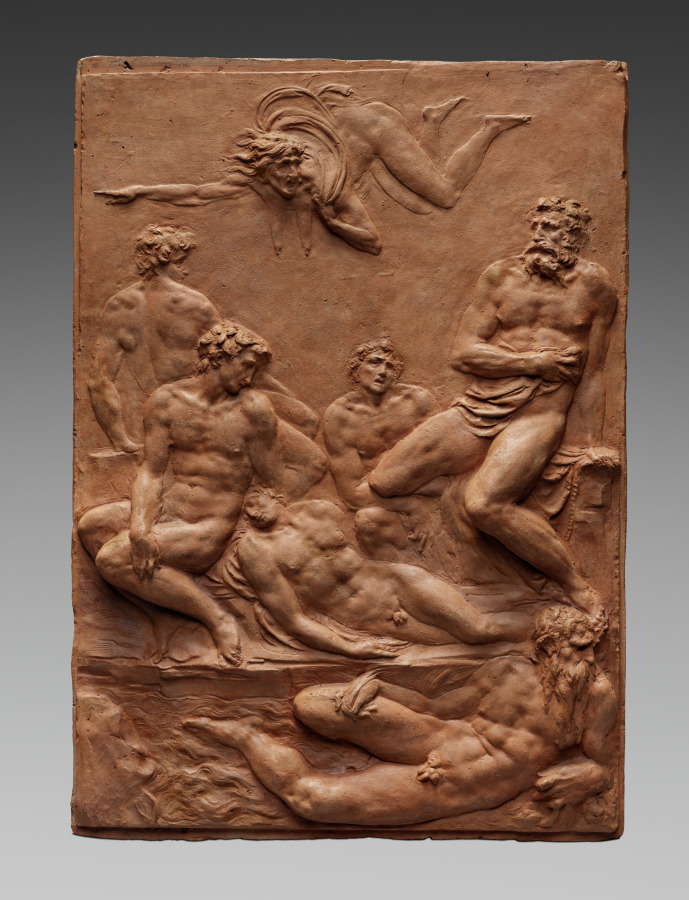
Urban Silhouette Research: The Death of Count Ugolino della Gherardesca and His Sons — Geometric Integrity and the 2026 Executive Silhouette
I. The Architecture of Confinement: A Study in Negative Space
The composition presents itself as a closed geometric system — a vertical tomb of interlocking bodies compressed within the architectural frame of the Hunger Tower. The Count's form occupies the apex of this human pyramid, his hunched spine describing a broken arch, while the sons' bodies below constitute a cascading series of diminishing arcs. This is not merely figuration; it is structural poetics rendered in flesh. The silhouette that emerges is one of deliberate compression — shoulders rounded forward, torso collapsed into a concave shell, the entire mass weighted downward by gravitational despair.
For the Addison executive, this translates into a silhouette defined not by expansion but by controlled contraction. The 2026 wardrobe demands garments that acknowledge the weight of contemporary leadership — the psychological burden of decision-making, the isolation of authority — through architectural means. The Ugolino silhouette proposes a shoulder line that slopes rather than squares, a torso that drapes rather than grips, and a hemline that pools rather than lifts. This is authority expressed through gravitas, not aggression.
II. Geometric Integrity: The Pyramid and Its Dissolution
The painting's geometric armature is fundamentally pyramidal — a form associated with permanence, monumentality, and hierarchical order. Yet Géricault (and here we reference the Romantic inheritance) subverts this stability by rendering the pyramid unstable, its edges blurred by chiaroscuro, its apex not triumphant but defeated. The Count's head, the pyramid's summit, is bowed — the geometry of power inverted into the geometry of suffering.
This inversion offers a critical lesson for urban materiality. The 2026 executive cannot afford the naive geometry of the power suit — the sharp shoulder, the rigid lapel, the unyielding line. Instead, Addison proposes a dissolved pyramid: garments whose structural integrity derives from internal tension rather than external rigidity. Consider a wool-cashmere overcoat with a dropped shoulder seam that follows the natural slope of the trapezius, its collar standing away from the neck like the tower's stone aperture. The silhouette is monumental yet permeable — a fortress that breathes.
III. Materiality of the Tower: Stone, Shadow, and the Urban Surface
The painting's material vocabulary is one of urban petrification — rough-hewn stone, iron bars, the cold intransigence of masonry. The flesh of the figures is rendered with a similar density, as though the bodies themselves have absorbed the mineral quality of their prison. This is materiality as destiny: the environment writes itself upon the body.
For Addison's 2026 collection, this suggests a palette of surfaces that evoke the urban condition without literal reference. Onyx — the color selected for this research — provides the chromatic foundation: a black that is not flat but layered, absorbing light rather than reflecting it, suggesting depth without transparency. The fabrics must follow suit: double-faced cashmere with a matte finish, brushed wool that catches shadow like stone catches moss, leather treated to resemble the patina of oxidized iron.
The tactile dimension is equally critical. The Ugolino figures are pressed against one another, their garments — where visible — are indistinguishable from their flesh. This collapse of textile into body proposes a radical intimacy of material and wearer. Addison interprets this as second-skin tailoring: garments cut so precisely that they cease to be objects and become extensions of the wearer's physical architecture. A coat that does not hang but adheres. A trouser that does not drape but follows.
IV. The Silhouette of Endurance: From Canto XXXIII to the Executive Uniform
The final consideration is temporal. The Count's tragedy is one of duration — the slow starvation, the prolonged witnessing of his sons' deaths, the eternity of his imprisonment in ice below. This is not a silhouette of the moment but of endurance. The 2026 executive, navigating perpetual uncertainty, requires garments that acknowledge time as a material force.
Addison's response is a silhouette that resists trend cycles through geometric permanence. The key pieces: a floor-length onyx overcoat with a single asymmetric closure, its interior lined in ivory silk — a hidden luminosity, like the single shaft of light in the tower. A column dress in slate wool, its surface interrupted only by a horizontal seam at the diaphragm — a breath line, a reminder of the living body within the architectural shell. A leather harness-belt, worn not as accessory but as structural element, cinching the waist like the iron bars of the tower window.
The geometric integrity of The Death of Count Ugolino lies in its refusal of resolution. The pyramid does not stand; it collapses. The bodies do not separate; they merge. The stone does not shelter; it entombs. For Addison Fashion, this is the definitive urban silhouette for 2026: a form that holds its shape through the tension of its own contradictions — monumental yet permeable, structured yet organic, onyx without and ivory within. The executive who wears this silhouette does not conquer the tower. She becomes it.