Urban Form: Seated Buddha (sculpture)
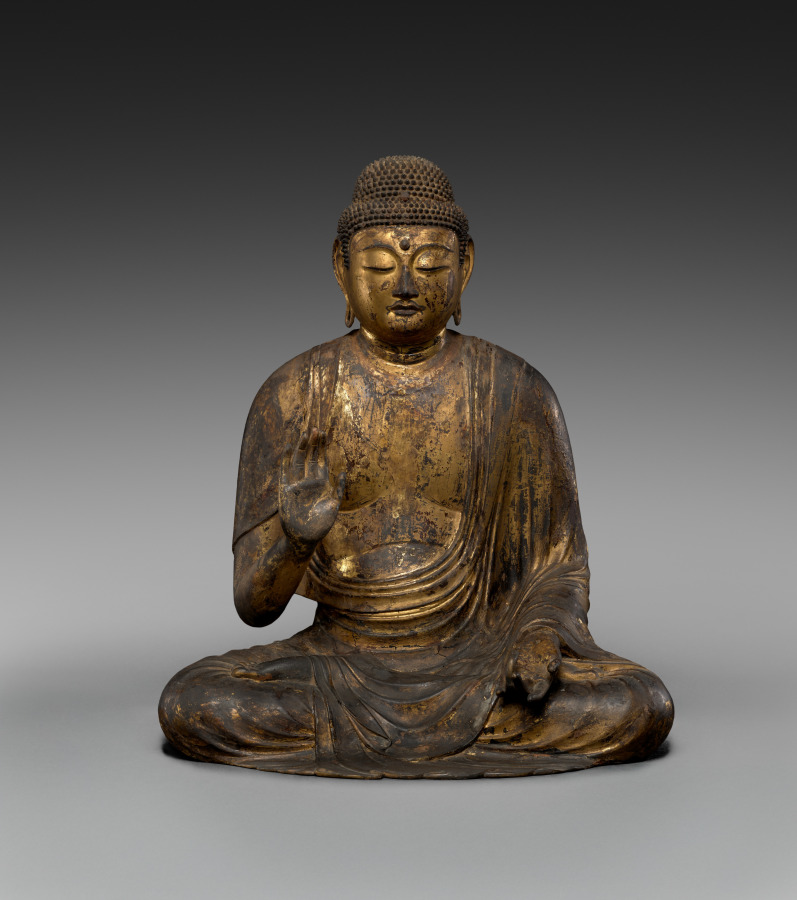
Urban Silhouette Research: The Seated Buddha as Structural Archetype
I. Formal Deconstruction: The Geometry of Stillness
The Seated Buddha presents a silhouette of radical economy. Its formal vocabulary is reducible to three primary masses: the cranial dome, the shoulder line, and the crossed-leg base. Each operates as a discrete architectural unit, yet the transitions between them are executed with a fluidity that negates any suggestion of assembly. For the Addison design team, this is the central lesson: monolithic form achieved through seamless articulation.
The shoulder line—broad, horizontal, and slightly descending—establishes the garment's primary axis. It is neither padded nor suppressed; it is declared. In the context of the 2026 executive wardrobe, this translates to a shoulder construction that asserts presence without aggression. The Buddha's shoulders do not compete with the head; they frame it. Similarly, the Addison blazer must frame the wearer's face without overwhelming it. The shoulder seam, therefore, migrates forward by approximately 1.5 centimeters, creating a subtle forward pitch that reads as attentive rather than rigid.
The crossed-leg base introduces a triangular foundation—the most stable geometric form in structural engineering. This triangulation is not merely decorative; it is load-bearing. The Buddha's posture is self-supporting, requiring no external armature. For the Addison silhouette, this informs the construction of the lower body: trousers and skirts that derive their shape from the wearer's stance rather than from interfacing or stiffening agents. The result is a garment that stands independently, yet collapses into fluidity when the body moves.
II. Chromatic Analysis: The Discipline of Onyx
The Seated Buddha's surface treatment—whether in bronze, stone, or lacquer—typically employs a monochromatic palette. This is not a limitation but a discipline. The absence of color variation forces the viewer to engage with form alone. Onyx, as a chromatic designation, operates within this same logic. It is not black; it is black activated—a hue that absorbs light rather than reflecting it, creating depth through negation.
In the Addison 2026 collection, Onyx serves as the foundational tone for the executive wardrobe. Its application is strategic: a single Onyx blazer over an Ivory silk shell, or Onyx trousers paired with a Slate cashmere knit. The Buddha's monochromatic surface teaches us that restraint amplifies impact. When the entire silhouette is rendered in Onyx, the eye is drawn to the cut, the drape, the proportion—not to the color. This is the essence of minimalist authority.
The Buddha's surface also reveals the importance of texture over hue. A matte Onyx wool absorbs light differently than a polished Onyx leather. The Addison wardrobe leverages this distinction: matte surfaces for daytime authority, subtle sheen for evening presence. The Buddha does not glitter; it resonates. Our fabrics must do the same.
III. The Container and the Contained: Sartorial Intertextuality
The Buddha as container—of breath, of consciousness, of stillness—offers a profound metaphor for the executive garment. The suit is not merely a covering; it is a vessel for the wearer's intent. The Buddha's robe does not cling; it accommodates. It creates a spatial buffer between the body and the world, a zone of privacy that is simultaneously a zone of power.
For 2026, Addison proposes a wardrobe built on this principle of generous containment. Jackets are cut with an additional 4 centimeters of ease through the chest and waist, allowing the fabric to drape rather than stretch. Trousers feature a higher rise and a wider leg, creating a columnar silhouette that echoes the Buddha's base. The wearer is not confined; she is housed.
This is not oversized dressing. Oversized implies excess; containment implies intention. The distinction is critical. The Buddha's robe is not too large—it is precisely calibrated to its purpose. Similarly, the Addison silhouette is engineered to the millimeter, ensuring that every fold and fall serves a function.
IV. The 2026 Executive Wardrobe: A Synthesis
Translating the Seated Buddha into a wearable collection requires a rigorous adherence to three principles:
1. Verticality. The Buddha's silhouette is vertically oriented despite its seated posture. The spine is erect, the neck is aligned, the crown is lifted. The Addison blazer must achieve the same effect: a clean vertical line from shoulder to hem, uninterrupted by darts or seams that break the visual flow. This is achieved through a single-piece back panel and a concealed closure system.
2. Weight. The Buddha's form has gravitas—a sense of mass that anchors it to the earth. The 2026 wardrobe must possess this same quality. Fabrics are selected for their density: double-faced wool, heavy silk crepe, bonded leather. The garment should feel substantial in the hand and on the body. Lightness is not the goal; presence is.
3. Silence. The Buddha does not speak, yet it communicates. The Addison wardrobe must achieve the same eloquence through omission. No logos, no hardware, no visible branding. The only signature is the cut itself—a shoulder line that is unmistakably Addison, a trouser break that is precisely calibrated, a collar that stands with quiet authority.
In the end, the Seated Buddha is not a religious object to be appropriated; it is a formal archetype to be studied. Its lessons are structural, chromatic, and philosophical. For the 2026 executive, the Addison silhouette offers not a costume but a condition—a state of being that is grounded, contained, and quietly powerful. The wardrobe does not shout. It resonates. And in the cacophony of the modern city, resonance is the ultimate luxury.