Urban Form: Portrait of Pope Innocent X Pamphili
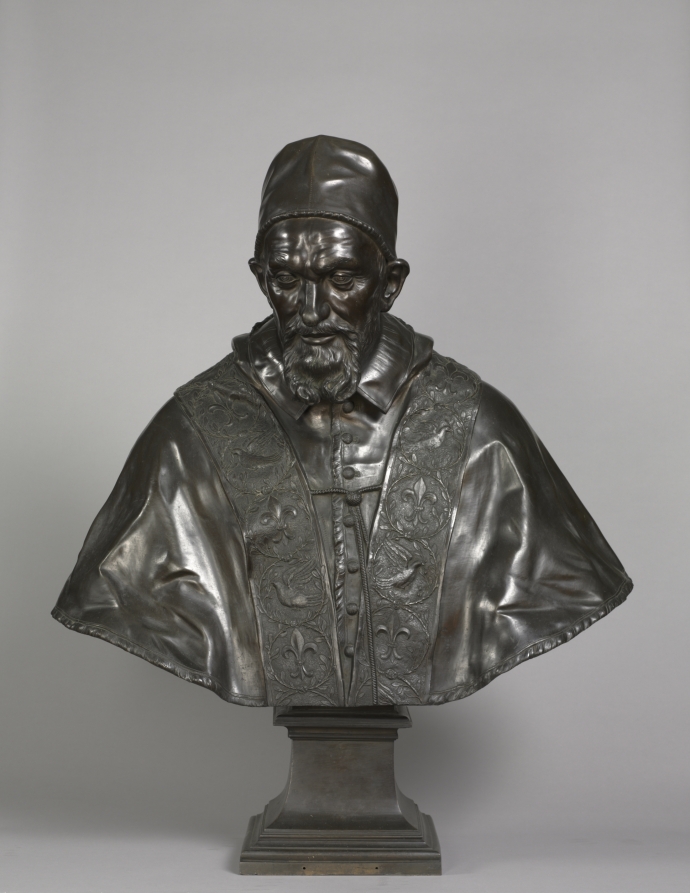
Urban Silhouette Research: The Innocent X Protocol — Form as Institutional Armor
I. Source Material: The Pamphili Portrait as Structural Artifact
Velázquez's Portrait of Pope Innocent X Pamphili (1650) is not a portrait. It is a load-bearing garment system rendered in oil. The subject's mozzetta and rochet function as a single architectural unit: a pyramidal mass that descends from the shoulders with the rigidity of cast concrete, interrupted only by the crimson silk's calculated drape at the chest. The camauro caps the composition with a dome-like closure, sealing the figure into a self-contained monolith. This is the ur-text of executive presence — authority expressed not through ornament but through volumetric certainty.
The DNA source — the Egyptian mold fragment and coffin platform — provides the chromatic and rhythmic counterpoint. The mold fragment's incised lines, compressed into a palm-sized shard, demonstrate how maximum expressive tension can be achieved through minimum material. The coffin platform's repeating scarab-and-sun-disc registers offer the opposing logic: seriality as permanence. Innocent X synthesizes both. The portrait's face — alert, suspicious, unyielding — is the mold fragment's captured instant. The vestments — layered, symmetrical, codified — are the coffin platform's eternal order. The garment becomes the interface between the transient body and the institutional body.
II. Chromatic Analysis: Onyx as Chromatic Null Set
The Addison palette for this research is Onyx — not black, but the color of compressed carbon under institutional pressure. Onyx absorbs light without reflecting it, creating a chromatic vacuum that forces the eye to read silhouette rather than surface. In the Pamphili portrait, the crimson mozzetta performs this function through saturation; in the 2026 executive wardrobe, Onyx achieves the same through absolute tonal density.
The Egyptian mold fragment's terracotta surface — degraded, fragmentary, monochromatic — reinforces this principle. Its power derives from the absence of chromatic distraction. The coffin platform's polychromy, by contrast, operates through systematic repetition: each color unit is identical, creating rhythm through redundancy. The Addison translation is a wardrobe built on Onyx as the dominant register, with Ivory and Sand appearing only as structural interruptions — a collar edge, a cuff line, a single horizontal band — echoing the coffin platform's serial logic without its decorative excess.
III. Silhouette Engineering: The Pyramidal Descent
The Pamphili silhouette is defined by a single geometric proposition: the shoulders establish the maximum width, and every subsequent element — mozzetta, rochet, stole — descends in controlled, incremental reduction. This is not the inverted triangle of athletic menswear. It is a pyramidal descent, where volume is concentrated at the top and released gradually toward the hem. The result is a figure that appears to be anchored rather than clothed.
For the 2026 NYC executive wardrobe, this translates to outerwear with fixed shoulder architecture — not padded, but structured, using canvas interlining and horsehair to create a shoulder line that does not collapse under movement. The coat or jacket must maintain its pyramidal integrity whether the wearer is seated at a boardroom table or standing at a podium. The Egyptian mold fragment's lesson applies here: the contour must be legible even when the material is fragmentary. A single seam, a single fold, must carry the entire structural argument.
IV. The Rhythm of Repetition: Coffin Platform Logic in Tailoring
The coffin platform's horizontal panel operates through serial repetition of identical units — scarab, sun disc, hieroglyph, scarab, sun disc, hieroglyph. This is not decoration; it is a visual metronome, establishing a tempo that the viewer's eye follows unconsciously. The Pamphili portrait employs the same logic in its vestment layers: each garment tier (rochet, mozzetta, stole) repeats the previous tier's silhouette at a reduced scale, creating a rhythmic descent from shoulder to hem.
The 2026 Addison executive wardrobe must internalize this principle. Repetition of proportion, not pattern. A suit jacket, a topcoat, a scarf — each should echo the same shoulder-to-hem ratio, the same closure placement, the same pocket geometry. The wearer becomes a walking serial composition, each layer reinforcing the last. This is how institutional presence is constructed: not through a single statement piece, but through the relentless consistency of a system.
V. The Fragment as Complete Statement
The Egyptian mold fragment is broken. Its edges are irregular. Its surface is worn. Yet it communicates a complete aesthetic proposition — the musician's posture, the instrument's angle, the rhythm of the performance — through the most economical means possible. This is the final lesson for the Addison executive wardrobe: the garment must function as a fragment of a larger system, yet be complete in itself.
A single Onyx jacket, worn with nothing else, must convey the full weight of the Addison proposition: authority through restraint, presence through absence, permanence through the repetition of a single, perfectly resolved form. The Pamphili portrait does not need its background. The mold fragment does not need its missing half. The 2026 executive does not need embellishment. Onyx. Pyramidal descent. Serial proportion. The rest is noise.