Urban Form: Statue of an Athlete
Urban Silhouette Research: The Athlete as Vessel — Geometric Integrity and the 2026 Executive Form
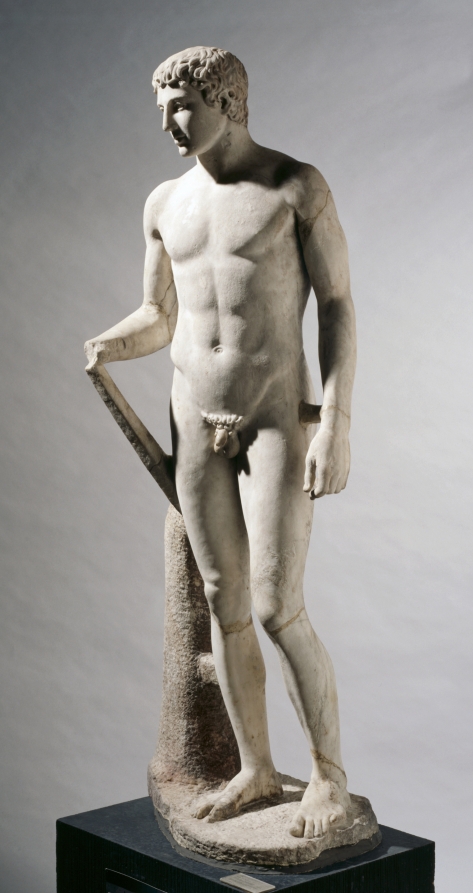
The subject under examination—a statue of an athlete—presents a paradox that Addison Fashion considers essential to the 2026 executive wardrobe. Unlike the dynamic torsion of Myron's Discobolus or the triumphant musculature of the Doryphoros, this figure operates within a register of contained tension. The athlete does not perform. The athlete is. This distinction—between action and state—forms the philosophical armature upon which we construct the coming season's silhouette.
I. The Geometry of Contained Force
Examine the statue's structural logic. The weight distribution is asymmetrical yet balanced—a contrapposto resolved into architectural stillness. The shoulders describe a horizontal plane that refuses to tilt. The pelvis locks into a counter-rotation that stabilizes the entire composition. What emerges is not a body in motion but a body as architecture: load-bearing, self-supporting, indifferent to the viewer's desire for narrative.
This is the geometric integrity we pursue. The 2026 executive silhouette must function as a load-bearing structure. It does not drape; it stands. Consider the shoulder line of our forthcoming Onyx wool-cashmere overcoat: a single horizontal seam, unbroken, extending from acromion to acromion with the precision of a Doric entablature. The waist suppression is minimal—a 2cm reduction at the natural waist, sufficient to suggest form without capitulating to the body's softness. The result is a silhouette that reads as object before it reads as garment.
This is not minimalism as absence. This is minimalism as concentration. Every seam must justify its existence. Every dart must perform structural labor. The athlete's body, after all, is not simple—it is the product of thousands of hours of disciplined repetition, each muscle fiber a decision made and remade. Our tailoring must reflect this same logic: invisible complexity resolving into apparent simplicity.
II. Materiality and the Urban Surface
The statue's surface demands equal scrutiny. Whether bronze, marble, or terracotta, the athlete's skin presents a patina—a record of time's passage through oxidation, weathering, or the accumulated touch of centuries. This surface is not decorative. It is evidence.
For 2026, Addison Fashion translates this principle into textile selection. Our Onyx palette draws from the deepest registers of oxidized bronze—not flat black, but a black that absorbs and reflects in equal measure, that shifts from matte to near-lustrous depending on the angle of urban light. The fabrics themselves must carry this same temporal weight: double-faced cashmere with a hand that suggests geological compression; technical wool bonded to a micro-membrane that renders the garment impervious to rain while maintaining a dry, architectural hand; silk-cotton blends that crease intentionally, the fold lines becoming part of the garment's evolving geometry.
The urban environment is not a backdrop. It is a co-author. The executive who wears our garments navigates spaces of concrete, glass, and steel—surfaces that reflect, refract, and distort. Our silhouettes must hold their integrity against these conditions. A shoulder that collapses under fluorescent light is a failed shoulder. A lapel that loses its roll in humidity is a failed lapel. The athlete's statue survives because its geometry is absolute. Ours must do the same.
III. The Vessel and the Void
Here we arrive at the internal DNA of this research: the dialogue between David's Death of Socrates and the Greek Jar. The painting presents death as spectacle—a fully articulated narrative of heroism, grief, and philosophical transcendence. The jar presents death as containment—a silent vessel whose value lies not in what it depicts but in what it holds, and ultimately, in its emptiness.
The 2026 executive silhouette must function as the jar, not the painting. It must not narrate the wearer's authority; it must contain it. The garment is a vessel for presence, not a costume for performance. This requires a radical subtraction of decorative gesture. No visible branding. No superfluous hardware. No rhetorical flourishes in cut or construction. The silhouette must achieve what the athlete's statue achieves: a form so resolved that it appears inevitable.
Consider the interior of our garments—the lining, the seam finishes, the pocket bags. These are the void of the vessel, the space that makes the object useful. They must be executed with the same rigor as the exterior. A jacket whose interior is chaotic cannot contain the wearer's composure. The executive who removes her coat in a boardroom reveals not just a blouse but a system—a coherent philosophy of dress that extends from the public surface to the private architecture beneath.
IV. The 2026 Silhouette: A Provisional Specification
From this analysis, we derive the following structural directives for the 2026 executive silhouette:
Shoulder: Extended by 1.5cm beyond the natural shoulder point. Unpadded but structured through internal canvas and a single layer of horsehair. The shoulder line must read as a continuous horizontal, unbroken by sleeve-head gathering or roping.
Torso: Semi-fitted through the waist, with a 2cm suppression at the natural waist and a 4cm flare at the hip. The torso must suggest a column—stable, vertical, indifferent to the body's movement beneath.
Length: Jackets terminate at the mid-thigh, creating a 3:5 ratio between upper and lower body. This proportion references the athlete's statue: the legs are not emphasized but implied, the garment's hem creating a horizon line that grounds the figure.
Material: Onyx-dyed double-faced cashmere for outerwear; matte technical wool for tailoring; silk-cotton poplin for shirting, with a hand that suggests paper rather than fabric.
Detail: None that does not perform structural or functional labor. Every visible element—button, seam, pocket—must justify its presence through utility or geometry.
V. Conclusion: The Athlete as Paradigm
The statue of the athlete teaches us that presence is not performance. It is structure. The 2026 executive does not need to signal authority through excess. She needs garments that contain her authority as the jar contains wine—silently, completely, without alteration of the contents.
Addison Fashion's Urban Silhouette for 2026 is not a departure. It is a distillation. We remove what does not serve the geometry. We retain what does. The result is a wardrobe that functions as the athlete's body functions: as a vessel for disciplined presence, a structure that holds its form against time, weather, and the indifferent gaze of the city.
The jar does not explain. The jar contains. Our garments must do the same.