Urban Form: Prayer Nut with Scenes from the Life of St. James the Greater
Urban Silhouette Research: The Prayer Nut as Structural Paradigm
I. Object Analysis: The Microcosmic Architecture
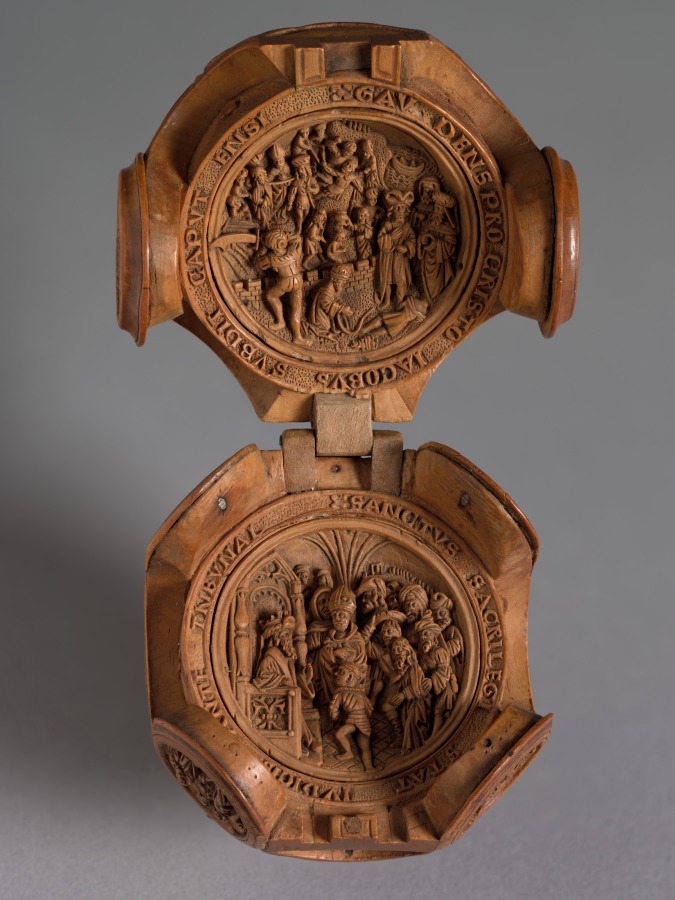
The Prayer Nut with Scenes from the Life of St. James the Greater—a carved boxwood sphere, approximately 4 centimeters in diameter, hinged and opened to reveal interior micro-reliefs—constitutes one of the most radical exercises in spatial compression within the late-medieval Northern European canon. Its exterior presents a closed, unbroken curvature; its interior, once opened, discloses a complete narrative architecture: diminutive figures, architectural canopies, and hagiographic scenes carved with a precision that defies the limits of the material. The object is, in essence, a building disguised as a bead—a portable cathedral compressed into the palm.
The geometric integrity of this artifact resides in its dual-state morphology. In its closed configuration, the Prayer Nut operates as a perfect sphere—a form of absolute containment, devoid of external ornamentation that might betray its interior complexity. The surface is carved with a reticulated Gothic tracery, a lattice that functions simultaneously as decoration and as structural armature. This is not surface applied to form; this is surface as form. The tracery creates a permeable membrane between exterior and interior, a threshold condition that prefigures the architectural logic of the opened state.
When opened, the two hemispheres separate along a precise equatorial hinge, revealing an interior that is not merely carved but constructed. The micro-architectural elements—vaulted canopies, foliate capitals, narrative tableaux—are organized according to a spatial hierarchy that mirrors full-scale Gothic ecclesiastical planning. The interior is not a cavity; it is a nave. The hinge is not a mechanism; it is a crossing. The Prayer Nut, therefore, is not a sculpture of architecture but an architecture of sculpture—a conflation of object and edifice that dissolves the boundary between the portable and the monumental.
II. Structural Poetics: Containment and Disclosure
The operative principle of the Prayer Nut is latency. Its aesthetic power is contingent upon the tension between what is visible and what is withheld. In its closed state, the object presents a disciplined exterior—a sphere of reticence, a geometry of silence. The viewer apprehends the object as a unified whole, a singular volume whose internal logic remains inaccessible. This is the poetics of the sealed: the refusal of immediate disclosure, the insistence that meaning requires an act of opening, a deliberate gesture of access.
This structural duality—closed exterior, narrative interior—maps directly onto the executive silhouette for 2026. The Addison wardrobe must operate as a system of controlled revelation. The exterior garment—the overcoat, the structured jacket, the architectural trench—functions as the closed hemisphere: a surface of disciplined geometry, devoid of gratuitous ornament, its power residing in proportion, material integrity, and the precision of its construction. The interior—the lining, the layered understructure, the concealed fastening—constitutes the narrative hemisphere: the private architecture of the wearer, visible only upon deliberate disclosure.
The hinge, in this analogy, is the point of transition: the lapel that folds back, the vent that opens with movement, the cuff that reveals the wrist. These are not decorative gestures; they are structural thresholds that mediate between the public and the private, the displayed and the withheld. The 2026 silhouette must be designed around these thresholds—not as afterthoughts but as primary architectural events.
III. Urban Materiality: Boxwood, Patina, and the Ethics of Surface
The Prayer Nut is carved from boxwood—a material of extreme density, fine grain, and remarkable dimensional stability. Boxwood does not forgive error; its hardness demands precision, and its homogeneity rewards restraint. The material is, in itself, an argument for minimalist intervention: the carver does not impose form upon the wood but rather removes material to reveal the form latent within. This is subtractive logic, the ethics of carving as disclosure rather than construction.
For the 2026 executive wardrobe, this translates into a material philosophy of essential surfaces. The fabrics must possess the density and integrity of boxwood: tightly woven wool, high-twist gabardine, bonded leather, technical silk. These are materials that do not require embellishment; their beauty resides in their inherent structure—the way a double-faced cashmere holds an edge, the way a matte-finish technical fabric absorbs light rather than reflecting it. The surface must be self-sufficient, capable of sustaining visual interest through texture, weight, and drape alone.
Furthermore, the Prayer Nut acquires meaning through patina—the gradual accumulation of wear, the darkening of the wood at points of contact, the softening of edges through handling. This is not degradation; it is biography. The object records its own history in its surface. The 2026 Addison silhouette must be designed with the same expectation: garments that improve with wear, that develop character through use, that resist the disposability of trend cycles. The urban environment is abrasive; the executive wardrobe must be abrasion-resistant—not in the sense of durability alone, but in the sense of aesthetic resilience, the capacity to absorb the city and return it as patina.
IV. Geometric Integrity and the 2026 Silhouette
The Prayer Nut's geometry is defined by the sphere—a form of perfect containment, self-referential and complete. But it is also defined by the hinge—a line of rupture, a seam of potential. The 2026 silhouette must negotiate between these two geometric imperatives: the closed volume and the open narrative, the unified form and the articulated structure.
This suggests a silhouette characterized by modular coherence: garments composed of distinct architectural components—the shoulder, the torso, the sleeve—each with its own geometric integrity, yet unified by a systemic logic of proportion and material. The shoulder must be carved, not padded; the torso must be structured, not constricted; the sleeve must be articulated, not tubular. The silhouette is not a single shape but a composition of shapes, each resolved in relation to the others.
The color palette follows from the material logic: Onyx as the primary tone—a black that is not flat but deep, absorbing light, suggesting the density of boxwood. Onyx is the color of containment, of the closed hemisphere, of the disciplined exterior. It is the color of the urban night, of polished stone, of the executive surface that reveals nothing and suggests everything. Against this ground, the interior—the lining, the underlayer—may introduce contrast: a flash of ivory, a whisper of silver, the muted warmth of sand. But these are interior events, visible only upon opening, accessible only through the deliberate gesture of disclosure.
V. Conclusion: The Object as Proposition
The Prayer Nut with Scenes from the Life of St. James the Greater is not merely a historical curiosity; it is a proposition—a statement about the relationship between containment and disclosure, between surface and structure, between the portable and the monumental. It argues that the smallest object may contain the largest architecture, that the most disciplined exterior may conceal the most elaborate interior, that the hinge is as significant as the sphere.
For Addison Fashion, this object defines the 2026 executive silhouette as a system of latent architectures: garments that operate on multiple levels of visibility, that reward attention, that demand interaction. The silhouette is not a statement but a structure—a geometry of containment and release, a materiality of density and patina, a poetics of the closed and the opened. The executive who wears this silhouette does not merely dress; she inhabits—a portable architecture, a microcosm of urban order, a Prayer Nut for the modern city.