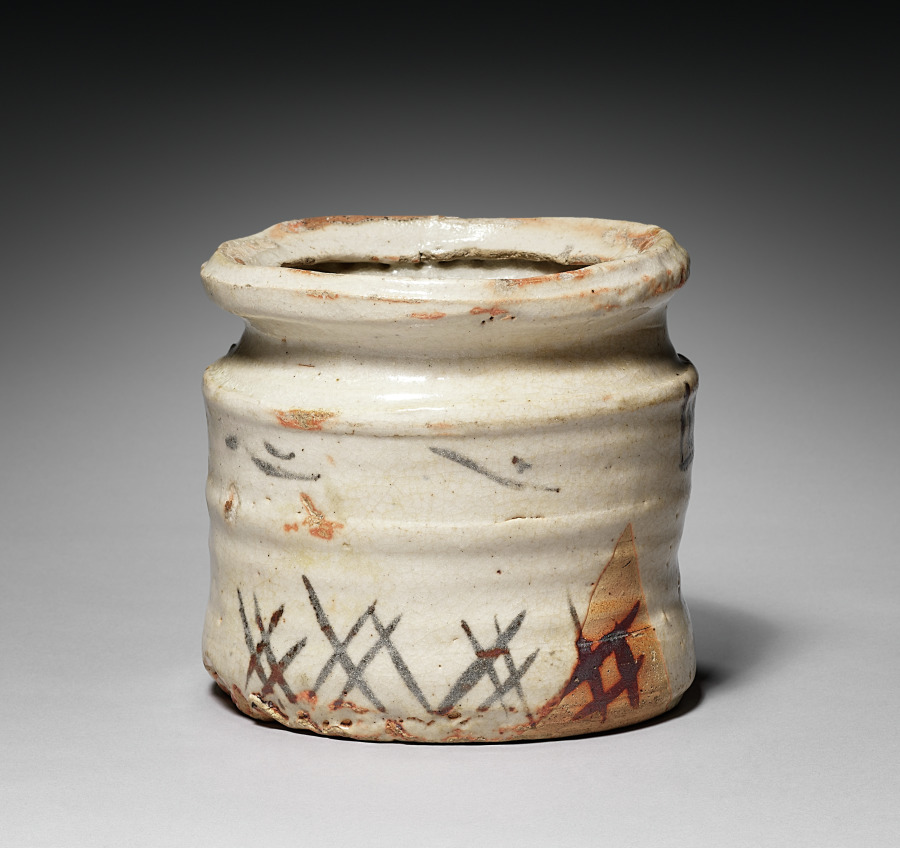
Urban Form: Water Container (Mizusashi) with Riverscape
Urban Silhouette Research: The Mizusashi Riverscape as Architectural Precedent
I. The Vessel as Silhouette: Rectilinear Discipline
The Addison 2026 executive wardrobe does not begin with the body. It begins with the container. The Mizusashi with Riverscape—a water vessel whose function is ritual, whose form is architectural—offers the definitive study in rectilinear discipline. Observe the vessel's profile: a compressed cylinder, its walls rising with the exacting verticality of a Muromachi-era tea room pillar. There is no taper, no concession to ergonomic softness. The silhouette is a column of intent.
This is the geometric integrity we translate into tailoring. The 2026 executive jacket abandons the waist suppression of the previous decade. Instead, it adopts the Mizusashi's parallel verticality—shoulder seam and hem falling in unbroken alignment, the torso encased as if poured into a ceramic mold. The result is not armor but architecture: a wearable structure that frames the wearer's authority without ornament. The riverscape painted across the vessel's surface—those meandering bands of slate and silver—becomes our tonal gradient: a single hue, modulated across panels, creating depth through material variation rather than cut.
II. The Riverscape as Material Logic: Slate, Silver, and the Poetics of Surface
The Mizusashi's riverscape is not a landscape. It is a meditation on flow within constraint. The painter's brush never breaches the vessel's rim; the river bends, pools, and vanishes into the ceramic's matte ground. This is the decorative sublime—ornament that does not distract but elevates, that turns a functional object into a spatial proposition.
For Addison's 2026 collection, we adopt this logic at the level of urban materiality. The executive coat in slate wool receives a silver-thread jacquard at the inner placket—visible only when the wearer moves, a river revealed in the garment's private geography. The trousers, cut with the Mizusashi's cylindrical severity, feature a hand-painted hem in graduated graphite, echoing the vessel's base where the glaze pools darkest. These are not embellishments. They are structural poetics: the garment's meaning resides in its interstitial details, not its silhouette alone.
The vessel's lid—a flat disc with a single knob—informs our accessory protocol. Bags are rectangular, hard-edged, and unadorned, their surfaces treated with a matte mineral finish that absorbs light rather than reflecting it. The executive does not sparkle. The executive contains.
III. The Safina Codex and the Juggler: Between Text and Motion
The internal DNA of this research draws from two unlikely sources: the Safina, that Persian anthology whose very name means "ship" and "treasure box," and the Renaissance painting of the juggler, suspended between gravity and grace. Both inform the kinetic minimalism of the 2026 silhouette.
The Safina's rectangular format—tall, narrow, portable—is the proportional template for our outerwear. The coat's length is not arbitrary; it is derived from the codex's golden-section ratio, falling to mid-calf to elongate the vertical line. The Nasta'liq script that dances across its pages, its letters suspended in white space, teaches us the value of negative space in tailoring. The 2026 jacket is sparsely detailed: a single seam, a hidden closure, a collar that stands away from the neck like a page lifted by a breeze.
The juggler contributes the principle of dynamic balance. His balls, frozen mid-arc, are the points of tension in our garments: the dart that disappears into a fold, the pocket that aligns with the hip bone, the cuff that breaks exactly at the wrist. These are not static solutions. They are moments of poise, designed to read as effortlessly suspended even when the wearer is in motion. The executive does not rush. The executive hovers.
IV. The 2026 Executive Silhouette: A Definition
The Addison 2026 silhouette is Minimalist in category, Slate in color, and architectural in intent. It rejects the fluid drape of the 2020s and the aggressive volume of the 2010s. It returns to the vessel: a form that holds, that protects, that frames the void within.
Key specifications:
Shoulder: Unpadded, extended by 1.5 cm, seam pressed open and flat.
Torso: Straight cut, no waist suppression, side vents to the hip.
Fabric: Slate wool crepe, 340 g/m, with a silver jacquard inner facing.
Length: Mid-calf, derived from the Safina's 3:5 ratio.
Detail: One hidden placket, one interior pocket, one hand-painted hem.
Accessory: Rectangular bag, matte mineral finish, no hardware.
This is not a costume. This is equipment for the urban sublime. The wearer does not dress to be seen. The wearer dresses to contain multitudes—rivers, poems, the suspended breath of the juggler—and to carry them through the city with the cold grace of a ceramic vessel that has survived centuries of use.
The Mizusashi does not leak. Neither does the Addison executive.