Urban Form: Enthroned Virgin and Child
Urban Silhouette Research: The Enthroned Virgin and Child as Architectural Prototype
I. Geometric Integrity: The Throne as Load-Bearing Metaphor
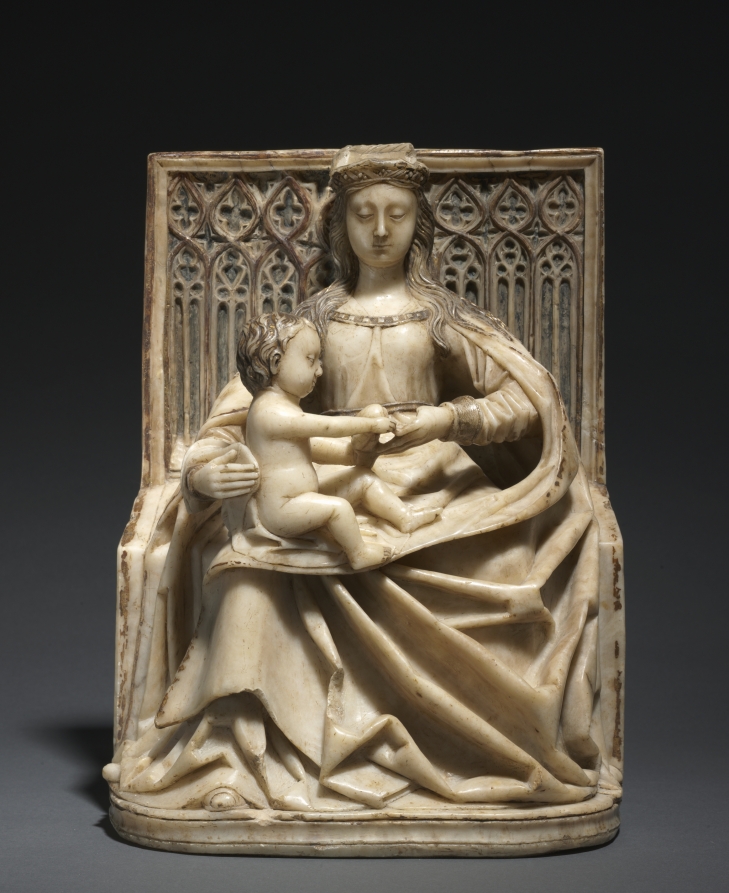
The Enthroned Virgin and Child—in its most canonical Romanesque and early Gothic iterations—presents a silhouette of uncompromising frontal symmetry. The Virgin is not seated so much as architecturally installed. Her body functions as a central column; the throne behind her operates as a shallow apse, a semicircular niche that frames and contains. The Child sits not as an infant but as a rigid, miniature emperor—a secondary volume nested within the primary mass. This is not a portrait of maternity. It is a structural diagram of authority.
For Addison Fashion’s 2026 executive silhouette, the lesson is precise: the shoulder line must echo the throne’s horizontal backrest—broad, flat, unapologetic. The torso must descend as a monolithic plane, neither cinched nor exaggerated. The lap, where the Child rests, becomes a shelf—a functional horizontal that breaks the vertical fall. In tailoring terms, this translates to a columnar coat with a defined but not suppressed waist, a squared shoulder, and a hem that stops just below the knee to preserve the throne’s block-like proportion. The silhouette is not fluid. It is carved.
II. Structural Poetics: Negative Space as Devotional Luxury
The genius of the Enthroned Virgin composition lies in its negative space. The void between the Virgin’s right arm and her torso, the gap between the throne’s armrests and her hips, the dark recess behind the Child’s head—these are not accidents of carving. They are breathing chambers within a dense iconographic program. The sculpture does not fill its own volume; it curates emptiness.
For urban materiality, this translates to a design philosophy of strategic omission. The 2026 executive wardrobe must resist the impulse to add. A coat should have one closure, not three. A trouser should have a single pleat, not a cluster. A bag should have no visible hardware beyond a single magnetic seam. The negative space—the gap between a cuff and a glove, the slit in a skirt that reveals the boot beneath—becomes the luxury. In a city of visual noise, the Addison silhouette whispers through its silences.
Consider the Virgin’s mantle: a single, unbroken plane of fabric that drapes from crown to floor. No darts interrupt its fall. No seams disrupt its gravity. This is the uninterrupted line—the holy grail of minimalist tailoring. For 2026, we propose a floor-length column dress in double-faced Onyx wool, cut on the bias only at the side seams, with a single vertical slit at the back for stride. The front remains a monolith. The back reveals the architecture of movement.
III. Urban Materiality: Stone, Wood, and the New Executive Armor
The original sculpture is polychrome wood or stone—materials that age, crack, and acquire patina. They are not pristine. They are witnessed. For Addison Fashion, the 2026 executive does not seek the sheen of newness. She seeks the authority of endurance. This demands materials that hold shape without rigidity: heavy crepe, bonded wool, vegetable-tanned leather that darkens at the touch points. The color palette is Onyx—not black, but the deep, light-absorbing black of a cathedral shadow. Slate and Silver are permitted only as accent: a single cufflink, a knife-edge collar, a belt buckle no wider than a thumb.
The throne itself—often carved with lion heads or geometric arcades—offers a lesson in micro-architecture. The 2026 executive does not wear patterns. She wears structures. A jacket lapel may be pick-stitched in a subtle arcade motif. A boot heel may be carved to echo a column base. These are not decorations. They are load-bearing details—visible only upon close inspection, invisible from across a boardroom.
IV. The Child as Accessory: Proportional Discipline
The Christ Child in these compositions is never proportional. He is either too large or too small, too adult or too doll-like. This deliberate disproportion serves a theological purpose: the human and divine cannot be reconciled by measurement. For fashion, the lesson is about accessory scale. The 2026 executive does not carry a tiny bag. She carries a proportional counterweight—a structured tote whose width equals the distance between her shoulder points, whose depth equals the length of her forearm. The bag is not an afterthought. It is the Child: a secondary volume that completes the composition.
V. Conclusion: The Enthroned Silhouette as Urban Armor
The Enthroned Virgin and Child is not a maternal image. It is a seat of power rendered in wood and pigment. For Addison Fashion’s 2026 executive, the translation is direct: dress as if you are seated on a throne that no one else can see. The shoulders square. The spine vertical. The negative spaces deliberate. The materials heavy enough to hold their own shape against the wind of a city avenue. This is not comfort. This is composure. And composure, in the urban landscape, is the only luxury that cannot be purchased—only constructed.
The silhouette is Onyx. The geometry is frontal. The poetics are silent. The executive has arrived.