Urban Form: Saint John the Baptist
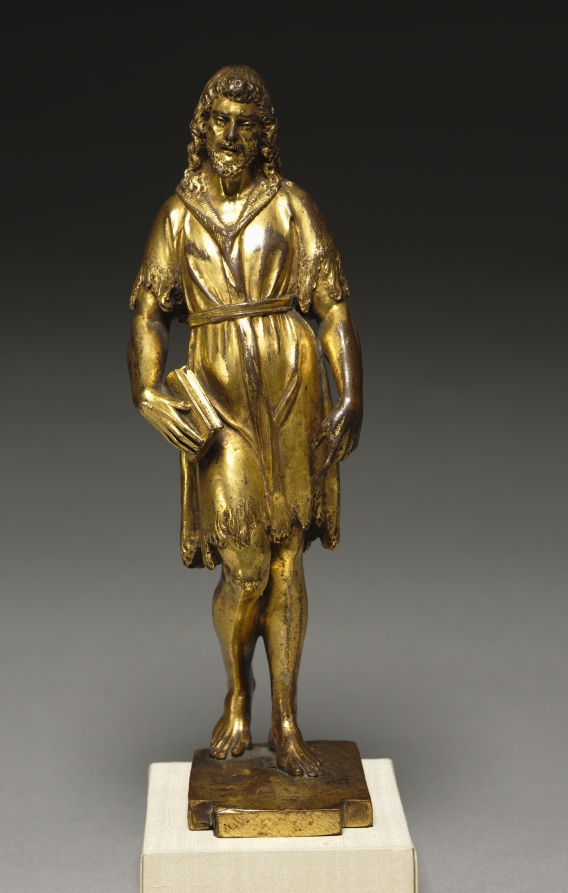
Urban Silhouette Research: Saint John the Baptist — Form as Ritual, Color as Silence
I. The Archive as Strategic Asset
The Addison Fashion NYC design intelligence apparatus has elected to interrogate a subject whose iconographic DNA is, at first glance, irreconcilable with the commercial imperatives of the 2026 executive wardrobe: Saint John the Baptist. Yet the Baptist is not a devotional figure in this analysis. He is a silhouette proposition — a study in radical reduction, in the elimination of surplus, in the authority of the unadorned form. He is, in the language of our atelier, the original minimalist.
To excavate this proposition, we have sourced two artifacts of profound civilizational distance: the Mold Fragment with Musicians held by the British Museum, and the Chinese funerary painting Mortuary Figure of the Zodiac Sign: Ox (Taurus). One originates in the ritual acoustics of Mesopotamia; the other in the cosmological bureaucracy of the Han dynasty. They share no geography, no theology, no material substrate. What they share — and what this research isolates — is a methodology of form: the deliberate subtraction of naturalistic detail in service of a higher-order symbolic contour. This is the methodology Addison Fashion imports into the 2026 executive silhouette.
II. The Mold Fragment: Rhythm as Structural Discipline
The Mold Fragment with Musicians presents a lateral frieze of instrumentalists — harp, flute, percussion — rendered in a near-geometric abbreviation of the human body. The shoulders are arcs. The necks are vectors. The hands, gripping instruments, are reduced to functional nodes. This is not anatomical failure; it is anatomical editing. The sculptor has performed a cost-benefit analysis on every line: each retained stroke must justify its presence through rhythmic contribution. The result is a contour that behaves like music — continuous, legible, and structurally load-bearing.
Critically, the artifact is a mold. It is a negative form designed for replication. Its aesthetic value is inseparable from its reproductive function. This duality — the singular gesture and the repeatable system — is the precise tension Addison Fashion resolves in its tailoring architecture. A blazer is a mold. A trouser block is a mold. The executive wardrobe is a replication system for authority, and its silhouettes must therefore be engineered with the same economy as the Mesopotamian frieze: no line without rhythmic purpose, no volume without structural justification.
III. The Ox of the Zodiac: Cosmological Compression
The Mortuary Figure of the Zodiac Sign: Ox operates in an adjacent but distinct register. Here the animal form is not observed but encoded. The ox is Taurus; Taurus is a celestial coordinate; the celestial coordinate is a station in the funerary itinerary of the deceased. The horns curve toward the sky not as zoological fact but as astronomical notation. The body is compressed into a decorative line system that reads simultaneously as beast, constellation, and calendar.
This is compression as metaphysics. The Han painter has collapsed the biological ox, the seasonal ox, and the cosmic ox into a single graphic proposition. For Addison Fashion, this establishes the second principle of the 2026 silhouette: the garment must function as a compressed symbol system. A single slate overcoat must simultaneously encode professional rank, seasonal appropriateness, and personal restraint. It must be legible at the distance of a boardroom and at the distance of a constellation.
IV. The Baptist as Synthesis: The Silhouette of Reduction
Saint John the Baptist occupies the intersection of these two methodologies. His iconographic tradition — camel hair, leather girdle, the wilderness — is a tradition of deliberate insufficiency. He is the figure who subtracts until only the prophetic function remains. In the visual arts, he is consistently rendered with a contour that is lean, vertical, and unadorned — a human mold for a message, a body compressed into a sign.
The Baptist thus provides the silhouette thesis for the 2026 executive wardrobe: authority is not accumulated; it is distilled. The Addison Fashion woman does not dress to display resources. She dresses to display resolution. Her silhouette is a mold — repeatable, disciplined, rhythmically coherent. Her palette is a compression — slate, onyx, ivory — each tone a station in a personal cosmology of restraint.
V. Technical Translation: The 2026 Executive Wardrobe
Form. The shoulder line adopts the arc logic of the Mesopotamian frieze: a continuous curve from neck to deltoid, unbroken by padding excess. The torso is compressed — not tight, but edited — with a vertical seam structure that echoes the Baptist's columnar iconography. The trouser is a mold: a single block, replicated across the season, with the hem line functioning as the ox's horn — a terminal curve that points outward, toward the future, without ornament.
Color. Slate is the operative tone. It is neither the black of mourning nor the grey of indecision. It is the color of stone that has been carved — the color of a mold that has been used. It absorbs light the way the Han ox absorbs the night sky: quietly, completely, with the confidence of a form that has already been decided.
Material. The fabric must behave like clay before firing: responsive to the hand, capable of holding an edge, and permanent once set. We specify a double-faced wool in slate, with a hand that recalls the burnished surface of the mold fragment — matte, dense, and acoustically silent. The garment should make no sound when the wearer moves. It should only make an impression.
VI. Conclusion: The Bridge Between the Two Moons
The Mold Fragment celebrates life through rhythm. The Ox of the Zodiac consoles death through order. The Baptist stands between them, reducing both to a single vertical proposition. Addison Fashion's 2026 executive wardrobe is the commercial instantiation of that proposition: a slate-colored system of forms in which celebration and consolation are indistinguishable, and in which the executive silhouette becomes — finally — a quiet, repeatable, and authoritative act of ritual.