Urban Form: Shri Raga, from a Ragamala
The Urban Silhouette Research: Shri Raga and the Architecture of Restraint
I. Preliminary Geometry: The Ragamala as Structural Codex
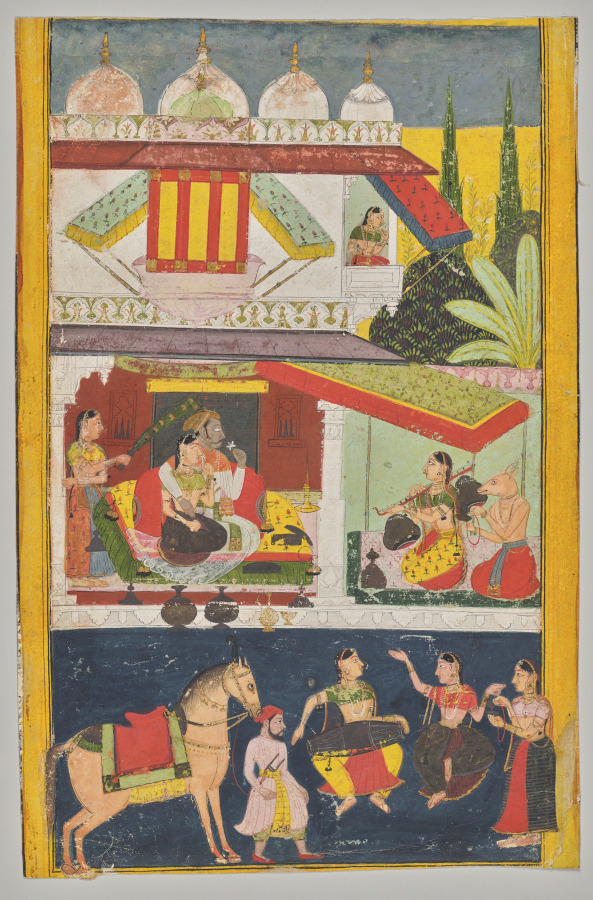
The Shri Raga folio from a Ragamala series presents itself not as a narrative illustration but as an architectural proposition. The composition is governed by a rigorous verticality: the central figure seated upon a terraced pavilion, the columnar alignment of the architecture, the stacked registers of sky and horizon. This is not decoration. This is load-bearing geometry. For the Addison 2026 executive wardrobe, the Shri Raga offers a masterclass in how the human body may be framed—not confined—by structural intent.
The figure's posture is the first datum. The torso is held in a state of suspended tension, neither rigid nor relaxed, the spine articulating a vertical axis that extends from the seat through the crown of the head. This is the posture we demand of the Addison executive: a silhouette that does not collapse into the body but rather constructs a parallel architecture around it. The shoulders in the painting are not sloped; they are planed, meeting the neck at an angle that suggests both authority and composure. In our tailoring, this translates to a shoulder line that is extended but not aggressive, padded but not armored—a plane of slate wool that sits above the deltoid like a cornice above a column.
II. The Pavilion as Garment: Negative Space and the Executive Frame
Examine the pavilion structure that surrounds the figure. Its pillars are slender, its arches are pointed, its roofline is crenellated. The figure does not fill this architecture; the figure inhabits it. There is a deliberate gap between the body and the built environment, a margin of air that allows the eye to read both form and void simultaneously. This is the central lesson for the 2026 silhouette: the garment must not cling; it must frame.
In the Addison atelier, we have translated this principle into a new block for the executive coat. The chest is cut with a two-centimeter ease from the body, creating a vertical channel of negative space that runs from the clavicle to the hem. The waist is suppressed—not cinched—by a single interior dart that follows the line of the lowest rib. The result is a silhouette that reads as monolithic from the front but reveals a subtle concavity in profile, like the shadowed interior of the pavilion's arch. The fabric is a double-faced slate wool, matte on the exterior, with a faintly iridescent twill on the interior facings—a private luxury, visible only when the wearer moves.
III. Materiality: Pigment, Mineral, and the Urban Surface
The palette of the Shri Raga is not incidental. The slate-grey of the sky, the oxidized silver of the architectural details, the ivory of the figure's dhoti—these are not merely descriptive colors. They are material states. The pigment is ground mineral, applied in flat fields that refuse the illusion of depth. The surface of the painting is a skin, not a window. This is the same logic that governs the Addison approach to urban materiality: the city is not a backdrop; it is a laminate of stone, glass, and steel that we wear against our own skin.
For the 2026 season, we have developed a textile that mirrors this mineral flatness. It is a bonded wool-silk with a slate finish that absorbs light rather than reflecting it. Under artificial illumination—the fluorescent grid of the executive floor, the halogen wash of the evening lobby—the fabric does not shine. It holds the light, the way the painting holds its pigment. The hand is dry, almost papery, with a faint memory of the loom. This is not a fabric that announces itself. It is a fabric that waits.
IV. The Figure and the Frame: Proportional Integrity
Return to the central figure. Note the proportion of head to body: approximately one to seven and a half. This is not the heroic canon of classical sculpture, nor the elongated mannerism of later Indian miniatures. It is a proportion of civic realism—the body as it exists in the world, not as it aspires to the divine. The Addison 2026 silhouette adopts this proportion as its governing ratio. Our jackets are cut to a length that terminates at the mid-thigh, creating a visual break that echoes the horizontal line of the pavilion's seat. The trouser is narrow but not tapered, falling in a straight column from the hip to the ankle, where it meets a squared toe in slate calfskin.
The effect is a silhouette that is neither vertical nor horizontal but architectural—a structure that stands in the urban field with the same quiet insistence as the painted pavilion. It does not demand attention. It commands it through proportion alone.
V. Conclusion: The Executive as Inhabitant
The Shri Raga does not depict a king. It depicts a listener—a figure who has internalized the discipline of the raga and now sits within its structure. The Addison executive is similarly positioned. She does not wear the city; she inhabits it. The 2026 silhouette is her pavilion: a slate-grey architecture of wool and silk, cut with the precision of a Mughal miniature, worn with the composure of a figure who knows that true authority is not asserted but framed.
The geometry is complete. The silhouette is resolved. The urban field awaits its inhabitant.