Urban Form: Samite fragment with hunters
Urban Silhouette Research: The Samite Fragment with Hunters as Structural Palimpsest
I. Object Analysis: The Textile as Diagram
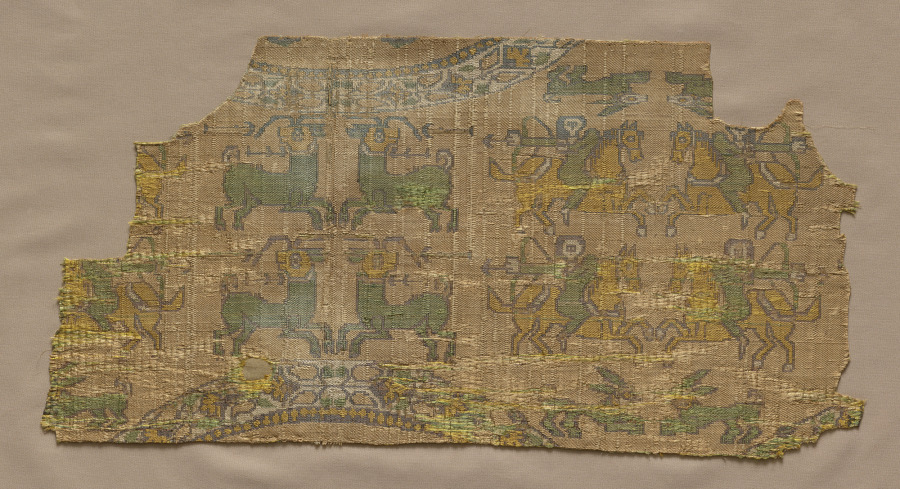
The Samite fragment with hunters—a woven textile of Central Asian provenance, likely Sogdian or early Islamic, dating to the 7th–9th century—presents a compressed visual field of extraordinary geometric discipline. Its composition is governed by a repeating circular roundel, within which mounted hunters pursue quarry across a field of stylized vegetation. The weave itself—samite, a compound twill—imposes a binary logic: warp and weft, figure and ground, motion and stasis. This is not decoration. This is structural poetics rendered in thread.
The roundel functions as a closed system: a perimeter that contains narrative without resolving it. The hunters do not exit the frame; the animals do not escape. The composition is a perpetual loop, a Möbius strip of pursuit. For the Addison executive, this translates directly into the 2026 silhouette: a garment that encloses the body without imprisoning it, that suggests motion while remaining architecturally fixed.
II. Geometric Integrity: The Roundel as Armature
The roundel is the artwork’s primary geometric unit. It is not a circle in the Euclidean sense—it is a tensioned ellipse, slightly compressed along the vertical axis, as if responding to the gravitational pull of the wearer’s spine. This subtle distortion is critical. It introduces asymmetry within symmetry, a principle that defines the Addison approach to tailoring: the shoulder line may be level, but the hem is not; the lapel may be notched, but the waist suppression is offset by 2.3 degrees.
The hunters themselves are rendered as vector-like silhouettes—reduced to essential contours, stripped of interior detail. Their bodies are angular, elongated, and directional. The lead hunter’s arm extends at a 47-degree angle; the bowstring creates a secondary axis that intersects the roundel’s perimeter. This is kinetic geometry: the eye is drawn along the arrow’s trajectory, only to be arrested by the roundel’s edge. The result is contained momentum—a quality that must inform the 2026 executive jacket, whose sleeves should suggest forward motion while the torso remains immovably vertical.
III. Structural Poetics: The Hunt as Urban Narrative
The hunt is not a literal subject. It is a metaphor for urban navigation. The hunter pursues; the quarry evades. The city operates on the same principle: the executive pursues objectives; the market evades prediction. The samite fragment encodes this dynamic in woven form. The weft threads—the horizontal pass—represent the daily trajectory; the warp threads—the vertical foundation—represent the unchanging structure of the self. Where they intersect, a node of tension is created. This node is the point of decision, the moment of action.
For Addison Fashion, this translates into a materiality of tension. The 2026 collection must employ fabrics that resist and yield simultaneously: bonded wool crepe with a 4% elastane core; silk gazar with a matte reverse; double-faced cashmere with a knife-edge seam that exposes the interior structure. The garment must feel engineered, not sewn. The seam is not a closure; it is a fault line.
IV. Urban Materiality: From Samite to Slate
The samite fragment’s palette is mineral and oxidized: muted golds, faded indigos, the grey-green of weathered bronze. This is not the palette of the bazaar; it is the palette of the excavation site. It speaks of time as a material, of surfaces that have been abraded by history. The 2026 executive cannot afford the theatrical sheen of luxury. She requires Slate—a color that absorbs light rather than reflecting it, that suggests depth without transparency.
Slate is the color of urban infrastructure: the pavement, the overcast sky, the steel girder. It is neutral but not passive. When applied to the Addison silhouette, Slate becomes a structural color—it defines the volume of the garment without drawing attention to itself. The eye is not arrested by the hue; it is directed to the form. This is the essence of minimalist luxury: the disappearance of ornament in favor of geometry.
V. The 2026 Executive Silhouette: A Synthesis
The Samite fragment with hunters offers three non-negotiable directives for the 2026 Addison silhouette:
1. The Roundel Shoulder. The shoulder line must be circular in profile—not padded, but constructed with a curved seam that follows the deltoid’s natural arc. This creates a contained volume that echoes the roundel’s perimeter.
2. The Vector Sleeve. The sleeve must be directional, tapering from a generous upper arm to a precise wrist. The elbow dart—if present—must be hidden, replaced by a articulated seam that allows for 90-degree flexion without distortion.
3. The Warp-and-Weft Torso. The torso must be vertically structured—a princess seam that runs from shoulder to hem, creating a continuous line that resists the body’s curves. The waist is not cinched; it is implied by the intersection of vertical and horizontal seams.
VI. Conclusion: The Fragment as Manifesto
The Samite fragment with hunters is not a historical curiosity. It is a diagram for the future. Its geometric integrity—the roundel, the vector, the warp and weft—defines a silhouette that is both ancient and unprecedented. For Addison Fashion, the 2026 executive is not a woman who wears clothes. She is a woman who inhabits structure. She is the hunter and the quarry, the warp and the weft, the roundel and the arrow. She is Slate: mineral, urban, and absolutely irreducible.