Urban Form: Niagara Falls
Urban Silhouette Research: Niagara Falls — The Architecture of Withheld Form
I. Preliminary Geometry: The Fall as Vertical Rupture
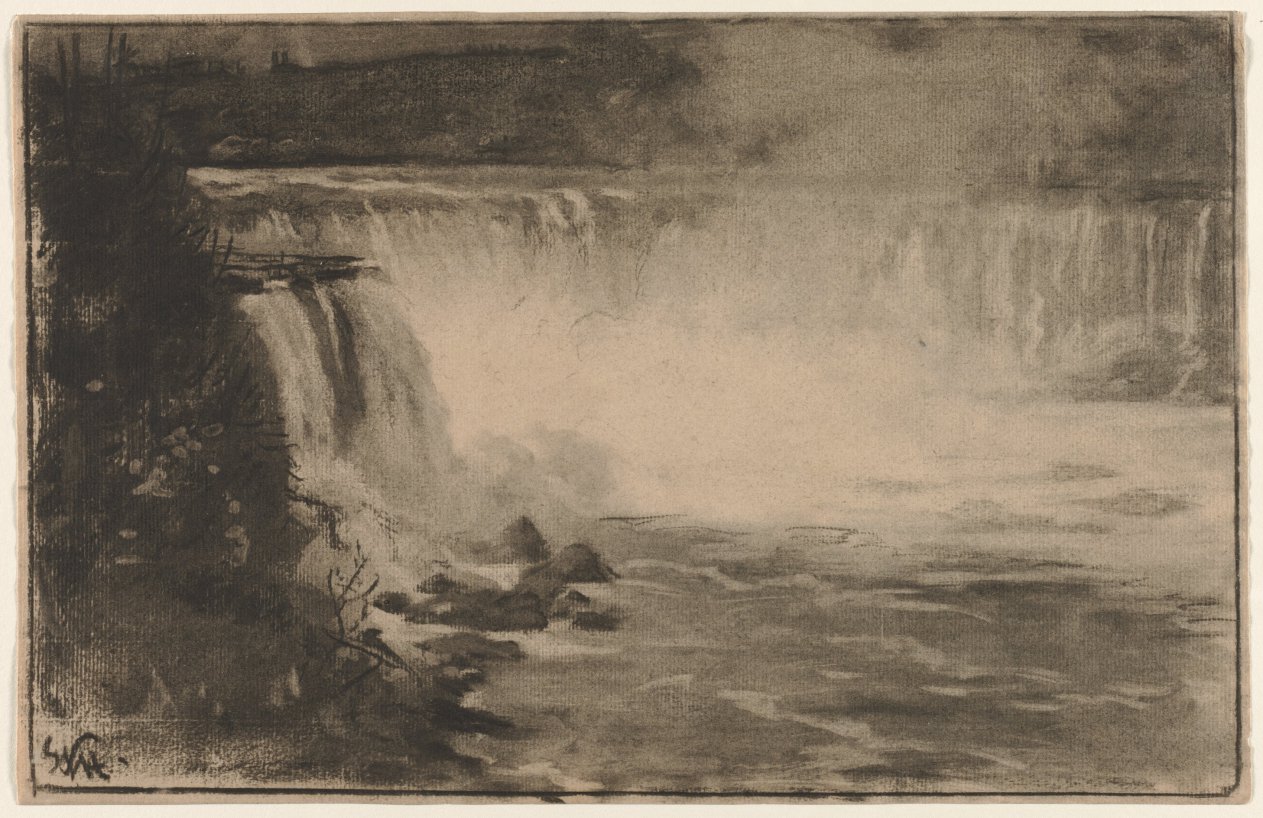
Niagara Falls presents itself not as a subject but as a structural event. The cascade is a vertical incision through horizontal strata — a geological gesture of subtraction rather than addition. For the 2026 executive silhouette, this is the primary lesson: the garment must be conceived as an act of removal, not accumulation. The falling water does not build; it carves. It defines the cliff by what it takes away. In the same manner, the Addison silhouette for 2026 abandons the additive logic of layering — the superfluous lapel, the ornamental seam, the decorative closure — in favor of a subtractive architecture where the body's line is revealed through strategic absence.
The Falls' geometry is deceptively simple: a horizontal crest, a vertical descent, a basin of reception. Yet within this tripartite structure lies an entire cosmology of force and surrender. The crest is the shoulder line — broad, unbroken, absolute. The descent is the torso — elongated, uninterrupted, a single plane of motion. The basin is the hem — the point of dissolution where the garment meets the ground and relinquishes its authority. This is not a silhouette of containment but of release. The 2026 executive does not wear a garment; she inhabits a trajectory.
II. Materiality: Mist as Textile, Stone as Structure
The material paradox of Niagara is that its most enduring image — the mist — is the least material element. The mist is the garment's aura, the atmospheric residue of violent transformation. In Addison's 2026 research, this translates to a fabric philosophy of engineered evanescence: slate-toned wool crepe that holds a sharp architectural line yet breathes with the body's movement; bonded silk-cotton hybrids that appear matte and mineral at rest but reveal a faint, almost imperceptible sheen when the wearer shifts. The mist is not decoration. It is the visible trace of invisible force.
The stone beneath the water — the dolomite and shale of the Niagara Gorge — provides the counterargument. It is the structural memory of the garment: the internal corsetry, the hidden canvassing, the precise placement of weight that allows the exterior to appear effortless. The 2026 executive silhouette demands this duality. The exterior must read as fluid, almost liquid in its descent from shoulder to hem. The interior must be as rigid as sedimentary rock. The wearer should feel held, not constrained — supported by an architecture she never sees.
III. The Udonge Principle: The Silhouette That Does Not Bloom
Here the internal DNA becomes operative. The Udonge plaque — the Buddhist relic that names a flower without depicting it — offers the definitive model for the 2026 silhouette. The garment must not show its meaning. It must be the condition for meaning. The Udonge is a wooden board that signifies a flower through the sheer force of its naming. The Addison garment is a slate column of fabric that signifies power through the sheer force of its restraint.
This is the opposite of the maximalist executive wardrobe — the pinstripe as armor, the power shoulder as weapon. The 2026 silhouette is post-aggressive. It does not assert; it withholds. The neckline is high but not choking. The waist is defined but not cinched. The hem falls just below the knee but does not flare. Every decision is a negation of excess. The garment becomes, like the Udonge plaque, a negative theology of dress: we know what it is by what it refuses to be.
IV. The Chest for Storing Garments: The Interior as Sacred Void
The medieval European chest — closed, carved, impenetrable — completes the dialectic. If the Udonge is the Eastern principle of absent presence, the chest is the Western principle of present absence. The 2026 executive silhouette must incorporate both. The exterior is the Udonge: a surface of quiet signification, a slate plane that invites contemplation rather than consumption. The interior is the chest: a hidden architecture of pockets, linings, and structural seams that the wearer alone knows. The garment's true luxury is its secrecy.
In urban terms, this translates to a silhouette that functions in the city as the Falls function in the landscape: as a fixed point of vertical authority within a horizontal chaos. The executive moves through the metropolis — through glass lobbies, through subterranean transit, through the horizontal drift of crowds — and she does so as a column of stillness. The slate wool does not wrinkle; it records. The shoulder line does not slump; it holds. The hem does not trail; it terminates.
V. Conclusion: The 2026 Silhouette as Secular Reliquary
Niagara Falls is not a backdrop. It is a structural precedent. The 2026 Addison executive silhouette is a garment that behaves like falling water: it descends with purpose, it carves its wearer's presence into the urban field, and it leaves behind only the memory of its force. The Udonge plaque teaches us that the most powerful statement is the one that names without showing. The chest teaches us that the most valuable interior is the one that remains closed. Together, they define a silhouette that is minimalist in form, maximalist in implication — a slate column of withheld meaning, worn by the executive who understands that true authority is not displayed. It is inhabited.
The Falls do not ask to be watched. They simply fall. The 2026 silhouette does not ask to be admired. It simply is.