Urban Form: Cover with Border of Abstract Floral Motifs
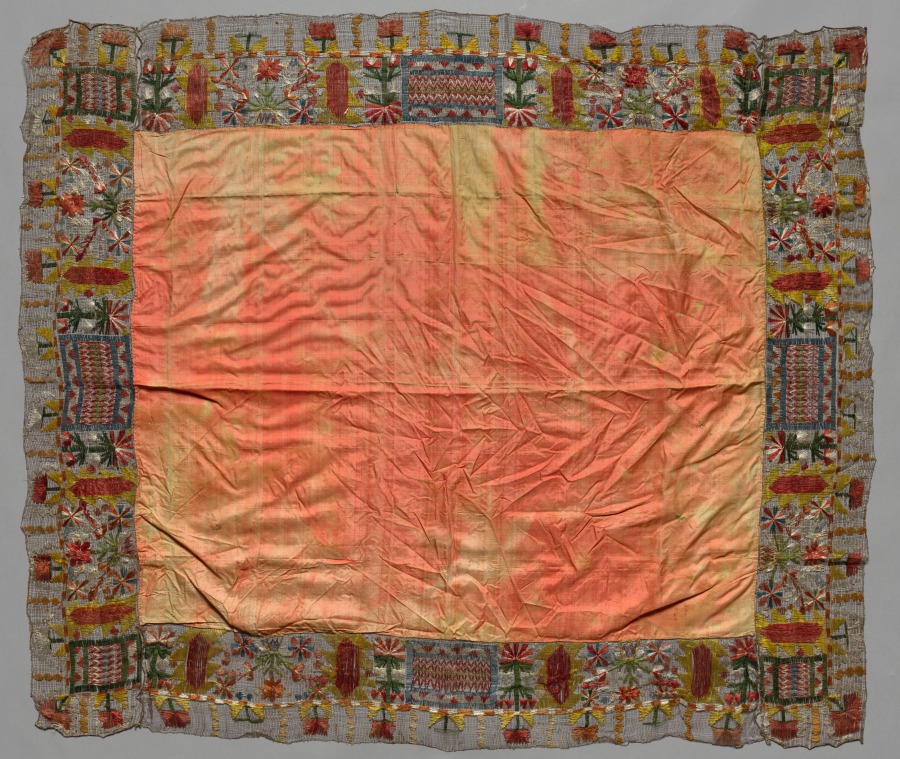
Urban Silhouette Research: The Liminal Frame — Abstract Floral Motifs as Structural Protocol
I. Geometric Integrity: The Border as Architectonic Constraint
The artwork under examination presents a decisive paradox. Its central field—an abstract floral dispersion—operates without gravitational hierarchy, each motif suspended in a state of chromatic drift. Yet this apparent formlessness is contained, with surgical precision, by a border of rigorous geometric intent. The border does not merely frame; it disciplines. It establishes a perimeter within which organic gesture is permitted to occur, and beyond which it may not trespass.
This is the foundational principle of the Addison 2026 executive silhouette: containment as liberation. The border functions as the sartorial equivalent of a tailored shoulder—a fixed coordinate from which all subsequent drape, volume, and movement are measured. Without this armature, the floral abstraction would collapse into decorative noise. With it, the motifs acquire the weight of intentionality. They become evidence of controlled expression rather than symptoms of unedited emotion.
Geometrically, the border operates on two axes. The horizontal plane establishes a horizon line—a reference to the Ver Meerian window ledge, the table edge, the quiet architecture of domestic stillness. The vertical plane asserts posture—the spine of the He Xiangu figure, ascending without effort, defying gravity through sheer compositional conviction. The intersection of these axes creates a cartesian cage for the floral interior, transforming what might have been wallpaper into a statement of executive restraint.
II. Structural Poetics: The Dialectic of Sleep and Ascension
The internal DNA of this artwork is a conversation between two temporal states: the suspended dormancy of Vermeer's A Maid Asleep and the weightless ascension of the Daoist immortal He Xiangu. This is not a binary opposition but a continuum of consciousness—and it is precisely this continuum that defines the 2026 Addison silhouette.
Consider the Vermeerian component. The sleeping maid represents the body at rest, yet the painting vibrates with latent energy: the wine glass catching light, the map on the wall suggesting territories unexplored, the heavy drape of fabric that implies both protection and confinement. In sartorial terms, this translates to structured softness—garments that appear fluid but possess an internal architecture of seams, darts, and invisible reinforcements. The Addison executive does not wear clothing that slumps; she wears clothing that rests with intention.
Now consider the He Xiangu component. The immortal does not walk; she is suspended in a state of perpetual becoming. Her robes do not drape—they billow, animated by a wind that exists only in the painter's imagination. This is the poetics of arrested motion, and it is the second pillar of the Addison silhouette. The 2026 executive does not stride; she glides. Her garments are engineered to suggest movement even in stillness, to imply that at any moment, she might ascend.
The genius of the artwork lies in its synthesis: the border holds both states in tension. Sleep and ascension, gravity and weightlessness, the mundane and the transcendent—all coexist within the same geometric frame. The Addison silhouette achieves the same synthesis through material intelligence. A slate wool coat with a sharply defined shoulder line and an unexpectedly fluid hem. A column dress in ivory silk that pools at the floor yet maintains a vertical axis of authority. The border is the tailoring; the floral abstraction is the woman who wears it.
III. Urban Materiality: The City as Medium
The abstract floral motifs demand a specific material response. They are not literal flowers; they are gestural residues—traces of organic form that have been filtered through the grid of urban experience. This is the aesthetic of the city: nature abstracted, rhythm mechanized, beauty disciplined by infrastructure.
For the 2026 Addison collection, this translates to fabrics that carry memory of structure. Slate-toned wool crepe with a matte finish that absorbs light rather than reflecting it. Silk georgette printed with tonal florals that reveal themselves only upon close inspection—a private language for the wearer, not a public announcement. Leather that has been tanned to a state of near-fabric softness, allowing it to drape with the fluidity of the He Xiangu robes while retaining the protective density of the Vermeerian interior.
The color slate is not incidental. It is the color of the border—the urban sky at dusk, the concrete of a gallery floor, the shadow cast by a well-tailored shoulder. It is the color of quiet authority. Against this neutral ground, the abstract florals function as controlled disruptions: moments of chromatic release that never threaten the overall compositional integrity.
IV. The 2026 Executive Silhouette: A Definition
The Addison 2026 executive silhouette is defined by three principles derived from this artwork:
First, the primacy of the frame. Tailoring is not decoration; it is the precondition for freedom. The border comes first. The floral abstraction—the personality, the gesture, the life—emerges only within a structure that can contain it.
Second, the suspension of time. The silhouette must suggest both rest and motion, dormancy and ascension. It must be capable of stillness without rigidity, movement without chaos. This is achieved through bias cuts, asymmetric closures, and fabrics that respond to the body's slightest shift.
Third, the abstraction of the organic. Floral motifs are permitted, but only as traces—never as illustration. The urban executive does not wear a garden; she wears the memory of a garden, filtered through the grid of the city, disciplined by the border of her own intention.
The artwork, in its quiet geometry, teaches us that beauty is not the absence of constraint but its most sophisticated expression. The Addison woman does not choose between sleep and ascension. She inhabits both, simultaneously, within a silhouette that holds her—and releases her—with equal precision.