Urban Form: Brahma-Shiva
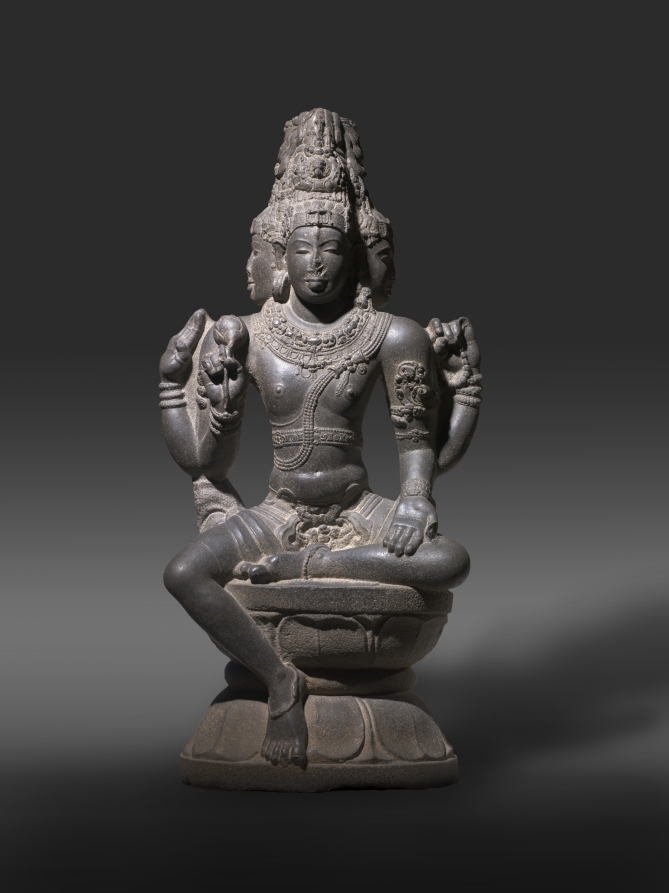
Urban Silhouette Research: The Brahma-Shiva Dialectic in Executive Form
I. Thesis: Two Temporalities, One Wardrobe
The Addison 2026 executive wardrobe is not designed for a single temporality. It is engineered for the Brahma-Shiva dialectic—the simultaneous imperative to construct and to dissolve, to legislate and to flow. Our DNA source pairs Jacques-Louis David's The Death of Socrates (1787) with a Meiping vase bearing wave motifs. These are not decorative references. They are structural paradigms for how a modern executive silhouette must negotiate permanence and mutability within a single garment architecture.
David's Neoclassical composition operates on the logic of the event: a frozen instant, geometrically stabilized, morally legible. The Meiping operates on the logic of the process: the wave that never breaks, the form that contains without arresting. The first is heroic; the second is ecological. The Addison silhouette must be both.
II. Form Analysis: The Davidian Armature
David's Socrates is a study in controlled verticality. The raised right hand establishes a vector toward the ideal; the left hand receives the hemlock with equal composure. The body is rendered as sculptural mass—dense, weighted, architecturally resolved. The composition is bilateral, symmetrical, and deliberately anti-dynamic. Nothing moves because everything has already been decided.
Translated into tailoring, this yields the Slate column: a shoulder line that is neither padded nor collapsed but resolved—a clean horizontal that anchors the torso without aggression. The lapel is narrow, straight, and unpeaked, echoing the philosophical austerity of the toga's fold. The jacket length extends to the upper thigh, creating a vertical unbroken by pocket flaps or decorative stitching. This is the event silhouette: a garment that presents the executive as a completed argument, not a work in progress.
But the Davidian armature alone is insufficient. It is too rigid, too declarative, too invested in the fiction of the final word. It requires the counter-pressure of the Meiping.
III. Form Analysis: The Meiping Wave
The Meiping is a vessel of contained turbulence. Its profile—broad at the shoulder, tapering to a narrow base—is itself a wave form arrested at the moment of maximum tension. The cobalt decoration does not sit on the surface; it has penetrated the glaze, fused with the body of the porcelain. The waves are not applied. They are immanent.
This informs the Addison approach to fluid construction. Where the Davidian jacket is built, the Meiping element is grown. We achieve this through bias-cut internal panels that follow the body's natural asymmetry without clinging. The result is a garment that appears structured from the front but reveals a subtle, wave-like torsion in movement. The executive does not wear the jacket; the jacket responds to the executive's kinetic field.
Color is critical here. Slate—that blue-grey register between stone and storm—is the chromatic equivalent of cobalt under glaze. It absorbs light rather than reflecting it, creating depth without shine. In a boardroom, Slate reads as authority. In motion, it reads as atmosphere. It is the only color that can hold both the Davidian event and the Meiping process without contradiction.
IV. Materiality: The Fired Garment
David's oil paint will craze and darken. The Meiping's glaze will remain vitreous for millennia. This is not a paradox; it is a material lesson. The Addison 2026 wardrobe rejects the perishable logic of the fashion cycle in favor of ceramic durability.
We specify a double-faced wool-cashmere blend with a tight, high-twist weave. The exterior is matte and dry—no sheen, no reflection, no performance of luxury. The interior is bonded to a micro-mesh that provides structural memory: the garment returns to its intended form after wear, like a glaze cooling after firing. Seams are taped, not surged. Buttons are corozo, not horn—dense, uniform, and resistant to the polishing that signals use.
The Brahma-Shiva principle manifests in the garment's dual-state construction. The front panels are cut on the straight grain (Davidian order). The side and back panels are cut on a 7-degree bias (Meiping flow). When the executive stands still, the silhouette is a column. When the executive moves, the column becomes a wave. The garment does not choose between permanence and change. It inhabits both.
V. The 2026 Executive Wardrobe: A Synthesis
The Addison 2026 collection is not a season. It is a philosophical position rendered in cloth. The executive who wears it does not signal allegiance to trend or tradition. They signal temporal competence—the ability to operate in the event and the process simultaneously, to legislate and to adapt, to hold the hemlock and the wave in the same hand.
This is the urban silhouette: a form that contains its own dissolution. A Slate column that moves like water. A garment that does not resist time but absorbs it.
The Brahma-Shiva dialectic is not resolved in the Addison wardrobe. It is worn. And in the wearing, it becomes the only aesthetic truth that matters: that form, at its highest register, is not the opposite of flux. It is its most disciplined expression.