Urban Form: Venus after the Bath
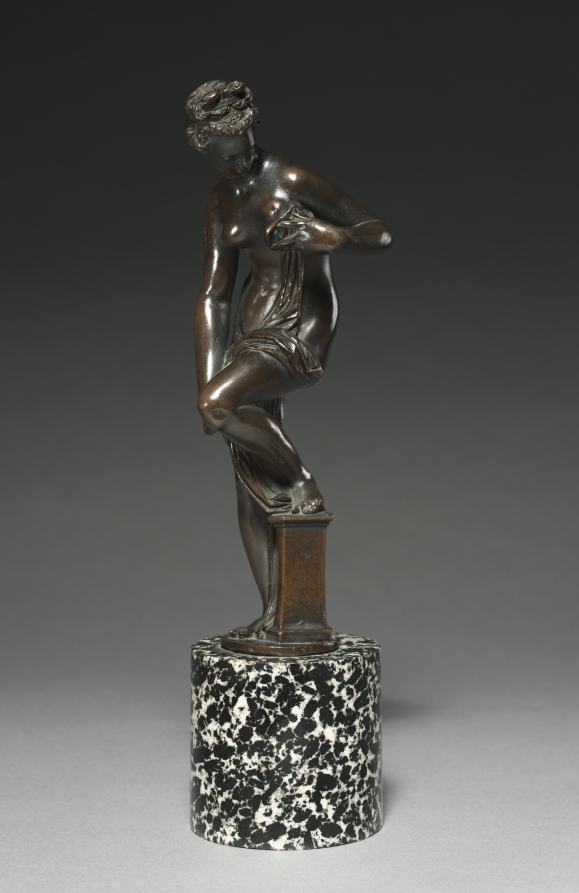
Urban Silhouette Research: Venus after the Bath — Form, Color, and the 2026 Executive Wardrobe
I. Materiality as Narrative Architecture
The Qing dynasty liuli figure of Sudhana and the medieval European reliquary finial operate at opposite ends of a material spectrum that maps directly onto the strategic tensions facing the 2026 executive wardrobe. The liuli object is a study in translucent volatility—its chromatic identity is not applied but suspended within the vitreous body, where jade-green and pale amber bleed into one another in a continuous state of chromatic indeterminacy. The finial, by contrast, is a study in opaque permanence: gilded copper, lapis, and enamel red are deployed as discrete, bounded signifiers, each color a fixed proposition in a visual theology of order.
For Addison Fashion, this dichotomy resolves into a single design directive: the executive silhouette must function as a controlled vessel for chromatic drift. The Slate palette—neither warm nor cool, neither matte nor reflective—is the precise material answer. Slate absorbs ambient light rather than reflecting it, which means a single garment can register as charcoal in a boardroom and as blue-grey in daylight. This is not indecision; it is strategic chromatic latency. The 2026 executive does not change outfits between contexts. The outfit changes with the context.
II. Silhouette: The S-Curve and the Vertical Axis
Sudhana's form is governed by the S-curve—a serpentine line that refuses frontal address and instead compels the eye to travel. The finial is governed by the vertical axis—a centripetal stack that terminates in a point aimed at the heavens. These are not merely decorative choices; they are grammars of attention.
The 2026 executive wardrobe must synthesize both. The Addison silhouette for the coming season proposes a columnar base with a displaced waist seam—a vertical architecture that nonetheless carries a subtle lateral torsion. In practice: a slate wool coat with a single asymmetric closure that pulls the eye diagonally across the torso before resolving into a clean vertical fall from the hip. The result is a garment that reads as authoritative from the front and as kinetic from the three-quarter view. This is the S-curve disciplined by the finial's verticality—process without disorder, order without rigidity.
Shoulder construction follows the same logic. The finial's stepped tiers suggest a shoulder that is structured but not padded into caricature. Addison's 2026 shoulder is a soft-dropped architectural line: sufficient structure to hold a lapel, insufficient padding to read as armor. The executive is not a soldier. She is a curator of her own presence.
III. Color as Metaphysical Position
The liuli palette—"flowing霞之色"—is a chromatic philosophy of immanence: color as the visible trace of an inner state. The finial's palette is a philosophy of transcendence: color as a fixed reference to an external truth. The 2026 executive operates in the gap between these positions.
Slate is the correct answer because it refuses both extremes. It is not the ecstatic indeterminacy of the liuli body, nor the doctrinal certainty of enamel red. Slate is the color of the informed pause—the chromatic equivalent of a well-timed silence in a negotiation. It pairs with ivory for contrast and with onyx for depth, but it never demands attention for itself. It is the color of someone who has already been heard.
Within the Addison system, Slate functions as the base layer of a modular chromatic architecture. A slate trouser, a slate knit, a slate overcoat—each is a discrete unit that can be recombined without chromatic friction. This is the finial's logic of bounded color applied to the liuli principle of continuous variation: a wardrobe that is stable in its components and fluid in its combinations.
IV. The Executive as Spiritual Container
Both the Sudhana figure and the finial are, at their core, containers—one of a pilgrim's becoming, the other of a relic's permanence. The 2026 executive wardrobe must function as a container of a different order: a portable architecture of composure in an environment of permanent disruption.
This means the Addison silhouette must be evaluated not only for fit and fabric but for psychological load-bearing capacity. A slate wool coat with a displaced closure is not merely a garment; it is a spatial envelope that regulates the wearer's relationship to the room. The S-curve of the lapel draws the eye inward; the vertical fall of the hem projects outward. The executive is simultaneously present and protected.
The finial's lesson is that permanence is achieved through reduction to essential geometry. The liuli figure's lesson is that vitality is achieved through controlled chromatic drift. Addison Fashion's 2026 proposition is the synthesis: a minimalist silhouette in a slate chromatic register, structured enough to signal authority, fluid enough to accommodate the wearer's own becoming. The wardrobe does not complete the executive. It provides the conditions under which she completes herself.
V. Technical Specification Summary
Silhouette: Columnar base, displaced waist seam, soft-dropped architectural shoulder, asymmetric closure resolving to vertical hem.
Palette: Slate as chromatic base; ivory and onyx as structural accents; no applied color.
Material: Matte-finish wool, brushed cashmere, technical silk with low-luster surface.
Design Intent: A portable architecture of composure—stable in components, fluid in combination, silent in address.