Urban Form: Capriccio: A Palace with a Courtyard by the Lagoon
Urban Silhouette Research: Capriccio as Structural Protocol
I. Geometric Integrity: The Courtyard as Negative Space
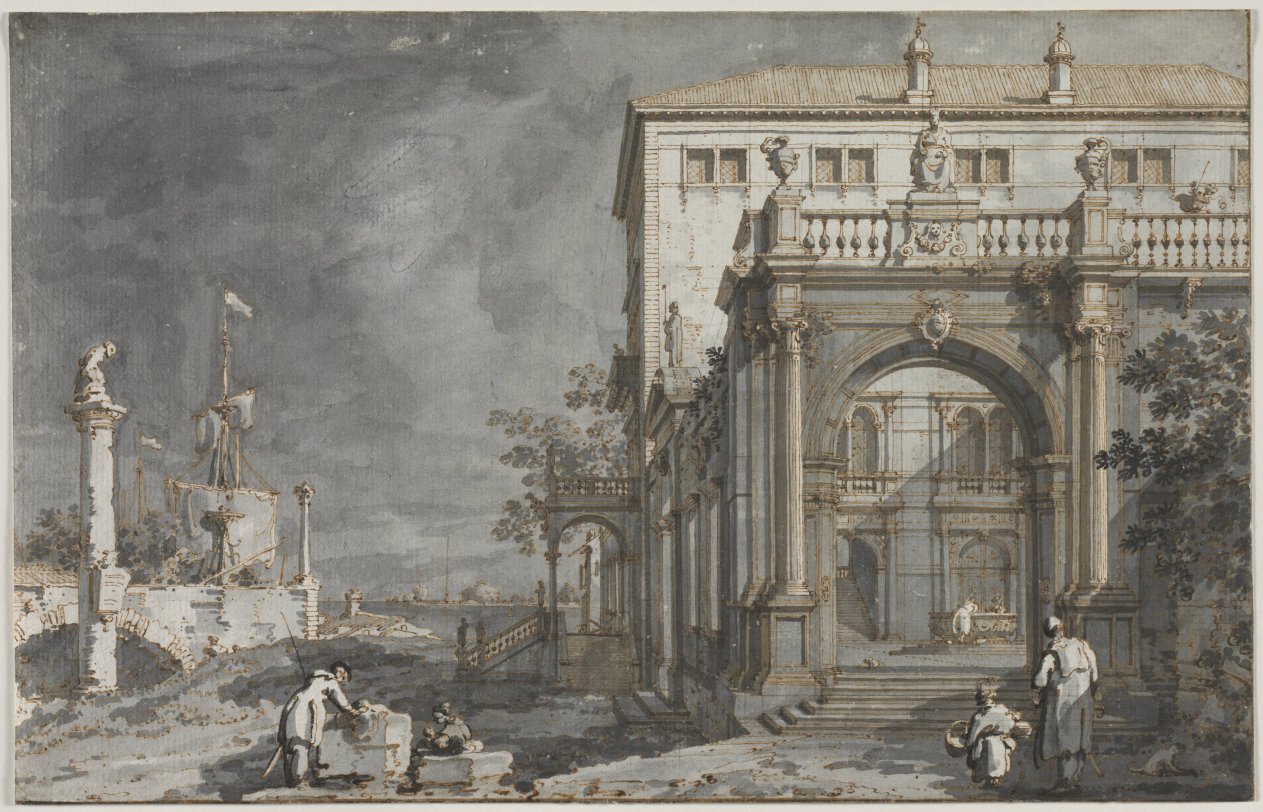
The Capriccio: A Palace with a Courtyard by the Lagoon operates not as a pictorial document but as an architectural proposition—a speculative geometry that anticipates the 2026 executive silhouette with uncanny precision. The composition is governed by a rigorous orthogonal logic: the courtyard functions as a void, a deliberate subtraction from the palace's mass. This is not emptiness but engineered absence, the spatial equivalent of a tailored seam that defines the garment by what it removes. The lagoon, rendered as a horizontal plane of near-monochrome tonality, establishes a datum line against which the palace's verticality is measured. The resulting tension—between the horizontal expanse of water and the vertical assertion of stone—produces a silhouette that is simultaneously grounded and aspirational.
For Addison Fashion, this geometric integrity translates directly into the 2026 executive wardrobe. The courtyard's negative space becomes the architectural gap—the deliberate interval between shoulder and hip, the controlled volume at the waist, the precise distance between collar and jawline. The silhouette is not achieved through addition but through strategic removal. The palace's facade, with its repetitive arcature and rhythmic fenestration, offers a lesson in modularity: each window, each arch, each column is a unit of measure, a repeatable element that accumulates into a coherent whole. The 2026 executive silhouette will be built on this principle—modular tailoring where each component (lapel, cuff, pleat) is a discrete architectural decision that contributes to the overall structural poetics.
II. Materiality: Stone, Water, and the Texture of Authority
The painting's materiality is twofold: the depicted stone of the palace and the depicted water of the lagoon. The stone is rendered with a matte, almost chalky opacity—a surface that absorbs light rather than reflecting it. This is the materiality of authority without ostentation, the visual equivalent of a wool-silk blend that whispers rather than shouts. The lagoon, by contrast, is a surface of subtle modulation, its tonal shifts suggesting depth, movement, and the capacity for reflection. Together, they propose a dialectic that Addison Fashion will exploit in 2026: the interplay between matte structure and fluid surface, between the rigidity of the architectural frame and the softness of the body it contains.
The internal DNA of this artwork—the dialogue between the Famous Women cassone and the Caparisoned Elephant—further complicates this material reading. The cassone's painted surface is a textile of narrative, its linear perspective and discrete scenes weaving a didactic program into the fabric of the object. The elephant's caparison is a textile of power, its repeating patterns and gold embroidery encoding imperial order into the animal's body. Both are surfaces that conceal as they reveal, that ornament as they regulate. The Capriccio inherits this double logic: its architectural surface is both a display of civic virtue and a mechanism of spatial control. The courtyard, after all, is a space of surveillance—open to the sky, enclosed by walls, visible from every window. The 2026 executive silhouette must similarly negotiate this paradox: it must be visible and impenetrable, a surface that invites the gaze while withholding access.
III. Structural Poetics: The Silhouette as Urban Proposition
The Capriccio is an urban image—a city imagined, a lagoon traversed, a palace positioned at the threshold between land and water. Its silhouette is not merely architectural but topographical, defined by the relationship between built form and natural context. The 2026 executive silhouette will adopt this topographical consciousness. It will be a silhouette that acknowledges its environment—the glass towers, the transit corridors, the interstitial spaces of the contemporary city—and responds with a geometry that is both defensive and adaptive.
The palace's roofline, with its subtle irregularities and its crowning statuary, introduces a note of controlled asymmetry. This is not the asymmetry of chaos but of calibration—a deliberate misalignment that animates the silhouette and prevents it from becoming static. The 2026 executive jacket will incorporate this principle: a lapel that sits a fraction off-center, a hem that dips imperceptibly at the back, a sleeve that rotates the shoulder line by degrees. These are not flaws but structural interventions, moments where the garment asserts its own logic against the body's symmetry.
The lagoon, finally, offers a lesson in tonal restraint. Its palette is narrow—slate, silver, the palest sand—and its power derives from this very limitation. The 2026 executive wardrobe will embrace this chromatic discipline. Onyx will serve as the foundational tone, a near-black that absorbs light and projects authority. Ivory will function as the counterpoint, a surface of clarity and precision. Silver will appear as accent—a hardware finish, a thread of metallic in a matte weave—and Sand will ground the palette in a warmth that is nonetheless controlled, desaturated, urban.
IV. Conclusion: The Silhouette as Ideological Surface
The Capriccio is not a neutral image. It is a fantasy of order, a vision of architecture as moral and political statement. Its geometric integrity, its material dialectic, its structural poetics—all are in service of a particular ideology of space, power, and visibility. The 2026 executive silhouette, as envisioned by Addison Fashion, will inherit this ideological burden. It will be a silhouette that frames the body as the palace frames the courtyard: with precision, with intention, with an awareness that every seam is a statement and every surface is a site of negotiation. The urban executive of 2026 will not merely wear a garment; they will inhabit a structure—a tailored architecture of onyx and ivory, slate and silver, sand and shadow—that positions them within the visual economy of the city. The silhouette will be the message. The surface will be the strategy. And the courtyard—that engineered void at the center of the palace—will remain the most eloquent argument for the power of negative space.