Urban Form: Study for "The Martyrdom of Saint Sebastian" (for the Augustinian monastery at Diessen, Germany)
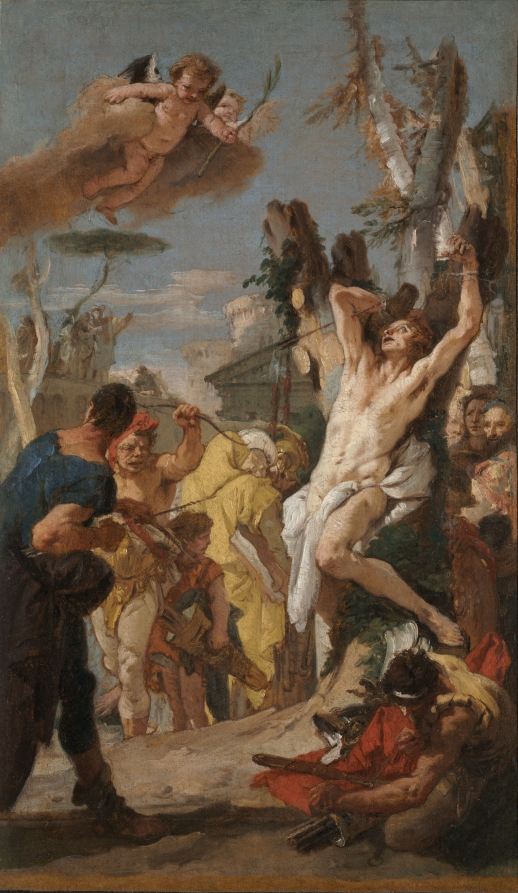
The Diessen Sebastian: Structural Poetics of the Pierced Silhouette
The subject under examination—the study for The Martyrdom of Saint Sebastian executed for the Augustinian monastery at Diessen—presents a singular problem in the architecture of the body. It is not a depiction of suffering in the conventional Baroque sense. It is a study in suspension, in the tensile logic of a form held between collapse and elevation. For the Addison Fashion 2026 executive silhouette, this work offers a precise grammar: the body as a scaffold, the garment as a binding agent, the silhouette as a resolved contradiction between penetration and integrity.
The Geometry of the Pierced Torso
The figure’s torso is constructed upon a vertical axis that is deliberately destabilized. The arrows—those instruments of martyrdom—function not as narrative devices but as structural vectors. They introduce a radial geometry into an otherwise frontal composition. The chest, the abdomen, the thigh: each becomes a site of intersection where the external line of the projectile meets the internal line of the musculature. This is not chaos. It is a controlled disruption, a system of load-bearing points that redistributes the weight of the figure across a network of tensions.
For the 2026 executive wardrobe, this translates into garments that are pierced without being perforated. The silhouette remains closed, monolithic, but its internal engineering—dart placement, seam direction, the precise angle of a shoulder yoke—creates the illusion of an armature beneath. The wearer does not wear the garment; the garment suspends the wearer. The shoulder line is not padded into passivity but articulated into a subtle upward thrust, as if the body were being drawn toward an invisible point above the collarbone. This is the Sebastian posture: elevated by what would otherwise destroy it.
Materiality and the Patina of Resistance
The study’s surface—whether rendered in oil, chalk, or preparatory wash—carries the evidence of its own making. The abrasions, the corrections, the visible grain of the support: these are not flaws. They are temporal inscriptions, the record of a form struggling to cohere. In the context of urban materiality, this suggests a fabric philosophy for 2026 that rejects the pristine. Slate-toned wool crepe with a dry, almost chalky hand. Silk that has been washed to remove its luster, leaving only a mineral matte. Leather that is not polished but burnished, its surface a map of micro-abrasions that catch the light in irregular, unprogrammed ways.
The executive silhouette must not gleam. It must absorb. The city is a hostile environment—grit, velocity, the constant friction of bodies against architecture. The Addison wardrobe for 2026 treats this hostility as a collaborator. A coat in double-faced slate cashmere, its edges raw and unfused, allows the wearer to accumulate the city’s residue. The garment becomes a receptacle of urban time, its surface a palimpsest of the day’s negotiations. This is the Diessen principle: the sacred is not protected from decay; it is revealed through it.
The Absent Arm and the Architecture of Restraint
In the Diessen study, the figure’s arms are bound—not behind the back, but in a position of deliberate inefficiency. The elbows are not flexed for action; they are fixed at angles that render the hands useless. This is a silhouette of strategic incapacity. The body is present, but its agency is withdrawn. For the executive wardrobe, this manifests as a radical reduction of gesture. Sleeves are cut long, extending past the wrist, their cuffs unfastened. Pockets are welted and shallow, discouraging the hand’s instinct to burrow. The garment does not facilitate movement; it frames stillness.
This is the opposite of athleisure. It is the opposite of utility. It is a silhouette that says: I do not need to reach for anything. The world will come to me. The Diessen Sebastian is not a victim. He is a monument to the refusal of collapse. His body is pierced, but his verticality is absolute. The 2026 executive silhouette borrows this verticality—not as rigidity, but as a quiet, unyielding axis around which the chaos of the urban day can rotate without ever displacing the wearer.
Conclusion: The Silhouette as Threshold
The Diessen study is not a portrait of pain. It is a diagram of endurance. Its geometric integrity lies in the tension between the radial intrusion of the arrows and the axial stability of the spine. Its materiality lies in the acceptance of wear as a form of consecration. Its poetics lie in the transformation of vulnerability into an architectural condition.
For Addison Fashion, the 2026 executive silhouette is therefore not a shape but a state of structural grace. It is slate-toned, mineral, and unadorned. It is pierced by the city and remains standing. It is the body as threshold—between the visible and the invisible, between the weight of the day and the lightness of the will. The wearer does not enter the room. The wearer occupies the axis around which the room arranges itself.