Urban Form: Silver Wine Jug, Ham, and Fruit
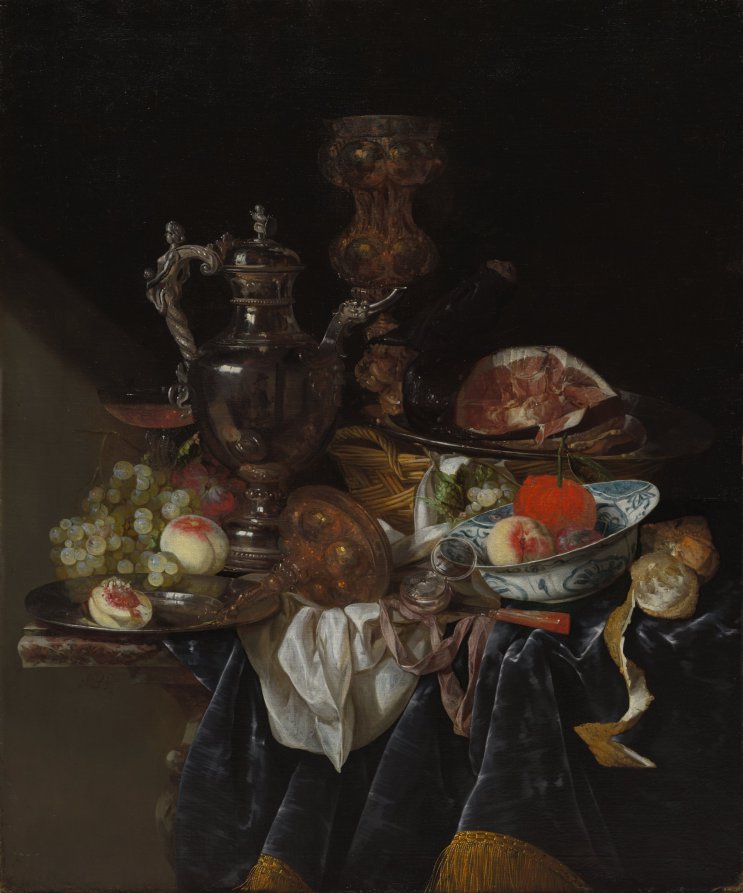
Urban Silhouette Research: The Silver Wine Jug, Ham, and Fruit as Proto-Minimalist Artifact
I. Object Analysis: The Still Life as Executive Armature
The subject under examination—a silver wine jug, a cut of ham, and assembled fruit—constitutes a still life composition whose formal logic anticipates the contemporary executive wardrobe with uncanny precision. This is not a culinary arrangement. It is a study in tonal hierarchy, volumetric restraint, and the semiotics of metallic surface. The silver jug operates as the compositional anchor: a reflective, cold-toned vessel whose curvature is disciplined by a vertical neck and a horizontal handle. The ham introduces organic mass—dense, matte, and irregular—while the fruit supplies chromatic punctuation through controlled bursts of saturation. Together, these elements establish a tripartite system: the reflective, the matte, and the chromatic. This triad is the foundational grammar of the Addison 2026 executive silhouette.
The silver jug demands particular attention. Its surface is not merely decorative; it is performative. It absorbs and re-emits its environment, functioning as a mirror that destabilizes the boundary between object and context. In this sense, the jug is the pre-modern equivalent of the power blazer: a garment that does not simply clothe the body but reframes it within a field of visual authority. The jug's handle—a functional appendage—introduces asymmetry without disrupting the whole. This is the logic of the asymmetric lapel and the offset closure in Addison's forthcoming tailoring.
II. Form: The Architecture of Restraint
The composition's formal discipline resides in its refusal of excess. The ham is not carved; it is blocked. The fruit is not scattered; it is placed. Every element occupies a defined spatial zone, creating a grid of visual weights that anticipates the modular logic of the 2026 NYC executive wardrobe. The silhouette that emerges is columnar with strategic interruption: a vertical through-line (the jug) disrupted by horizontal mass (the ham) and punctuated by spherical volume (the fruit). Translated to garment architecture, this yields:
1. The Silver Column: A floor-length or knee-length overcoat in brushed silver wool, cut with a single vertical seam that echoes the jug's neck. The coat's surface should possess a low-luster sheen—not glossy, but alive—mimicking the jug's capacity to shift tonality under varying light. This is the Minimalist imperative: the garment must perform differently in the boardroom, the gallery, and the evening reception without alteration.
2. The Ham Block: A structured, matte-finished blazer in slate or onyx, its shoulders squared but not exaggerated, its hem cropped at the hip to create a horizontal counterweight to the coat's verticality. The fabric should be dense—double-faced cashmere or bonded wool—to evoke the ham's organic solidity without its irregularity. The blazer is the ground against which the silver column figures.
3. The Fruit Accents: Chromatic interventions limited to three points: a silk scarf in oxidized burgundy, a pair of gloves in deep plum, or a structured bag in burnished copper. These are not accessories; they are compositional necessities. They prevent the silver-slate-onyx triad from collapsing into monochrome monotony. The fruit in the still life is not incidental—it is the event that activates the composition. Similarly, the executive wardrobe requires chromatic events, tightly controlled and strategically placed.
III. Color: The Silver Register and Its Discontents
Silver is the most treacherous color in the executive palette. It flatters the wearer only when its temperature is controlled. The silver of the wine jug is not the silver of automotive paint or bridal satin. It is a cool, gray-inflected silver, closer to pewter than to chrome. This is the silver that Addison will deploy for 2026: a silver that reads as neutral in artificial light and as cool-toned in daylight, capable of harmonizing with both warm skin tones and cool ones.
The supporting palette is derived directly from the still life's secondary elements. The ham's surface—a muted, brownish-pink—translates to sand, taupe, and warm gray for knitwear and trousers. The fruit's skin—deep red, purple, and gold—yields oxblood, aubergine, and antique brass for leather goods and jewelry. The background—a shadowed, indeterminate darkness—justifies onyx and charcoal as the foundational neutrals. The result is a palette that is simultaneously warm and cold, organic and metallic, restrained and expressive.
IV. The 2026 NYC Executive Wardrobe: A Speculative Inventory
The Addison 2026 executive wardrobe, derived from this still life, comprises:
The Silver Overcoat: Brushed wool-silk blend, unlined, with a single concealed closure. Worn open over the Ham Blazer or closed as a standalone statement.
The Ham Blazer: Double-faced cashmere in slate or onyx, with a slightly extended shoulder and a cropped, straight hem. No visible buttons. The closure is internal, magnetic, and silent.
The Fruit Trousers: High-waisted, wide-leg trousers in sand or taupe wool, with a single pleat and a cuff that breaks precisely at the ankle. The waistband is concealed. The silhouette is columnar with movement.
The Chromatic Interruptions: A silk scarf in oxblood, a leather portfolio in aubergine, a signet ring in antique brass. These are the events that prevent the wardrobe from becoming a uniform.
V. Conclusion: The Still Life as Wardrobe Logic
The silver wine jug, the ham, and the fruit are not merely objects. They are a system of formal relations that, when translated into textile and tailoring, produce a wardrobe capable of navigating the executive landscape of 2026 New York. The silver jug teaches restraint and reflectivity. The ham teaches mass and matte discipline. The fruit teaches the necessity of controlled chromatic event. Together, they articulate a silhouette that is Minimalist in form, Silver in register, and uncompromising in its refusal of decorative excess. This is the Addison proposition: that the most powerful wardrobe is not the most adorned, but the most precisely composed. The still life, after all, is not about the objects. It is about the space between them.