Urban Form: Helmet Mask
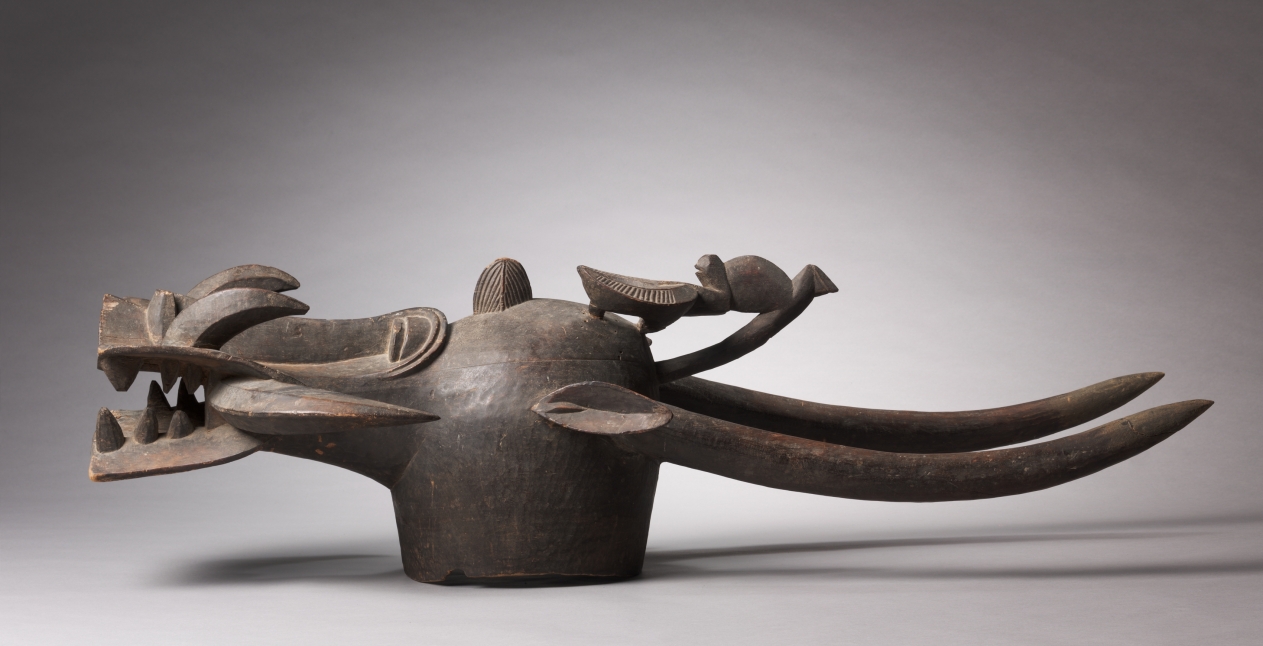
Urban Silhouette Research: The Helmet Mask as Structural Archetype
I. Formal Deconstruction: From Reliquary to Cranial Architecture
The helmet mask, as a formal category, occupies a liminal position between protective armature and ceremonial object. Its DNA—drawn from the Qing dynasty Shancai Tongzi (善财童子) in glazed liuli and the medieval European reliquary finial—presents two competing structural logics that must be reconciled in any serious design translation. The Shancai Tongzi operates on a principle of asymmetric S-curve dynamism: the figure's silhouette is not static but implies a trajectory, a pilgrimage compressed into a single posture. The finial, by contrast, enforces vertical axiality—a pyramidal convergence where every plane tapers toward a singular point of transcendence. For the helmet mask, this dichotomy manifests as a tension between the cranial dome (which must follow the ovoid geometry of the human skull) and the facial aperture (which must accommodate both vision and ventilation without compromising structural integrity).
The Shancai Tongzi's glazed surface introduces a second formal problem: translucency as structural variable. In liuli, color is not applied but suspended within the material matrix, creating depth without added mass. Translated to helmet mask design, this suggests a composite shell where opacity gradients serve both aesthetic and functional ends—dense at the occipital ridge for impact resistance, increasingly translucent toward the temporal and frontal zones to reduce thermal load and permit peripheral awareness. The finial's enamel-and-gilt vocabulary, conversely, argues for stratified surface articulation: discrete chromatic zones with hard boundaries that communicate hierarchy and function. A helmet mask that synthesizes both would employ a monochromatic base (Slate, in this instance) with selective, high-contrast accent zones that map to specific performance attributes—ventilation ports, sensor arrays, or structural reinforcement ribs.
II. Color as Operational Logic: Slate as Mediating Chromatic Field
The selection of Slate as the governing color for this research is not arbitrary. Slate occupies the precise midpoint between the Shancai Tongzi's "flowing sunset" palette—those fugitive blues, yellows, and greens that shift with the angle of incidence—and the finial's heraldic triad of gold, blue, and enamel red. Slate is achromatic in its base but polychromatic in its response to light. Under cool, diffuse illumination (the typical condition of a Manhattan morning commute), it reads as a neutral grey-blue, recessive and professional. Under warm, directional light (the halogen wash of a boardroom or the amber glow of a gallery opening), it shifts toward a muted bronze, acquiring a warmth that belies its apparent neutrality.
This chromatic instability is precisely the point. The Shancai Tongzi teaches that color can be phenomenological rather than essential—a function of viewing conditions rather than fixed pigment. The finial teaches that color can be indexical, pointing to fixed metaphysical referents. For the 2026 executive wardrobe, Slate functions as both: it is a stable anchor for tailoring (the finial's order) while remaining responsive to environmental context (the Shancai Tongzi's mutability). A Slate helmet mask—whether realized as a literal headpiece for urban cycling or as a metaphorical design language for hooded outerwear—becomes a chromatic interface between the wearer's interior state and the city's exterior conditions.
III. Silhouette Translation: The Helmet Mask as Executive Armature
The helmet mask's formal DNA translates into three distinct silhouette strategies for the 2026 NYC executive wardrobe:
1. The Cranial Dome as Shoulder Architecture. The finial's vertical convergence finds its sartorial analogue in the structured shoulder—not the aggressive, padded power shoulder of the 1980s, but a tapered, aerodynamic shoulder line that rises slightly from the clavicle before descending into a narrow, elongated sleeve. This creates a silhouette that is simultaneously protective (the dome) and directional (the taper). In Slate wool with a subtle mohair sheen, the effect is one of contained momentum—the wearer appears to be in motion even when standing still.
2. The Facial Aperture as Neckline Geometry. The helmet mask's opening—whether circular, oval, or keyhole-shaped—informs a new vocabulary of necklines and collars. The Shancai Tongzi's S-curve suggests an asymmetric cowl that drapes across one shoulder while exposing the opposite clavicle, creating a diagonal line of sight that guides the eye downward and across the torso. The finial's axial symmetry suggests a high, structured collar that frames the face like a reliquary niche—austere, vertical, and deliberately restrictive. Both are viable; the choice depends on whether the executive's posture is one of approach (the Shancai Tongzi) or authority (the finial).
3. The Ventilation Port as Textural Intervention. The helmet mask's functional apertures—whether for breath, vision, or thermal regulation—translate into perforated or mesh-paneled zones within an otherwise monolithic garment. A Slate wool coat with laser-cut micro-perforations along the inner arm and ribcage serves both a literal function (breathability during the subway-to-office transition) and a symbolic one (the body as a site of controlled exchange with the environment). The finial's enamel inlays suggest a more decorative approach: contrast-color piping or inset panels that trace the garment's structural seams, rendering visible the otherwise hidden architecture of the cut.
IV. Material Narrative: From Liuli to Technical Textile
The Shancai Tongzi's liuli glaze—a material that is simultaneously glass and ceramic, rigid and flowing—finds its contemporary analogue in bonded technical fabrics that combine hydrophobic membranes with hydrophilic linings. These materials, like liuli, are process-dependent: their final properties emerge from the interaction of layers rather than from any single component. A Slate helmet mask realized in such a fabric would be lightweight, weather-responsive, and capable of subtle color shifts as the wearer moves between microclimates.
The finial's gilded copper, by contrast, argues for material honesty—the visible expression of structural logic. A Slate executive coat that exposes its own construction (raw-edged seams, visible topstitching, unlined interiors) participates in this ethic. The garment becomes a reliquary of its own making, a container that does not conceal but reveals the labor and thought embedded within it.
V. Conclusion: The Helmet Mask as Executive Totem
The helmet mask, derived from these twin sources, is not a literal garment but a formal principle: the head as the site of both protection and projection, the body as a vertical axis that connects the ground of daily practice to the sky of professional aspiration. For the 2026 NYC executive, this principle manifests as a wardrobe that is Slate in color, Minimalist in category, and helmet-like in silhouette—close to the body, structurally resolved, and chromatically responsive. It is a uniform for the knowledge worker as pilgrim: armored against the city's abrasions, yet open to its transformations. The Shancai Tongzi sought enlightenment across fifty-three stations; the finial pointed eternally upward. The executive of 2026 must do both—move through the world while remaining anchored to a vertical axis of purpose. The helmet mask, translated into cloth, is the instrument of that dual mandate.