Urban Form: Mourner from the Tomb of Philip the Bold, Duke of Burgundy (1364–1404)
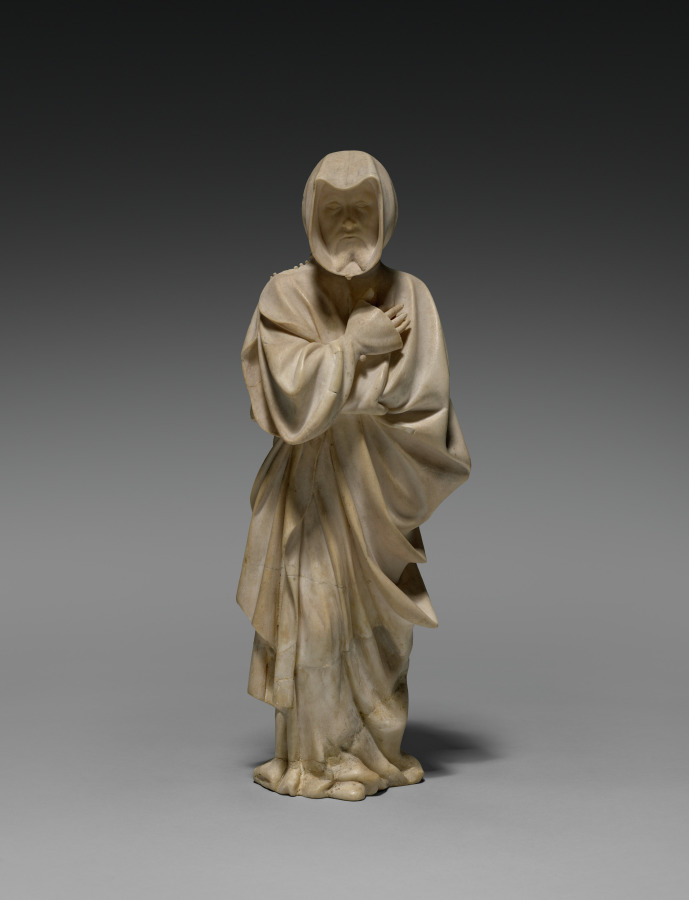
Technical Analysis: The Mourner's Geometry and the 2026 Executive Silhouette
The funerary sculpture of a Mourner from the tomb of Philip the Bold presents a paradigm of contained, architectonic grief. It is not a form given to fluid excess but one carved from a profound understanding of structural poetics. For the 2026 executive silhouette, this figure does not suggest trend; it mandates a re-calibration of the relationship between the body, fabric, and urban space. The analysis must begin with its geometric integrity—a study in vertical compression, angular articulation, and the silent drama of the occluded form.
Structural Poetics: The Architecture of Containment
The primary geometric proposition of the Mourner is the inverted triangle, stabilized by a rigid vertical axis. This is established by the expansive, cowled drapery that forms a solid, pyramidal base from the shoulders downward, tapering minimally to the concealed feet. The silhouette is one of absolute containment. There is no suggestion of the organic body beneath; instead, the body is re-imagined as a load-bearing column within a stone envelope. The cowl itself performs a critical architectural function: it simultaneously frames and obliterates the face, creating a focal point of profound negative space. This is not minimalism as reduction, but as calculated omission, where what is hidden carries greater weight than what is revealed.
The arms, crossed and bound within the drapery, complete the geometric lock. They create a strong, horizontal brace across the torso, intersecting the vertical axis and forming a cruciform stability. This self-containment is the essence of its poetics. It speaks of emotion internalized and structuralized, of pressure contained within a flawless geometric vessel. For the 2026 silhouette, this translates to a rejection of superfluous movement. The executive form becomes a monolithic entity, where tailoring must achieve this same sense of integrated, internalized structure. Seaming becomes analogous to the stone carver’s chisel marks, defining plane and volume not for decoration, but for existential truth.
Urban Materiality: From Funerary Alabaster to Technical Textile
The materiality of the sculpture—likely alabaster or limestone—informs its urban translation. The surface is cold, solid, and possesses a matte, non-reflective dignity. It absorbs light, deepening its own shadows within the carved recesses of the drapery. The 2026 material lexicon must pursue this same lithic intelligence. We move beyond wool and cotton into engineered composites: dense, matte-finish technical jerseys with substantial memory, molded neoprenes shaved to a precise, slate-grey matte, or non-woven felts with architectural drape. The color, Slate, is non-negotiable—it is the color of compressed time, of fog-laden city skies, and of the sculpture’s inherent solemnity. It provides a neutral, yet deeply authoritative, ground.
The key material innovation lies in achieving the sculpture’s simulated weight and rigidity without literal heaviness. This requires fabrics with inherent stability, capable of holding a knife-edge seam or a deep, permanent fold. The drapery of the Mourner is not soft; it is a series of hard, crystalline folds that catch the light in sharp, linear increments. In tailoring, this manifests as engineered pleating, laser-cut seams that create permanent shadow lines, and interfacings that are structural, not merely supportive. The garment becomes a second skin of urban armor, light to wear but monumental in impression.
Defining the 2026 Executive Silhouette: The Occluded Form
The 2026 silhouette derived from this analysis is rigorously Tailored, but it subverts traditional suiting. It is defined by three core principles:
1. The Cocoon Cowl: Reinterpreting the Mourner’s hood, we introduce a high, built-up neckline that rises from the shoulders to frame the jawline, often obscuring the lower face. This may be integrated into a coat’s collar or form the top of a dress. It creates anonymity and focus, directing attention to the eyes—the only visible point of human reference, much like the shadowed face within the stone hood.
2. The Cross-Braced Torso: The crossed arms are translated into diagonal seaming across the chest, or through asymmetric closures that wrap and bind the torso. Jackets may feature internal harnesses or wide, obi-like belts that cinch the monolithic form, creating that crucial horizontal interruption. Sleeves are set-in with extreme precision, continuing the clean line from the shoulder’s apex, often extending over part of the hand to further suggest containment.
3. The Vertical Aperture: The only break in the monolithic form is the single, vertical aperture where the Mourner’s hands emerge. In the silhouette, this becomes a strategic, severe opening—a single, long placket from neck to navel, a high slit in a column skirt, or a laser-cut vertical vent in the back of a coat. It is a controlled release of form, a precise negation of the whole, offering a glimpse of a contrasting black layer beneath, deepening the spatial mystery.
This silhouette is not for the expressive individualist. It is for the executive as a monumental function. It communicates through absence, through implication, and through geometric certainty. It is urban because it mirrors the city’s own combination of sheer planes, deep shadows, and relentless verticality. It is poetic because it understands that the most powerful statement is often the one most completely held in check. The Mourner from Dijon does not weep; it is weeping, rendered permanent and silent in stone. The 2026 Addison executive will not merely dress; they will be an architecture, rendered precise and formidable in Slate.