Urban Form: The Bread Line
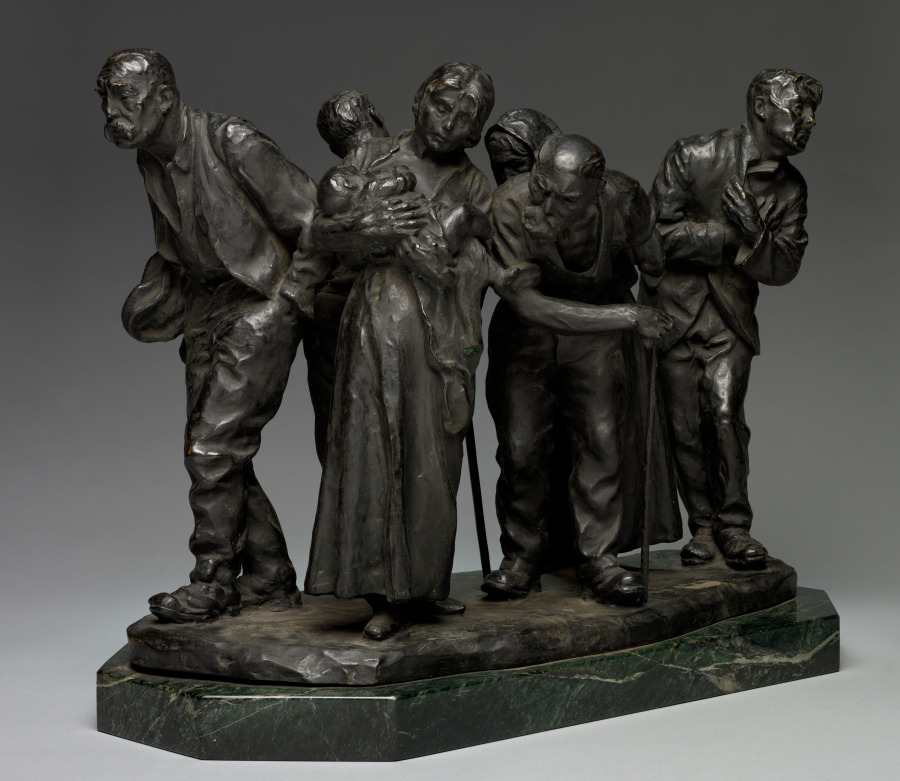
Urban Silhouette Research: The Bread Line — Structural Poetics of the Negative Fragment
I. Geometric Integrity: The Architecture of Absence
The Mold Fragment with Musicians presents a geometry that is, at first reading, incomplete. Yet within the Addison design lexicon, incompleteness is not deficiency—it is structural intentionality. The fragment’s perimeter is jagged, its interior void irregular, and its surface bears the impressed negative of fingers, strings, and breath. This is a geometry of residual pressure: the clay records force applied and then withdrawn. The silhouette it generates is not a boundary but a threshold—a line where presence becomes trace.
Contrast this with the Mortuary Figure of the Zodiac Sign: Ox (Taurus). Here, geometry achieves closure. The ox’s body is a compressed volume—haunches, shoulders, and cranial mass resolved into a single continuous contour. Its lines are taut, deliberate, and gravitational. The figure does not gesture outward; it withholds. This is the geometry of containment, where mass becomes a vessel for cosmic order. The ox stands as a column of stillness, its silhouette legible from any angle, its proportions governed by an internal logic that refuses ornament.
Together, these two artifacts define a dialectic essential to the 2026 executive silhouette: the fragment and the monolith. The Addison woman does not choose between them. She wears both—the negative space of the mold as strategic exposure, the ox as sculptural armor.
II. The 2026 Executive Silhouette: From Bread Line to Power Line
The "Bread Line" is not a reference to scarcity. It is a line of sustenance—the contour that separates the body from the void, the garment from the air. In the mold fragment, this line is porous, interrupted, and alive with absence. In the ox figure, it is sealed, weighted, and eternal. The 2026 Addison silhouette synthesizes these poles into a single architectural proposition:
Shoulder: The ox’s cranial mass translates into an extended, squared shoulder—not padded, but structured. The seam sits slightly forward, creating a negative space at the clavicle, a direct quotation of the mold’s void. This is not a cap sleeve; it is a cantilevered plane.
Torso: The mold’s impressed surface suggests compression and release. The 2026 torso is columnar but not cylindrical—a subtle A-line from underarm to hip, with a single vertical seam that runs off-center, echoing the fragment’s broken edge. The fabric does not drape; it holds a crease, as if pressed by an invisible hand.
Hip and Hem: The ox’s haunches provide the volume anchor. The hem is weighted—not with lead, but with density of weave. It falls in a controlled parabola, neither flaring nor clinging. The silhouette terminates in a clean horizontal, a line as decisive as the ox’s plinth.
Negative Space: The mold fragment teaches that what is missing defines what remains. The 2026 silhouette incorporates strategic apertures—a slit at the inner elbow, a gap at the waist seam, a keyhole at the nape. These are not decorative. They are structural vents, allowing the garment to breathe as the clay once breathed in the kiln.
III. Urban Materiality: Slate, Ash, and the Memory of Fire
The mold fragment is terracotta—earth transformed by flame. The ox figure is earthenware glazed—surface sealed against decay. For 2026, Addison translates these material histories into urban textiles that carry the memory of fire without its fragility.
Primary fabrication: A double-faced wool crepe in slate—a color that occupies the exact midpoint between the mold’s oxidized red and the ox’s funerary grey. The face is matte and dry, like unglazed clay. The reverse is smooth and cool, like the ox’s polished flank. The garment is reversible in theory, singular in practice—the wearer chooses which archaeology to expose.
Secondary fabrication: A bonded silk-cotton for the negative-space panels—semi-sheer, rigid, and paper-like. It does not flutter. It holds a fold as if it were folded parchment. This is the material of the mold’s void: absent but articulate.
Hardware: None visible. The ox figure wears no harness. The mold fragment bears no signature. The 2026 silhouette closes with concealed hooks, internal grosgrain, and a single exposed seam—a line of raw, overlocked thread that runs from hem to shoulder, a bread line of construction that refuses to hide its own making.
IV. Structural Poetics: The Silhouette as Mortuary Figure
The executive of 2026 does not dress for the boardroom. She dresses for the archive—a space where her presence will be recorded not by what she said, but by the shape she left behind. The Addison silhouette is a mortuary figure for the living: a vessel that contains ambition, fatigue, authority, and silence within a single geometric integrity.
The mold fragment reminds us that music ends. The ox reminds us that stars endure. The 2026 silhouette is the line between them—a bread line, a power line, a line of flight from the ephemeral into the permanent. It is not beautiful because it is complete. It is beautiful because it holds its own absence with the same rigor that it holds its own mass.
This is the Addison proposition: wear the fragment. Become the monolith. Leave a silhouette that outlasts the body that filled it.