Urban Form: Cupid Secretly Drawing an Arrow
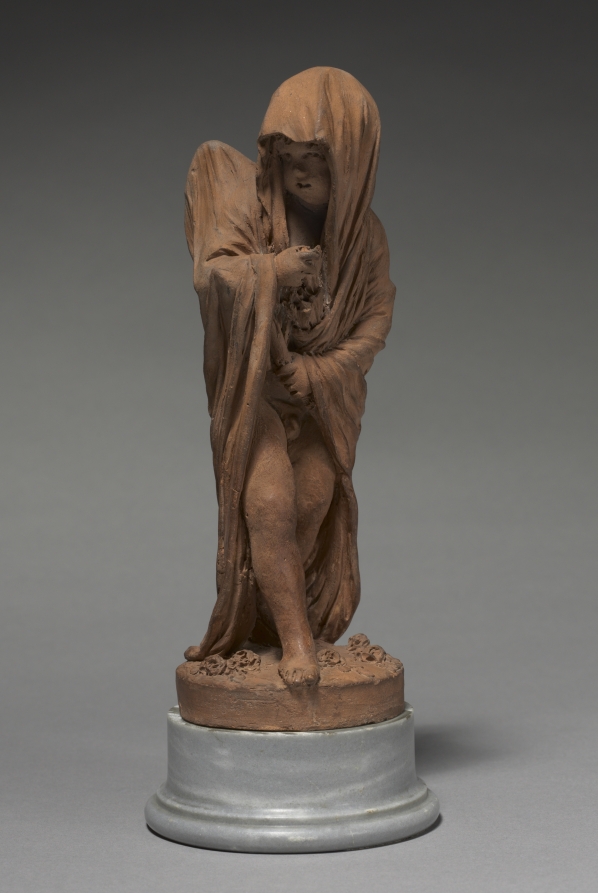
Urban Silhouette Research: Cupid Secretly Drawing an Arrow
I. The Concealed Vector: Form as Latent Tension
The Addison Fashion design intelligence for 2026 begins with a paradox: the most potent gesture is the one withheld. Our subject—Cupid Secretly Drawing an Arrow—is not a study of impact but of imminence. It is the fraction of a second before release, when the bowstring is drawn taut and the arrow has not yet left the hand. In sartorial terms, this translates to a wardrobe predicated on potential energy rather than kinetic release. The silhouette must suggest the drawn bow: a curve under tension, a line that has not yet committed to its trajectory.
The DNA source material—David's The Death of Socrates and the anonymous Wave-Patterned Meiping—operates on precisely this principle. David's Socrates is captured at the instant before death, his body already surrendering while his hand still points upward. The Meiping's cobalt waves are frozen mid-curl, their motion arrested by the kiln. Neither image depicts an event; both depict the architecture of an event. For Addison's 2026 executive wardrobe, this means garments that do not describe the body but frame its capacity for action. The shoulder is not padded to assert power; it is structured to imply the possibility of movement. The waist is not cinched to display form; it is articulated to register the breath before speech.
II. Slate as Chromatic Restraint: The Color of Unreleased Light
Slate is the chromatic equivalent of the drawn bow. It is neither the black of finality nor the white of beginning; it is the gray of the interval, the color of stone that has not yet been carved, of sky before storm. In the David painting, slate manifests as the shadowed stone of the prison cell—the ground against which Socrates' white robe and the pale light from above achieve their moral clarity. In the Meiping, slate is the blue-gray of cobalt under glaze, the wave pattern that recedes into the vessel's curve.
For the 2026 executive wardrobe, Slate functions as a chromatic neutralizer. It absorbs the ambient anxiety of the boardroom and returns it as composure. A Slate wool-cashmere overcoat, cut with a single-button closure and a collar that stands away from the neck, creates a vertical column of unbroken tone. The eye is not directed to any single feature; it is invited to perceive the whole. This is the sartorial equivalent of the Meiping's empty belly—a void that is not absence but receptive capacity.
Slate also performs a critical function in the layered executive wardrobe: it mediates between the severity of Onyx and the softness of Ivory. A Slate silk-crepe blouse beneath an Onyx tailored blazer does not compete for attention; it regulates the visual temperature of the ensemble. The result is a form of authority that does not announce itself—precisely the authority of the arrow that has not yet been loosed.
III. The Drawn Bow: Tailoring as Tension Management
The technical challenge of the Cupid silhouette is to construct garments that hold tension without visible strain. In David's composition, the tension is between Socrates' upward-pointing finger and his downward-sloping body; the painting's stability depends on this asymmetry. In the Meiping, the tension is between the vessel's swelling shoulder and its tapering foot; the pot stands because its curves are counterbalanced.
For Addison's 2026 tailoring, this translates to a new approach to the shoulder-waist-hip relationship. The shoulder is extended by 1.5 centimeters beyond the natural acromion, but the sleeve head is set with a low, soft roll rather than a sharp peak. The waist is suppressed by 2 centimeters, but the suppression is achieved through curved panel seams rather than darts, so the fabric wraps the body without pinching. The hip is released by 3 centimeters, creating a flared hem that suggests the arrow's fletching—the stabilizing feathers that ensure the arrow flies true.
The result is a silhouette that reads as poised rather than posed. It does not imitate the body; it extends the body's intention. A woman wearing this jacket does not need to square her shoulders to command a room; the garment has already done the work of drawing the bow.
IV. The Arrow's Secret: Minimalist Detailing as Narrative Withholding
Cupid's arrow is secret because it has not yet been seen. The 2026 Addison wardrobe must operate on the same principle: the most important details are the ones that are almost invisible. A single Slate silk thread stitched along the edge of a lapel. A concealed magnetic closure that eliminates visible buttons. A raw-edged hem that suggests the garment is still in the process of becoming.
These details do not decorate; they encode. They reward the viewer who looks closely, and they punish the viewer who does not. This is the sartorial equivalent of the Meiping's wave pattern: from a distance, it is a blue-and-white vase; up close, it is a philosophy of impermanence rendered in cobalt oxide.
The Addison woman of 2026 does not wear her authority on her sleeve. She wears it in the precision of her shoulder seam, the weight of her Slate wool, the silence of her closure. She is Cupid before the release—the arrow drawn, the target chosen, the world not yet changed. And in that fraction of a second, she is absolute.