Urban Form: Landscape at Loosduinen
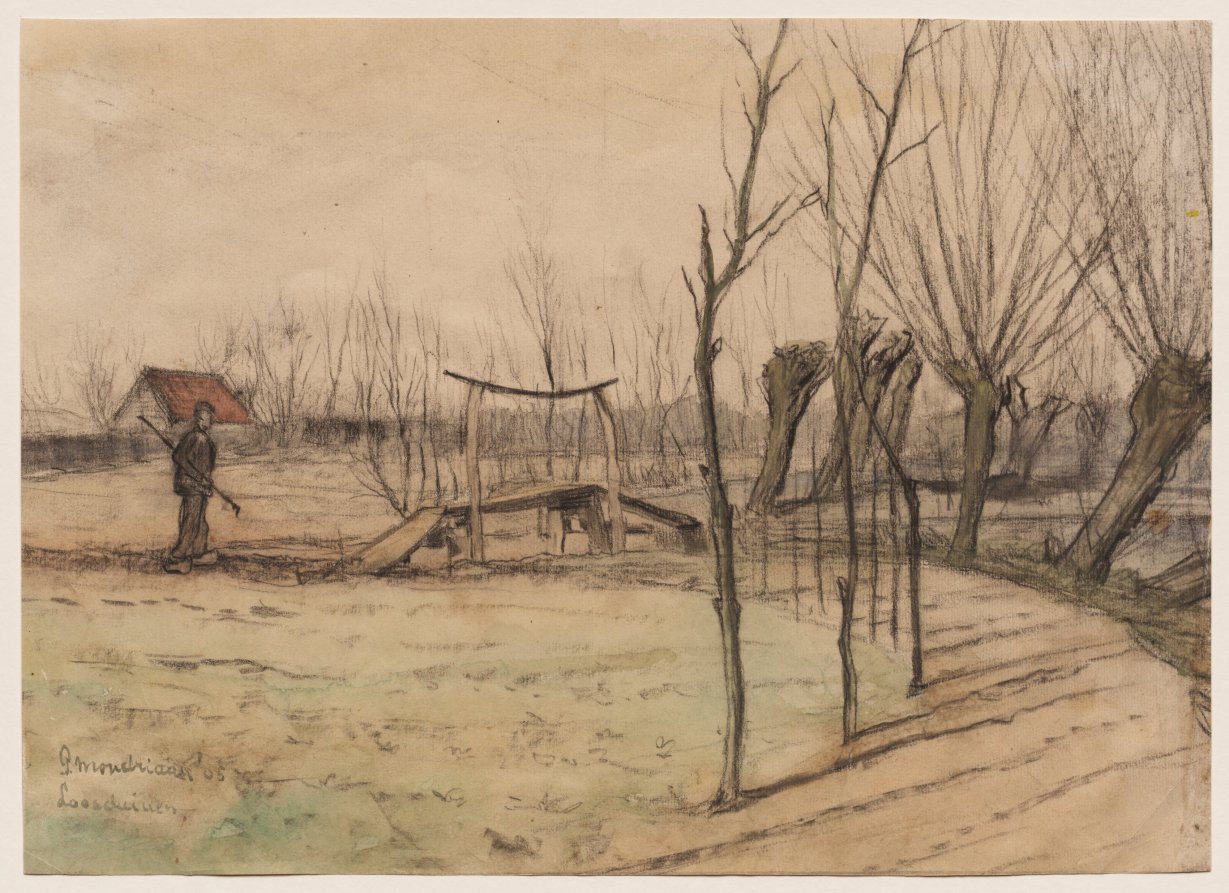
Urban Silhouette Research: Landscape at Loosduinen — Form as Containment, Color as Interval
I. The Object as Argument
The Addison Fashion NYC design intelligence for 2026 begins not with a garment but with a proposition: that the Dutch landscape painting Landscape at Loosduinen operates as a structural precedent for the executive wardrobe. Where the source DNA juxtaposes Ingres’ Oedipus and the Sphinx against a Ming blue-and-white Landscape Inscription Dish, it establishes a dialectic between the interrogative and the receptive — the sword and the mirror. Loosduinen belongs to the latter lineage. It does not dramatize. It accommodates. For the 2026 executive, whose operating environment is defined by volatility, informational density, and the collapse of the office/home binary, the receptive model is not a retreat from authority. It is a more sophisticated instrument of it.
The painting’s formal logic is one of horizontal stratification: a low horizon, an expansive sky, a recessive ground plane. There is no apex, no triangular armature of the kind Ingres deploys to stabilize his mythic confrontation. Instead, the composition distributes weight laterally, allowing the eye to travel without obstruction. This is a democratic spatial order — and it is precisely the order that the contemporary executive silhouette must adopt to remain legible across contexts.
II. Form: The Architecture of Non-Interference
The Addison 2026 silhouette is derived from this lateral logic. The shoulder line is extended but not exaggerated — a controlled horizontal that references the painting’s horizon without descending into caricature. The torso is constructed as a single continuous plane, eliminating the darting and seaming that would introduce visual noise. This is not minimalism as absence; it is minimalism as structural clarity. Every seam that remains must justify its existence as a load-bearing element of the composition.
The sleeve is the critical intervention. In the Loosduinen model, the sleeve does not taper to a wrist-hugging cuff, which would create a terminal point of tension. It falls in a straight column, its volume sustained by a bias-cut underlayer that allows movement without collapse. The effect is one of suspended animation — the garment appears to be in a state of continuous, unhurried motion, much as the painting’s cloud formations suggest a sky that is never static.
Below the waist, the Addison trouser abandons the aggressive taper of the previous decade. The leg is cut straight from hip to hem, with a subtle break at the instep that references the painting’s recessive ground plane. The silhouette is not vertical; it is columnar — a term that implies both support and restraint. In the executive context, this reads as composure under pressure.
III. Color: Slate as Interval, Not Statement
The palette for this collection is anchored in Slate — a color that occupies the precise midpoint between the painting’s atmospheric greys and the mineral blues of its distant tree line. Slate is not a neutral in the conventional sense. It is an active interval, a chromatic pause that allows adjacent elements to register with greater precision. In a wardrobe designed for the executive who moves between boardroom, studio, and transit, Slate functions as a stabilizing constant — the visual equivalent of a low horizon that never competes with the figures moving across it.
The collection deploys Slate in three tonal registers: a cool, blue-leaning variant for outerwear; a warmer, brown-leaning variant for tailoring; and a near-grey variant for knitwear and base layers. These are not variations for their own sake. They are calibrated to interact with the wearer’s skin tone and the ambient light of the environments in which the garments will be worn. The result is a wardrobe that does not announce itself but adapts — a direct translation of the painting’s capacity to hold both storm light and clear light within a single frame.
IV. The Executive Application
For the 2026 NYC executive, the Loosduinen-derived silhouette resolves a persistent tension: the demand for authority without aggression, for presence without performance. The garment does not interrogate the room. It contains it. The extended shoulder and columnar leg create a perimeter of calm; the Slate palette provides a chromatic ground against which the wearer’s gestures — a hand raised in negotiation, a turn toward a window — register with heightened clarity.
This is the Addison proposition: that the most powerful position in any room is not the apex of a triangle but the horizon line itself — the element that organizes everything above and below it without ever demanding to be the subject. The 2026 wardrobe is not a costume for the executive. It is the infrastructure of executive presence.