Urban Form: Architecture of the Middle Ages: Hotel Bourgtheroulde, Rouen
The Bourgtheroulde Protocol: Architectural Geometry and the 2026 Executive Silhouette
I. The Facade as Armature
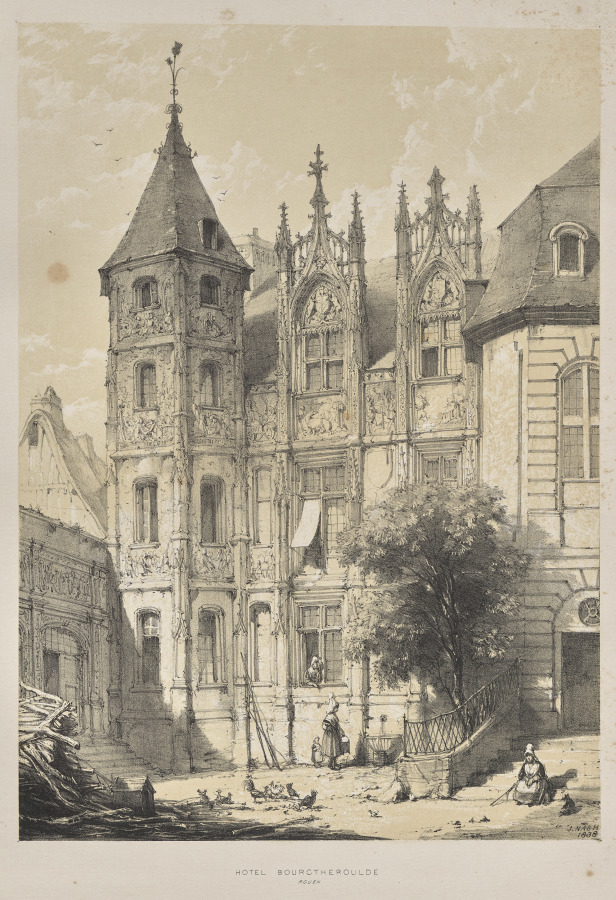
The Hôtel de Bourgtheroulde in Rouen is not merely a building; it is a treatise on the tensile relationship between ornament and structure. Constructed between 1486 and 1531, its transition from Flamboyant Gothic to early Renaissance syntax offers the Addison studio a precise vocabulary for the 2026 executive wardrobe. The facade presents a double-coded geometry: the vertical insistence of the Gothic pinnacle and the horizontal rationality of the Renaissance entablature. This is not contradiction. It is layered resolution—the architectural equivalent of a tailored jacket whose shoulder line carries the severity of a flying buttress while its hem dissolves into the quietude of a limestone plinth.
For the Addison executive, this translates into a silhouette that refuses the false binary between soft and hard. The Bourgtheroulde does not choose. Its stone is carved into foliate tracery, yet that tracery obeys a structural logic as strict as any load-bearing column. The 2026 silhouette must perform the same operation: decorative rigor. A lapel that curves like an ogee arch but holds its edge like a machined beam. A cuff that flares with the confidence of a gargoyle’s wing but retracts into the wrist with the discipline of a steel joint.
II. The Courtyard as Negative Space
We must consider the courtyard—the cour d’honneur—as the primary generator of the Addison silhouette. The Bourgtheroulde’s interior court is a void carved from mass, a negative space that defines the building’s volume more decisively than any exterior wall. In the 2026 executive wardrobe, this principle manifests as strategic absence. The silhouette is not built from fabric alone; it is built from the air that the fabric encloses. A coat that does not hug the body but architects a chamber around it. A trouser that does not taper to the ankle but descends like a colonnade, each pleat a pilaster, each break a shadow.
The courtyard also introduces the concept of controlled exposure. The Bourgtheroulde’s facade is pierced by windows that reveal and conceal in equal measure. The 2026 executive silhouette must operate with the same discretion: a slit at the shoulder blade that suggests movement without revealing skin. A vent at the back that opens like a Gothic lancet but closes with the finality of a Renaissance door. This is not modesty. This is architectural tension—the knowledge that what is withheld defines the form more than what is displayed.
III. Materiality: Stone, Shadow, and the Weight of Light
The Bourgtheroulde is built from limestone—a material that absorbs light rather than reflecting it. This is the antithesis of the metallic, high-gloss surfaces that have dominated executive fashion for a decade. For 2026, Addison proposes a return to matte materiality: wool crepe that swallows light like Caen stone, silk that pools in shadow like a recessed niche, leather that ages with the patina of a weathered buttress. The palette is Slate—not gray, but the specific, mineral gray of Rouen’s sky pressed against its cathedral. A color that is neither warm nor cool, but structural.
The stone’s surface is not smooth. It is tooled, pitted, marked by the centuries. The 2026 silhouette must carry the same tactile memory. A weave that records the loom’s tension. A seam that reveals the hand of the cutter. A button that bears the weight of its own casting. This is not nostalgia. This is evidence—the proof that the garment was made by a human hand, for a human body, in a human time.
IV. The Silhouette as Secular Reliquary
The Bourgtheroulde was built as a residence for a wealthy merchant, but its architecture aspires to the sacred. Its pinnacles reach toward heaven; its courtyards enclose a private Eden. The 2026 executive silhouette must perform the same secular transubstantiation. It must transform the boardroom into a cathedral, the negotiation into a liturgy, the quarterly report into a stained-glass window. This is not irony. This is earnest architecture—the belief that form can elevate function, that a well-cut jacket can make a person feel not merely dressed, but consecrated.
The Addison executive does not wear clothing. They inhabit it. The Bourgtheroulde does not stand in Rouen. It presides. The 2026 silhouette must do the same: preside over the body, over the room, over the moment. It must be a structure that the wearer enters, not a skin that the wearer wears. It must be Slate—the color of stone, of shadow, of the space between what is said and what is meant. It must be Minimalist—not because it lacks detail, but because every detail is load-bearing.
The Bourgtheroulde has stood for five centuries. The 2026 Addison silhouette will not last that long. But it must carry the same architectural intention: the knowledge that a garment, like a building, is a promise made to the future. A promise that form will hold. That structure will endure. That the body, like the stone, will find its shape in the space between gravity and grace.