Urban Form: Kneeling Carthusian Monk
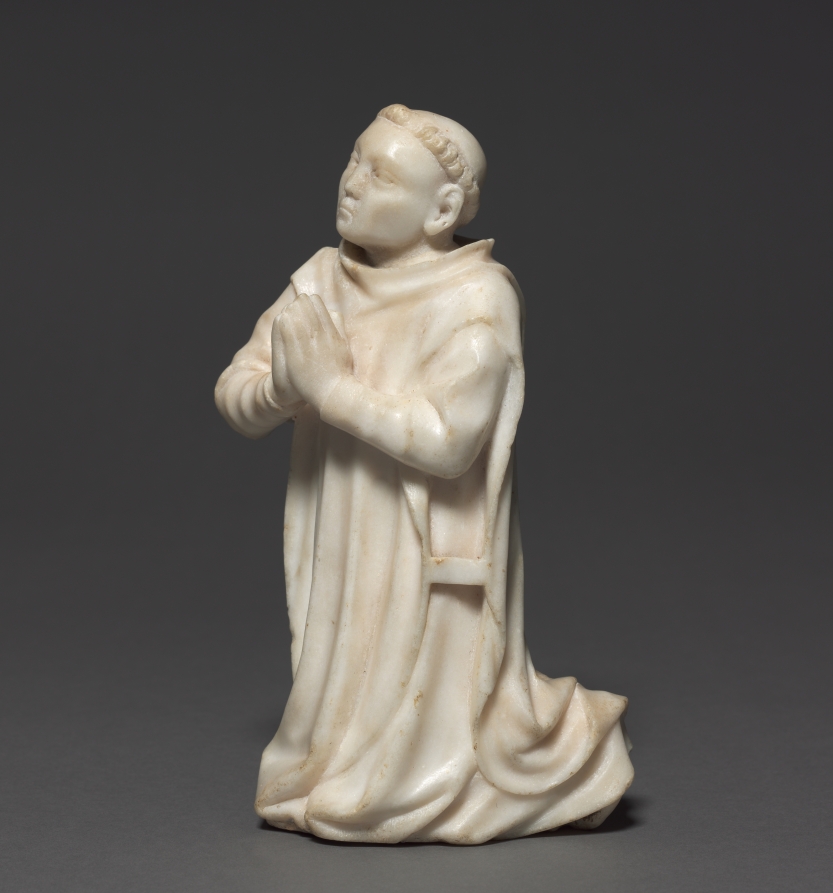
Urban Silhouette Research: The Kneeling Carthusian Monk as Architectural Prototype
I. Preliminary Geometry: The Fold as Structural Unit
The Addison Fashion atelier approaches the Kneeling Carthusian Monk not as devotional iconography but as a closed geometric system. The figure presents a near-perfect pyramidal mass—apex at the bowed cranium, base distributed across the kneeling shins—whose integrity depends entirely upon the discipline of its textile envelope. This is the architecture of surrender: a silhouette that achieves monumental stillness through the systematic negation of the body beneath. For the 2026 executive wardrobe, the lesson is unambiguous. Power no longer announces itself through shoulder breadth or waist suppression; it manifests as contained volume, a controlled monolith that refuses the viewer's gaze while commanding the room's negative space.
The cowl and scapular function as a single continuous plane, unbroken by seam or fastening. This unitary construction—what we term the "monastic monoblock"—eliminates the visual noise of conventional tailoring: no lapel roll, no button stance, no dart interruption. The result is a garment that reads as carved rather than sewn, its surface a single uninterrupted field of Slate wool or bonded cashmere. The 2026 executive jacket will adopt this logic: a collarless, closure-less shell whose only articulation is the shoulder slope and the hem's relationship to the knee.
II. The Fold as Load-Bearing Element
Examine the drapery at the figure's lap and forearms. Each fold is not incidental but structural—a compression fold that redistributes the weight of the heavy wool across the horizontal plane of the thighs. In engineering terms, these are living hinges: points of calculated flexion that allow a rigid material to accommodate the body's geometry without losing its architectural memory. Addison's 2026 outerwear will replicate this through knife-pleated gussets at the elbow and hip, allowing the garment to collapse into a seated posture while retaining its standing silhouette.
The critical insight is that the monk's robe does not drape over the body; it replaces it. The textile becomes the primary volume, the flesh a mere armature. This inversion—garment as architecture, body as infrastructure—defines the coming season's most radical proposition: the executive silhouette as inhabited space rather than fitted surface.
III. Materiality and the Urban Surface
The Carthusian wool is coarse, matte, and light-absorptive—a fabric that refuses sheen. In the urban context, this translates to non-reflective surfaces: brushed alpaca, felted cashmere, double-faced wool in undyed Slate and graphite. The 2026 executive will move through glass towers and halogen-lit lobbies without catching a single specular highlight, a deliberate optical withdrawal that signals authority through absence rather than display.
The cowl's deep shadow—that black void where the face should be—is the silhouette's most potent gesture. It is a negative space that functions as a visual anchor, drawing the eye downward and inward. Addison will translate this into the deep-set funnel collar, a neckline that rises to the jaw and casts the wearer's features into partial obscurity. In an age of surveillance and overexposure, the covered face is the ultimate luxury.
IV. The Kneeling Posture and Executive Mobility
The monk kneels, but the robe does not crease at the knee. This is the result of strategic excess—fabric allocated not for movement but for postural transition. The garment anticipates the body's next position without revealing the current one. For the 2026 executive, this demands a new pattern-cutting philosophy: anticipatory tailoring, in which the garment is engineered for the next gesture rather than the present stance.
Practically, this means extended back hems, dropped shoulder seams, and circular side panels that allow the wearer to rise from a seated position—boardroom, sedan, dining chair—without the silhouette fracturing. The Addison prototype will employ a single-seam back, eliminating the center vent in favor of a continuous panel that maintains its line whether the wearer is standing, seated, or in transit.
V. Conclusion: The Monastic Monoblock as 2026 Archetype
The Kneeling Carthusian Monk offers Addison Fashion a total silhouette: a closed, self-referential volume that neither invites nor requires interaction. Its geometry is pyramidal, its materiality absorptive, its construction unitary. For the 2026 executive, this translates to a wardrobe of Slate monoliths—collarless, closure-less, seam-reduced—that prioritize spatial presence over bodily display. The monk does not dress to be seen. The 2026 executive will not either. The difference is that the monk kneels before God; the executive will kneel before no one, wearing the silence of the cloth as armor.