Urban Form: Maharaja of Rewa and Sardars
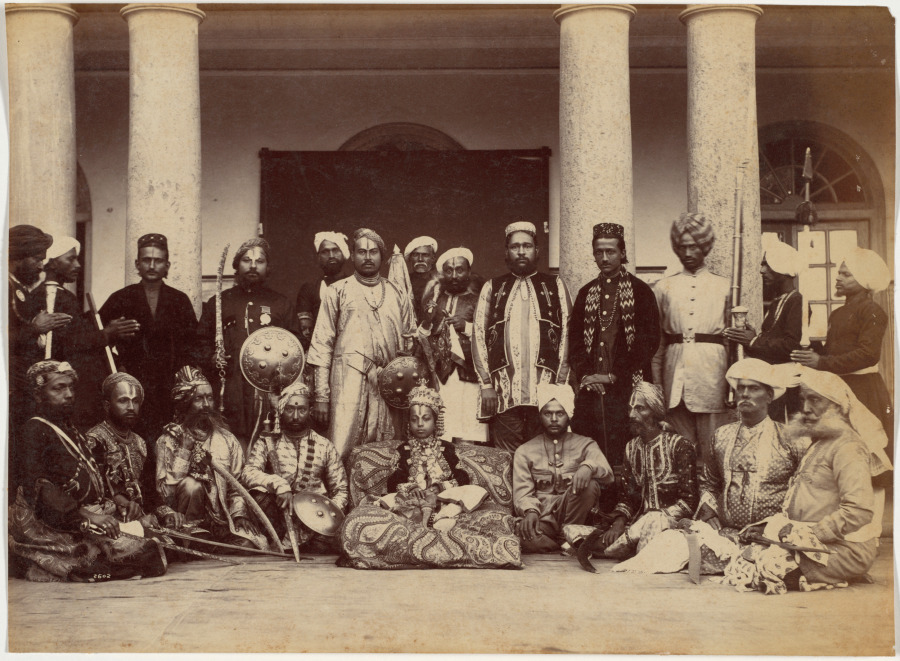
Urban Silhouette Research: The Rewa Lineage and the Architecture of Sonic Space
I. The Geometric Integrity of the Fragment
The Mold Fragment with Musicians presents a critical study in interrupted geometry. Its structural logic is not derived from the completeness of the vessel but from the residual tension between the musicians' postures and the broken perimeter. Each figure occupies a discrete spatial cell, yet the rhythmic alignment of shoulders, elbows, and instruments creates a continuous horizontal band of kinetic energy. The geometry is non-symmetrical but rhythmically calibrated—a sequence of offset verticals anchored by the implied horizon of the mold's original rim. The negative space between figures is not void; it is the acoustic interval, the breath between notes, rendered in fired clay.
For the 2026 executive silhouette, this fragment dictates a principle of asymmetric structural continuity. The Addison tailleur must not resolve into a closed system. Instead, it should preserve the tension of the incomplete—a shoulder seam that suggests extension beyond the body, a lapel that cuts at an angle implying a missing counterpart. The garment becomes a mold: it shapes the wearer without fully containing them.
II. The Mirror as Dialectical Surface
The Square Mirror with Two Phoenixes and Floral Sprays operates on a contrary geometric principle. Here, the square format imposes absolute containment, while the interior composition—two phoenixes in mirrored flight, their wings interlocking with floral sprays—generates a centrifugal force that strains against the frame. The phoenixes are not decorative; they are vectors of escape. Their curved necks and swept primaries describe arcs that, if extended, would breach the mirror's edge. The floral sprays function as connective tissue, binding the avian figures into a single rotational system. This is geometry as contained explosion.
Translated to urban materiality, the mirror's logic demands a fabric surface that is simultaneously reflective and absorptive. The 2026 executive requires textiles with a low-sheen slate finish—matte enough to absorb ambient light, yet with a subtle luster that catches movement. The silhouette must echo the phoenix's paradox: a tailored jacket that appears rigid in repose but reveals fluid articulation when the wearer gestures. The square shoulder, the defined waist, the flared hem—each element is a frame within which the body's motion becomes the decorative motif.
III. Time and Space in the Rewa Sardar's Wardrobe
The Maharaja of Rewa and his sardars operated within a visual culture that understood ceremonial dress as temporal architecture. The angarkha's crossover closure, the sash's diagonal tension, the turban's spiral elevation—these are not merely garments but instruments of spatial negotiation. The sardar's silhouette in durbar was a calculated intervention: broad at the shoulders to assert presence, tapered at the waist to signal discipline, grounded at the feet to imply permanence. This is the same dialectic found in the Tang artifacts—the musician's dynamic posture and the phoenix's cyclical flight.
For Addison's 2026 executive line, the Rewa DNA manifests as layered structural transparency. An outer coat in slate wool, cut with a geometric precision that references the mold fragment's rhythmic intervals. Beneath it, a silk twill shirt whose print—abstracted from the mirror's phoenix symmetries—remains visible only at the cuffs and collar. The layers do not compete; they converse. The outer garment is the mold, the inner is the music.
IV. Materiality and the Urban Condition
The urban executive navigates spaces of compression and release: the elevator, the boardroom, the street. The silhouette must perform under these varying pressures. The Mold Fragment teaches us that incompleteness is a form of resilience—a garment that does not attempt to resolve every line remains adaptable. The Mirror teaches us that reflection is a structural property—the surface must engage with its environment without surrendering its integrity.
Therefore, the Addison 2026 silhouette employs engineered slate wool with a bonded inner layer that maintains the garment's architectural line while allowing micro-movements. Seams are placed not where tradition dictates, but where the body's kinetic map requires reinforcement. The result is a tailored form that feels inevitable—as though the wearer's skeleton has been extended into cloth.
V. Conclusion: The Silhouette as Instrument
The Maharaja of Rewa's sardars understood that dress is a form of governance—over space, over time, over perception. The Tang artisans understood that art is a form of listening. The 2026 Addison executive wears a silhouette that does both: it governs the visual field through geometric precision, and it listens to the body's rhythm through material intelligence. The slate palette is not a retreat into neutrality; it is the color of stone that has been shaped by water, of sky before a storm, of a mirror's reverse. It is the color of structural poetics.
The definitive urban silhouette for 2026 is not a shape. It is a system of tensions—between the fragment and the whole, the frame and the flight, the mold and the music. Addison Fashion does not dress the executive. It equips the executive with a second architecture.