Urban Form: Virgin and Child
Urban Silhouette Research: The Virgin and Child as Architectural Prototype
I. Geometric Integrity: The Closed Contour as Executive Armature
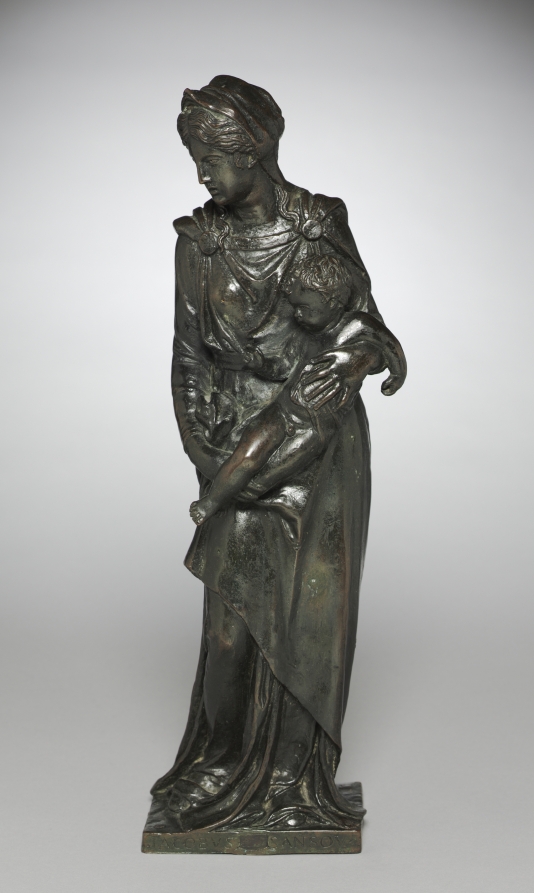
The Virgin and Child presents a compositional geometry that operates less as devotional iconography than as a closed structural system. The Virgin's mantle describes a near-perfect isosceles triangle—apex at the crown, base at the hem—while the Child introduces a secondary, countervailing mass that disrupts the symmetry without collapsing it. This is not organic drapery. This is load-bearing fabric.
For the 2026 executive silhouette, the implication is precise: the shoulder line must remain uncompromised. The mantle's descent from clavicle to floor is continuous, unbroken by waist suppression or decorative interruption. We are reading a columnar architecture in which the body is present but subordinate to the garment's tectonic logic. The Virgin's form is not revealed; it is housed. This is the fundamental distinction between tailoring that follows anatomy and tailoring that constructs a parallel anatomy. Addison Fashion operates in the latter register.
The Child's position—held at the left hip, angled forward—creates what we term a displaced axis. The silhouette is not bilaterally symmetrical, yet it reads as balanced. This asymmetry is structural, not gestural. It anticipates the 2026 requirement for garments that accommodate movement without sacrificing planar integrity. The executive woman does not stand still. The silhouette must therefore be engineered for controlled disequilibrium.
II. Materiality and the Urban Surface
The surface treatment of the Virgin and Child—whether in tempera, fresco, or mosaic—consistently privileges matte density over luminosity. The blues are mineral, the reds are earth-derived, the gold is applied as line rather than field. This is a palette of urban materiality: slate, oxidized copper, brick, and the particular grey of concrete at dusk.
For 2026, we translate this into fabric selection. The mantle's weight suggests a double-faced wool or a bonded crepe with sufficient body to hold a sculpted line without interlining. The Child's garment, by contrast, implies a finer gauge—perhaps a merino-silk blend—that allows for the compression and release of the figure's angled posture. The contrast is not decorative; it is functional. The outer layer provides structure, the inner layer permits movement. This is the onion principle of executive dressing, refined to its most essential expression.
The gold line—whether halo, hem, or architectural detail—must be understood as linear infrastructure. It does not embellish; it articulates. A single vertical seam, a precisely placed topstitch, a narrow piping at the shoulder: these are the equivalents of the gold ground in a Byzantine icon. They define the garment's geometry without filling it. The 2026 executive wardrobe will be built on this principle of selective articulation.
III. The Virgin and Child as Proto-Minimalist Statement
What distinguishes this work from its contemporaries is its refusal of narrative excess. There is no landscape, no attendant figures, no architectural setting. The Virgin and Child exist in a void—a neutral ground that functions as both absence and potential. This is the visual equivalent of the urban executive's daily reality: a figure moving through undifferentiated space, defined not by context but by presence.
The 2026 silhouette must therefore be self-sufficient. It cannot rely on layering, accessorization, or environmental cues to achieve its effect. A single coat, a single dress, a single suit must carry the entire visual argument. This demands a level of internal complexity—dart placement, seam engineering, grain manipulation—that is invisible in the finished garment but perceptible in its movement and drape. The Virgin's mantle does not reveal its construction. Neither should the Addison coat.
IV. Structural Poetics: The Held Child as Design Principle
The Child is not merely an accessory to the Virgin's silhouette. The Child is a structural counterweight. The Virgin's body must accommodate this additional mass without losing its vertical integrity. The left arm supports; the right arm gestures. The torso rotates slightly; the hips remain forward. This is a study in asymmetric load-bearing.
For the 2026 executive silhouette, this translates into garments designed for the carrying body—the body that holds a bag, a tablet, a portfolio, a child. The shoulder must be reinforced. The waist must be released. The hem must be weighted. The garment must function as exoskeleton, not as decoration. The Virgin's mantle is not a dress. It is a system.
Addison Fashion's 2026 collection will operationalize this insight. The Virgin and Child is not a religious image. It is a technical drawing for the urban executive silhouette: closed, columnar, materially dense, and structurally asymmetric. It is the prototype for a garment that does not follow the body but precedes it—a garment that constructs the woman who will wear it.
The void behind the Virgin is the city. The gold line is the skyline. The Child is the weight of the day. The mantle is the Addison coat. The silhouette is resolved.