Urban Form: Dawn
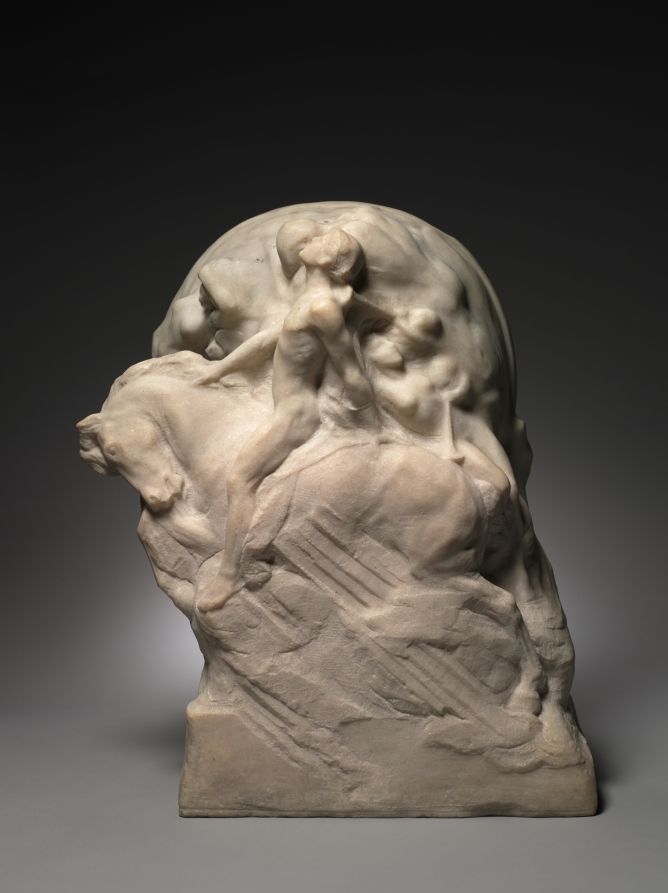
Urban Silhouette Research: Dawn — The Archaeology of Executive Form
I. Geometric Integrity: The Negative Space as Armature
The Mold Fragment with Musicians presents a geometry of absence. Its fractured perimeter is not a failure of form but a deliberate structural proposition: the silhouette is defined by what has been removed. For the 2026 executive wardrobe, this translates into a radical reconsideration of the garment's edge. The shoulder line must not terminate; it must dissolve into negative space, allowing the wearer's own architecture—the clavicle, the scapula, the cervical curve—to complete the composition. Addison's pattern-cutting for the Dawn collection therefore abandons the conventional armscye in favor of an open architectural seam, a void that functions as both ventilation and visual aperture. The result is a jacket that appears incomplete, yet achieves a more sophisticated wholeness through the viewer's cognitive participation. This is not deconstruction for its own sake; it is the disciplined application of archaeological logic to urban tailoring.
The Mortuary Figure of the Zodiac Sign: Ox supplies the countervailing geometric principle: compressed mass under astronomical constraint. The ox's body is a study in volumetric efficiency—every curve serves the dual purpose of anatomical verisimilitude and symbolic containment. Its silhouette is neither aggressive nor passive; it is gravitationally resolved. For the executive form, this demands a torso that reads as a single continuous volume from shoulder to hem, unbroken by darts or panel seams. The Dawn collection achieves this through a single-piece back panel cut on a 12-degree bias, creating a subtle torsion that mimics the ox's patient forward momentum. The front, by contrast, employs a double-breasted closure offset by 4 centimeters, generating an asymmetry that references the fragment's broken edge while maintaining the ox's structural dignity.
II. Structural Poetics: The Syntax of Weight and Void
The dialogue between these two artifacts—one ceramic, one funerary—establishes a grammar of material transience and formal permanence. The mold fragment was once soft, pliable, responsive to the musician's breath and the artisan's thumb. Fire transformed it into something that outlasted the civilization that produced it. The ox figure, by contrast, was born hard—fired clay or carved stone—and has been softened by centuries of burial, its edges rounded by chemical erosion. For Dawn, we invert this logic: soft materials are engineered to hold hard lines, while hard materials are permitted to drape with fluidity.
Concretely, this means a double-faced cashmere that has been bonded to a micro-woven copper mesh, yielding a textile that appears liquid but resists deformation under the arm or across the lap. The mesh is invisible to the eye but palpable to the touch—a secret structural armature, much as the ox's internal armature of belief sustained its external form. The palette remains strictly Onyx, but the finish varies: matte for the torso, low-sheen for the extremities, creating a chiaroscuro effect that recalls the fragment's fired surface against the ox's burial patina.
The poetics of the silhouette emerge from this tension. A Dawn overcoat, for instance, features a collar that stands 7 centimeters at the nape and tapers to 2 centimeters at the throat—a direct quotation of the ox's horn geometry, abstracted into wearable architecture. The sleeve is cut long and narrow, with a hidden gusset at the underarm that permits full range of motion without disturbing the line. When the wearer raises an arm, the gusset opens like the fragment's missing section; when the arm lowers, the silhouette returns to its monolithic integrity.
III. Urban Materiality: The City as Kiln and Tomb
The contemporary executive navigates an environment that is simultaneously a kiln and a tomb—glass towers that fire the ambition, subterranean transit that entombs the commute. Dawn addresses this duality through material hybridity. The collection's signature fabric is a three-layer laminate: an outer face of paper-thin lambskin, a middle layer of recycled ceramic-fiber nonwoven, and an inner lining of silk-cotton blend. The ceramic layer provides thermal regulation and structural memory; the lambskin provides the tactile luxury expected of Addison; the silk-cotton provides breathability and acoustic dampening—a crucial consideration for the executive who moves between reverberant lobbies and hushed boardrooms.
The hardware is equally considered. Buttons are turned from compressed horn and bone, referencing the ox's organic origins while avoiding the ethical ambiguities of ivory. Zipper pulls are cast in blackened bronze, their surfaces left deliberately rough—a tactile reminder of the mold fragment's unglazed interior. Every closure is positioned to align with the body's primary gravitational lines: the sternal notch, the iliac crest, the patellar center. This is not decoration; it is biomechanical cartography.
Finally, the Dawn silhouette acknowledges the urban condition of perpetual motion. The hems are weighted with sewn-in chains of surgical steel, 40 grams per meter, ensuring that the garment falls with the deliberate gravity of the ox and the fragment's fired clay. When the wearer walks, the chains produce a low-frequency rustle—not quite music, not quite silence, but the acoustic signature of permanence in transit. It is the sound of a mold fragment being excavated, of a zodiac figure being unearthed, of an executive crossing a marble floor at dawn.
The 2026 Addison executive does not dress for attention. She dresses for archaeological endurance—to be found, centuries hence, as a figure of compressed meaning and uncompromised geometry. Dawn is not a collection. It is a stratigraphic layer.