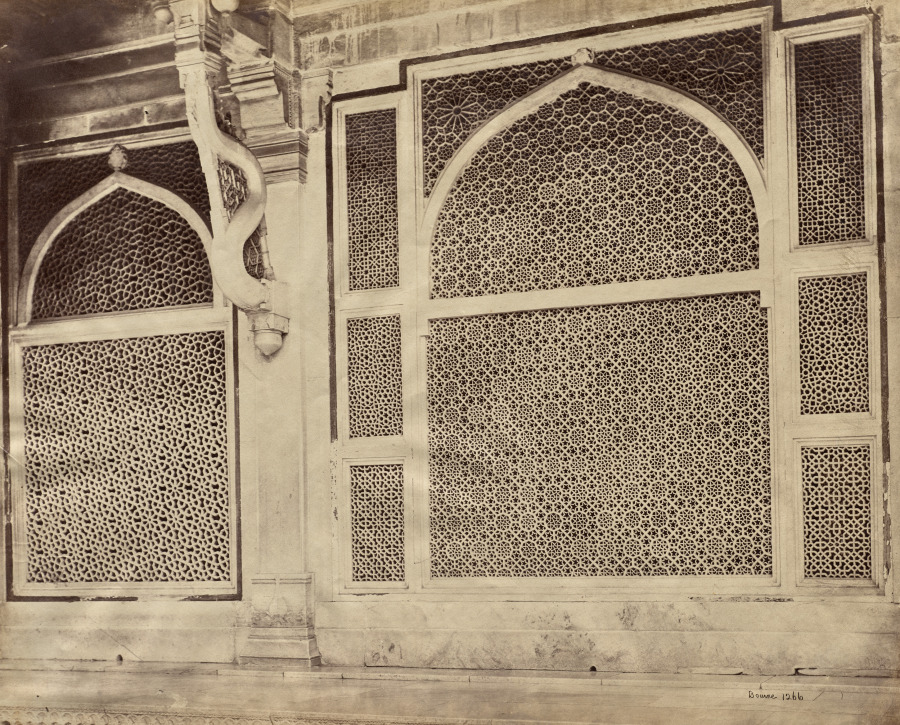
Urban Form: Futtypore Sikri—Two of the Marbled Screens in the Tomb of Sheik Selim Chisti
Urban Silhouette Research: The Perforated Plane as Executive Armature
I. Object Analysis: Two of the Marbled Screens in the Tomb of Sheik Selim Chisti
The subject under examination is not an object of adornment but an instrument of spatial division—two pierced marble screens, jali, set within the tomb of Sheik Selim Chisti at Fatehpur Sikri. Their material is ivory-toned marble, veined with the faintest geological memory, carved into a lattice of interlocking hexagons and six-pointed stars. The screens do not depict. They filter. Light passes through them not as illumination but as a calibrated substance, broken into geometric increments that fall upon the interior floor as a secondary architecture—a shadow-grid that shifts with the sun's declination. The marble itself is thin, nearly translucent at the intersections, a testament to the Mughal lapidary's refusal to treat stone as mass. Here, stone is treated as membrane. The screen is a wall that breathes, a boundary that admits. Its structural logic is one of subtraction: the removal of material to generate pattern, the carving away of the superfluous until only the essential armature remains. This is not decoration. This is load-bearing emptiness.
II. Geometric Integrity: The Hexagon as Executive Protocol
The governing geometry is the hexagon—six sides, six vertices, a figure that tessellates without residue, that distributes stress evenly across its perimeter, that encloses maximum area with minimum perimeter. In the context of the 2026 executive silhouette, the hexagon is not a motif but a behavioral code. It dictates that a garment must resolve tension through distribution, not through reinforcement. The shoulder line, therefore, is not padded into a rigid shelf but carved into a perforated plane—a structure that appears weightless yet bears the full gravitational load of authority. The jali screen teaches that strength is not synonymous with opacity. The executive jacket of 2026 must function as a social screen: it reveals and conceals in precise ratio, admitting the gaze while withholding the interior. The hexagon's six-fold symmetry also implies a 360-degree awareness—the wearer is not oriented toward a single audience but calibrated for omnidirectional scrutiny. This is the geometry of the boardroom as panopticon, and the silhouette must answer it with a lattice of composure.
III. Structural Poetics: The Poetics of the Perforated Plane
The poetics here are not lyrical but tectonic. The screen's beauty resides in its capacity to make absence visible. The voids are not negative space; they are active participants in the composition. Translated to tailoring, this demands a radical rethinking of the seam. The seam is no longer a line of closure but a line of controlled aperture. Consider a wool crepe jacket in ivory, its front panel constructed not as a solid field but as a series of vertical slits—laser-cut, bound in silk organza—that allow the body beneath to register as a shadow-self. The lapel is not folded but excavated, its edge a clean incision that exposes the interior structure: the horsehair canvas, the hand-stitched pad, the architectural skeleton normally hidden. This is the honest silhouette—one that does not disguise its construction but presents it as ornament. The jali screen does not hide its marble; it reveals its marble through the act of piercing. The 2026 executive garment must do the same: reveal its material truth through the precision of its cut.
IV. Urban Materiality: Ivory Marble and the Executive Palette
The color is ivory—not white, which is absolute and sterile, but ivory, which carries the memory of organic origin. Ivory is the color of bone, of parchment, of the interior of the shell. It is a warm neutrality, a hue that absorbs the ambient light of the city and returns it softened, diffused, civilized. In the urban context, ivory is the color of strategic withdrawal. It does not compete with the neon and the glass; it absorbs them and renders them irrelevant. The materiality of the screen—cool to the touch, faintly luminous, marked by the subtle veining of geological time—translates to a fabric vocabulary of matte silk faille, paper-thin calfskin, merino crepe with a chalky hand. These are materials that do not shine; they glow. They do not reflect the city; they filter it. The executive who wears ivory in 2026 is not seeking visibility but legibility—a presence that is read rather than seen, that operates through the slow accumulation of detail rather than the sudden flash of assertion.
V. The 2026 Silhouette: A Provisional Specification
The definitive 2026 executive silhouette, derived from the jali screen, is a column of filtered light. It is narrow but not tight, structured but not rigid. The shoulder is unpadded but reinforced through internal taping, creating a line that is horizontal yet soft. The torso is elongated, the waist suppressed not by darts but by the convergence of vertical apertures—slits that draw the eye downward in a controlled descent. The hem is weighted, not with lead but with the density of the fabric itself, ensuring that the garment falls with the gravity of stone. The sleeve is narrow at the wrist, exposing the hand as the screen exposes the garden—a framed glimpse of the organic within the geometric. The overall effect is one of contained permeability: the wearer is present but not exposed, armored but not sealed. This is the silhouette of the urban ascetic, the executive who understands that authority is not the assertion of mass but the mastery of interval—the precise calibration of what is shown and what is withheld, what is solid and what is void, what is marble and what is light.
The screens of Fatehpur Sikri have waited four centuries for a wardrobe that understands them. The 2026 Addison executive is that wardrobe: a wearable jali, a portable tomb for the living, a geometry of composure in a city that has forgotten how to be still.