Urban Form: Virgin and Child in Majesty
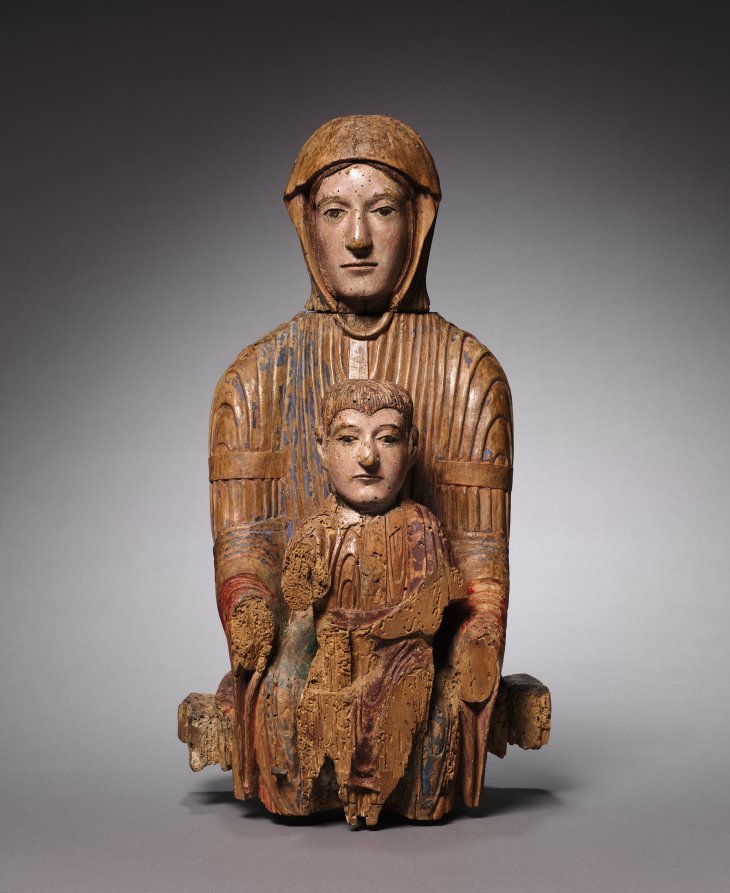
Urban Silhouette Research: The Virgin and Child in Majesty as Structural Archetype
I. The Enthroned Form: A Study in Centralized Mass
The Sedus Sapientiae—the Seat of Wisdom—is not a chair. It is an architectural proposition. In the Romanesque Virgin and Child in Majesty, the Madonna does not sit so much as she occupies a volumetric axis. The frontal pose, the symmetrical drapery, the rigid verticality of the throne: these are not devotional accidents. They are formal decisions that produce a silhouette of absolute authority. For Addison Fashion’s 2026 executive wardrobe, this is the ur-text of power dressing. The Virgin’s mantle does not follow the body; it replaces it. The body becomes a column, the drapery a load-bearing wall. In minimalist terms, this translates to the column dress in double-faced wool, the cocoon coat with suppressed waist, the tunic that falls from the clavicle in a single uninterrupted plane. The silhouette is not about the wearer’s anatomy. It is about the wearer’s jurisdiction.
II. Color as Hierarchy: Ivory, Gold, and the Absence of Chromatic Noise
The palette of the Majesty is ruthlessly edited. Ivory for the flesh, lapis for the mantle, gold for the throne and halo. There is no mid-tone, no gradient, no atmospheric perspective. Color functions as rank. The ivory of the Virgin’s face is the same ivory as the Christ child’s body—a shared purity that excludes the viewer. For the 2026 executive, this suggests a wardrobe built on tonal monoliths: a single ivory suiting fabric across blazer, trouser, and shell; a slate column gown with no accessory but a silver cuff; an onyx coat worn over onyx knitwear. The goal is not contrast. It is coherence as command. When every element belongs to the same chromatic family, the eye has nowhere to rest except the wearer’s face. This is the opposite of street-style maximalism. It is the visual equivalent of a closed-door board meeting.
III. The Child as Asymmetrical Counterweight
Here is the formal tension that prevents the Majesty from becoming a monolith: the Christ child. He sits on the Virgin’s left knee, breaking the perfect symmetry. His body is smaller, his gesture is active—blessing, holding the book, reaching. In silhouette terms, he is a disruptive volume. He creates a diagonal where the Virgin creates a vertical. For Addison’s design language, this is the principle of the intentional interruption. A tailored blazer in ivory wool, yes—but with a single asymmetric lapel in slate. A column skirt in sand crepe, but with a side slit that reveals a silver lining. The executive wardrobe of 2026 cannot be a costume of static authority. It must contain its own counterweight: a pocket square that breaks the line, a shoulder seam that shifts forward, a hem that falls unevenly. The child is not decoration. He is structural relief.
IV. The Throne as Negative Space: What the Silhouette Excludes
Look at the throne. It is barely visible—a few curved lines, a hint of armrest, a suggestion of legs. The Majesty does not describe furniture. It describes the space the body refuses to occupy. This is the most sophisticated lesson for urban silhouette research. The power of the Virgin’s form comes from what it omits: no background, no floor, no architectural detail beyond the bare minimum. The silhouette is defined by its edges against the void. For the 2026 executive, this means the wardrobe must be designed for the negative space of the city—the elevator, the taxi, the corner office. A coat that reads as a single shape against a glass tower. A trouser that does not wrinkle because it does not need to. A bag that is a line, not a volume. The Virgin does not compete with her throne. She supersedes it. The executive does not compete with the skyline. She edits it.
V. From Devotional Object to Urban Armor: The 2026 Translation
The Virgin and Child in Majesty is not a painting of a woman. It is a diagram of presence. The frontal gaze, the centralized mass, the chromatic restraint, the disruptive counterweight, the negative space—these are the five formal operations that Addison Fashion will deploy in the 2026 executive collection. The fabrics will be dense: double-faced cashmere, bonded wool, matte silk crepe. The colors will be limited: ivory, slate, onyx, silver, sand. The silhouettes will be architectural but not rigid—capable of movement, but never casual. The woman who wears this wardrobe does not enter a room. She occupies it. She does not follow trends. She sets the temperature. In the cold light of the Manhattan morning, she is the Majesty: enthroned, edited, and absolutely irreducible.